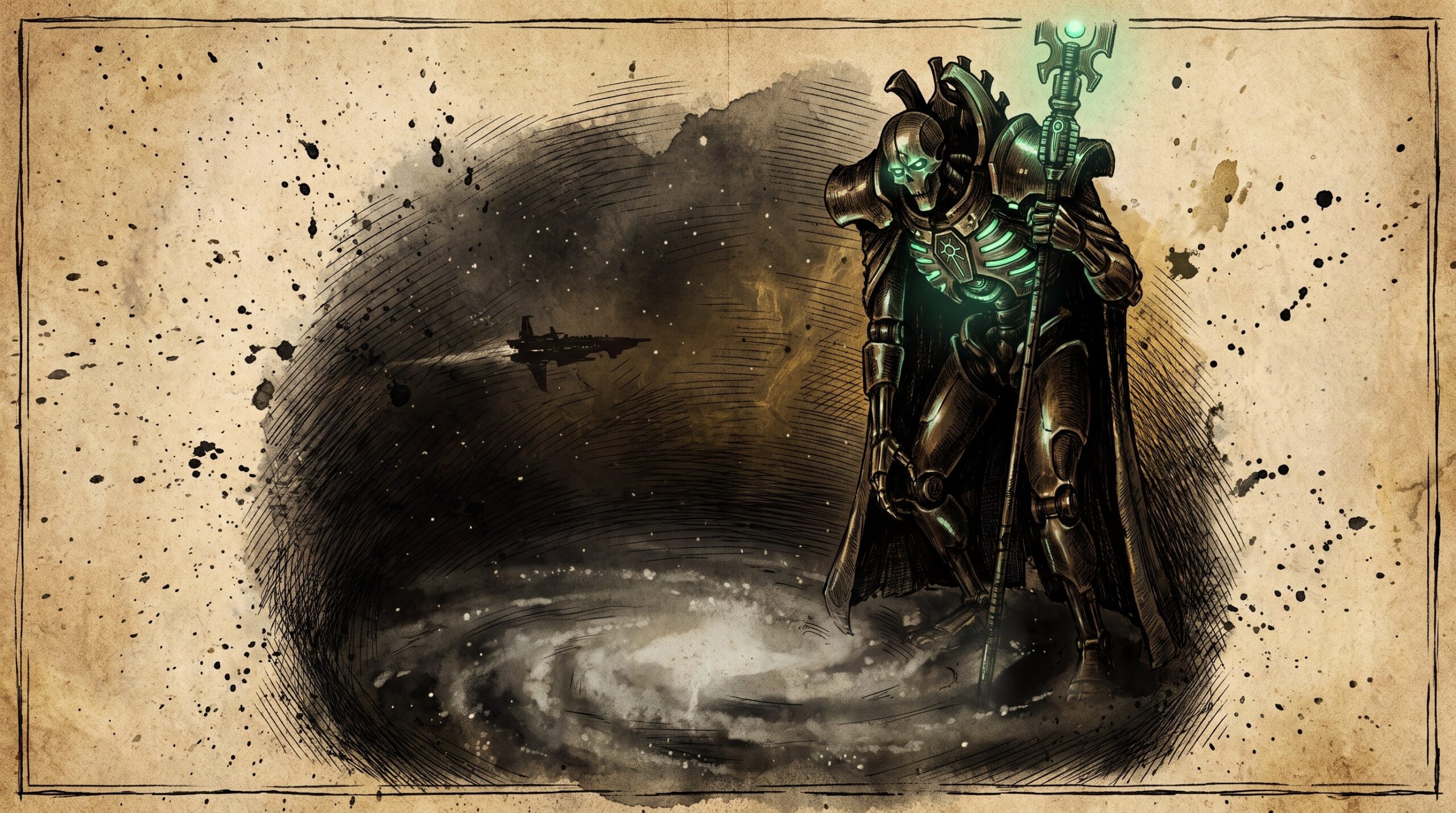
The Silent King: Szarekh and the Bargain That Devoured a Species’ Soul
He traded the souls of an entire people for immortality — and only when it was done did he look upon what he had made. This is the chronicle of Szarekh, the Silent King who walked into the dark between galaxies to atone.
The archives whisper of a king who does not speak, and who cannot forget. Where his subjects march as mindless legions of undying metal, memory scoured clean, he alone carries the full weight of what was done — every name, every face, every soul consumed. He is Szarekh, last ruler of the Triarch, called by the sagas the Silent King. And the tale of his long guilt begins not with victory, but with a dying star and a doomed people who could not bear the brevity of their own lives.
To read his chronicle is to trace the slow ruin of a civilisation that chose damnation over death, and of the one lord who lived long enough to understand the price. The novels tell it plainly: it was only when the Silent King himself emerged from the bio-transference process and looked upon what had become of his people that he saw the awful truth of the pact he had made.
The Dying Necrontyr and the Envy of the Old Ones
Before the metal, there was flesh. The Necrontyr were a species born, the archives say, beneath the glare of a volatile and radiation-scarred star, cursed with lives so pitifully short that their whole civilisation became a monument to death. They raised vast tombs and mausoleums, ruled by dynasties each answering to a Phaeron, and above them all sat the Triarch and the office of the Silent King, an inheritance of the Szarekhan Dynasty.
What consumed them was not merely mortality but envy. The Old Ones, an ancient and far more fortunate race, seemed to live as though death held no dominion over them, and the Necrontyr believed they hoarded the secret of immortality. From that envy came war. As the oldest chronicles record, the Necrontyr declared war on the Old Ones, little expecting the doom that act heralded. It was a short war, and a ruinous one, and the Necrontyr were crushed. Yet the flame of hatred burned all the fiercer in their frail hearts.
The C’tan’s Bargain of Biotransference
It was in that hour of humiliation that Szarekh made his fateful alliance. The C’tan — the star gods of Aeldari myth — had themselves warred against the Old Ones and been defeated, and they came to the Silent King with a promise: that together, victory might at last be won. The sagas name The Deceiver as the honeyed voice that swayed him.
The price was the flesh itself. Through the process called biotransference, the Necrontyr surrendered their fragile organic forms and were poured into new bodies of living metal, becoming the Necrons. Immortality was theirs — but so was theft. The archives describe furnaces over which the ethereal true-forms of the C’tan swooped and dove as they glutted themselves on the spiritual detritus of an entire species. The soul was the coin, and the C’tan collected every one.
The Awful Truth of the Pact
Szarekh gained immortality and nigh-godlike strength, yet the novels are unflinching: it had come at the cost of his soul, the effluvial remains of which had already been sucked down the gullet of a circling C’tan. When he emerged and looked upon his transfigured people, he understood at last the enormity of what he had authorised. Only the very strongest of the Necrontyr retained any spark of intellect, and even they were but shadows. The rest were left as ghostly echoes — deathless, soulless, and bound.
For into every one of his subjects, biotransference had woven the command protocols by which the Silent King might govern them absolutely. His people were united as never before. They were also, in every way that had once mattered, gone.
The War in Heaven and the Great Betrayal
Empowered by the terrible weapons of the C’tan, the Necrons returned to the War in Heaven with dreadful effectiveness. Immune to psychic assault, wielding energies that could unmake even the immortal, they turned the long conflict. The star gods feasted upon the souls of the Old Ones’ servants and, whether by design or blind hunger, unleashed such Warp-spawned perils upon the galaxy that the Old Ones were at last utterly defeated.
Yet all through that war, the novels tell, the Silent King had nurtured his hatred of the C’tan, even as he had led his armies against their foes. Knowing the Necrons could never triumph alone, he had done all the star gods bade — and waited. With the war finally won, Szarekh enacted a betrayal long prepared. Knowing it was no more possible to truly destroy a C’tan than to snuff out a star, he did the next thing: the Necron revolt shattered his former masters into countless shards, splinters of divinity bound and imprisoned, to be wielded ever after as slaves rather than gods.
The Great Sleep and the King Who Would Not Rest
But victory revealed a bitter horizon. The new races the Old Ones had crafted — chief among them the Aeldari — were rising to dominance, and the Necrons, exhausted by aeons of war, could not stand against them. So the Silent King gave his final command: that his people withdraw into their Tomb Worlds and enter the Great Sleep, to slumber sixty million years until the galaxy had healed and the living had fallen to their own discord. Then, and only then, would the undying rise to reclaim all.
Szarekh did not sleep. The sagas record that he shattered the command protocols granting him mastery over the Necron race, and took to the void in a planet-sized sepulchral engine, bearing legions of his own Szarekhan Dynasty in stasis. Into the black between the galaxies he went, alone in his memory. He was, the archives say, the only Necron to remember fully his time as flesh — and so the only one to bear the full grief of what he had done. Aeons of that sorrow would have destroyed any lesser mind. Some whisper he sought penance; others, that he sought a way to reverse biotransference itself. No certain record survives.
The Return from the Intergalactic Dark
The plan laid sixty million years past came, at last, to its ordained hour. Across desolate worlds the ancient machineries stirred; the dread dynasties began to wake. On the fringes of the 41st Millennium, death stirs at the edge of the galaxy, death in the shape of a faceless legion of unfeeling metal. And the wanderer returned, for beyond the galaxy’s rim the Silent King is said to have encountered the Tyranids and grasped the threat they posed — a devouring tide that might consume the very biomass upon which any hope of restoring his people’s souls depended.
So the exile ended. The king who traded a species’ soul for its survival came back out of the dark, to lead once more the empire he had doomed and could never forgive himself for dooming. Whether he seeks conquest, salvation, or atonement, the archives do not agree — but they whisper, all of them, that he remembers. And that he has never once spoken of regret aloud.
Questions from the Archive
Who is the Silent King in Warhammer 40,000?
The Silent King is Szarekh, last ruler of the Triarch and Phaeron of the Szarekhan Dynasty. He led the Necrontyr through the War in Heaven, sealed the C'tan bargain that transformed his people into the soulless Necrons, and later exiled himself into intergalactic space in penance before returning in the 41st Millennium.
What was biotransference and what did it cost the Necrons?
Biotransference was the process by which the C'tan transferred the dying Necrontyr from fragile flesh into immortal bodies of living metal. The archives record that it stripped away their souls, which the star gods devoured, leaving the Necrons deathless but hollow — with only the strongest retaining any shard of intellect.
Why did Szarekh turn against the C'tan?
Szarekh realised too late that the C'tan had made his people soulless pawns. Nurturing his hatred throughout the War in Heaven, he waited until the Old Ones were defeated, then led the Necron revolt. Unable to destroy the star gods outright, he shattered them into bound C'tan Shards to be enslaved rather than served.
Sources and reading
- Nate Crowley, The Twice-dead King: Reign — the bargain accepted by Szarekh and the cost of biotransference.