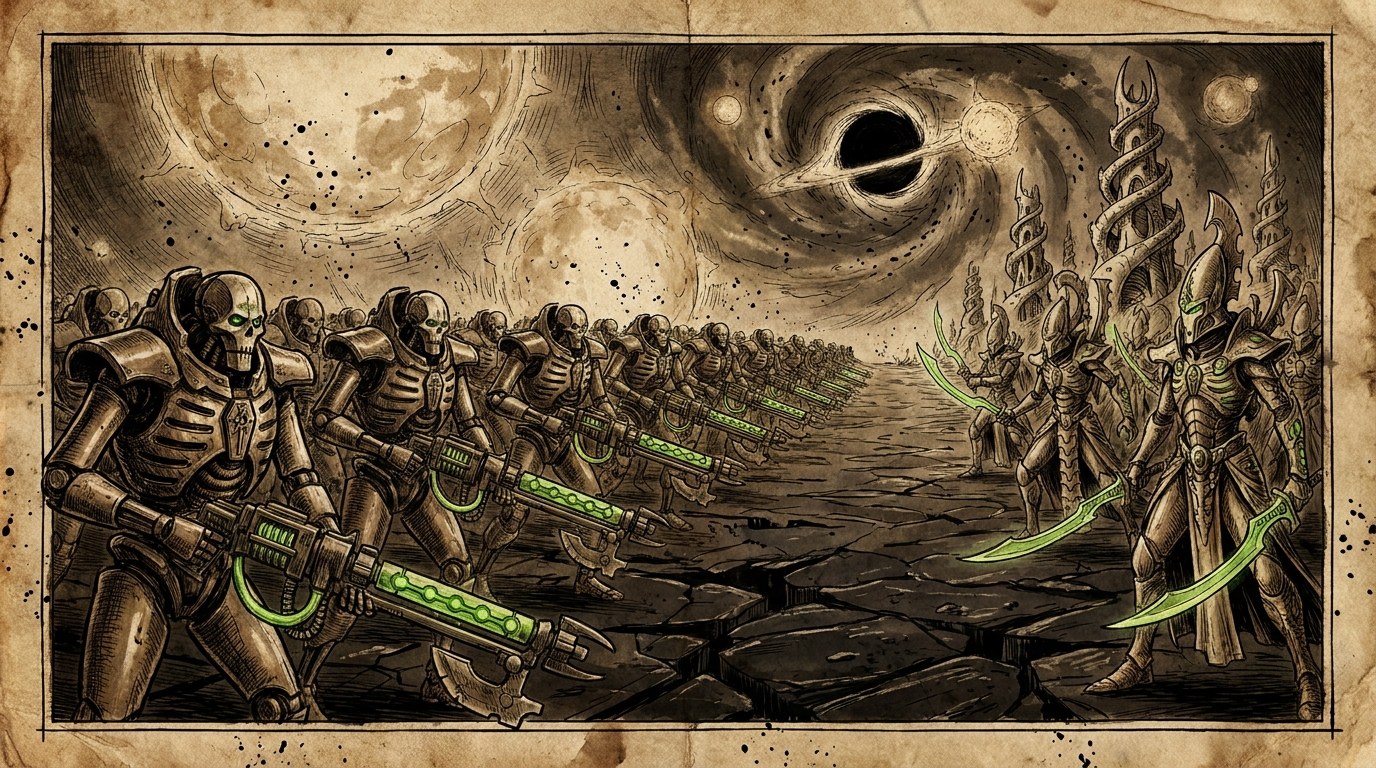
The War in Heaven: When Gods Fought Before Mankind
Before Man drew breath, the stars already screamed. A chronicle of the Old Ones, the C'tan and the Necrontyr — and the war whose wreckage we still live in.
The oldest pages in any archive are the least trustworthy — and the most important. What follows happened so long before mankind that no human record of it exists at all; we know it only from the boasts of deathless things and the myth-cycles of dying ones. The savants who dare put a number to it speak of sixty million years. Read it, then, as the aeldari and the necron each tell it, weigh each telling against the other, and remember this above all: the galaxy you stand in is this war’s unburied battlefield.
The Old Ones — Masters of the Webway
In the beginning — as near to a beginning as any account reaches — the galaxy belonged to the Old Ones: patient, unknowable beings, so far beyond the younger races that even the aeldari speak of them in the language of myth rather than memory. They were shepherds of life, seeding worlds the way lesser races sow fields. And they were masters of the great labyrinth between realities that later ages would call the webway — a network of hidden roads threaded through the skin of the universe, by which they stepped from world to world without ever daring the perils of the open Warp. Ten thousand generations of lesser species rose, flourished and were tended beneath their unhurried gaze. It must have seemed, if such beings entertained anything so small as satisfaction, that their order would last forever. Nothing lasts forever. That is the first lesson of this archive, and the Old Ones taught it to the whole galaxy.
The Necrontyr — a People Cursed by Their Own Star
Against that eternity, set the Necrontyr: a people born under a cruel and scouring sun, on a world that poisoned them from the cradle. Their flesh failed early and painfully; their science, prodigious as it became, could lengthen nothing but the list of their resentments. They built their tombs before their cities, the accounts say, because the tomb was the only dwelling a Necrontyr could rely upon inhabiting for long. A short-lived people staring up at deathless ones — the arithmetic of envy writes itself. The Necrontyr demanded from the Old Ones the secret of their longevity, and were refused; and the wars that followed, waged across generations by a race that could never live to see a single campaign completed, ended in defeat after crushing defeat. Scattered and humiliated, the Necrontyr fell to fighting among themselves in wars of secession — until their king found them a common cause, and something far worse than a cause: allies.
Gods Found Sleeping in the Skins of Stars
It was in the study of their own hateful sun that the Necrontyr found them. Anomalies in the oldest dying stars; sentiences older than any corporeal thing in creation — beings of pure living energy that had fed on solar fire since before the first world cooled. The Necrontyr named them C’tan, and in their desperation they did the unforgivable: they built the star-gods bodies. Shells of living metal — necrodermis — into which those vast hungers poured themselves, and in pouring, learned appetite of an entirely new kind. A being that has drunk only starlight discovers the taste of souls. Whatever the Necrontyr thought they were summoning to their war, what they actually gave the galaxy was a pantheon of predators wearing the faces of gods.
Biotransference — the Price of Forever
The C’tan kept their bargain, and it is precisely for that reason that the bargain is the most terrible in the history of sentient life. Immortality was promised, and immortality was delivered. Into the furnace-temples the whole Necrontyr race marched — the accounts name the machinery biotransference — and mind by mind, body by body, a species of flesh was poured into deathless metal. And all the while, the records tell, the C’tan swarmed unseen about the great engines, drinking in the torrent of cast-off life essence: feasting on the souls of the very people they were saving. Their king — Szarekh, whom every account thereafter names the Silent King — watched his people emerge immortal, tireless, unaging. And then he understood, too late and forever, what had been paid. The Necrontyr were gone. What remained was the necrons: minds purged of joy, of appetite, of nearly everything that had made each one a self — save among the strongest-willed of the nobles and generals, who kept their reason and lost everything else worth keeping. The Silent King had led his entire species out of death’s reach, and into something the archives struggle to call life.
The War That Broke the Galaxy
What followed beggars every chronicle that dares attempt it. Gods and their deathless legions against the eldest power in creation. Glutted on the life-force of a whole species, the C’tan unleashed forces beyond comprehension: worlds razed, suns extinguished, whole star systems fed to black holes called into being by the star-gods’ reality-bending wrath. The necron legions breached even the webway, carrying the war into the Old Ones’ hidden roads and besieging their strongholds in every corner of the galaxy. For the first time in their unmeasured existence, the Old Ones were losing.
The Young Races — Soldiers Kindled in Desperation
And so the shepherds turned their craft to the forge. The Old Ones, whose art was life itself, kindled new races bred for the war they could not win alone — species with souls that burned bright in the Warp, whose psychic fury was the one power the soulless necrons could not answer in kind. The accounts name the aeldari first among them; beside them the K’nib, the Rashan, and the Krork — bred huge and green and joyful in war, whom many savants name the forebears of the orks that plague us yet. This third act of the war was its bloodiest. The young races unleashed the raw power of the Warp as a weapon, and the tide turned; the star-gods reeled; for a breath of cosmic time, the Old Ones’ victory seemed assured. The galaxy has never been closer to a different history than it was in that moment. Hold onto it, reader. It does not last.
The Enslaver Plague — Ruin Out of the Deep
For the Warp was changing. The bright sea behind the world — which the eldest accounts insist was once calm — had drunk sixty million years of slaughter, terror and grief, and the psychic blaze of the young races burned above it like a beacon-fire over dark water. Something answered. The accounts name them Enslavers: predators of the deep Warp that breach into reality through the minds of living psykers — and the galaxy of that age was nothing but living psykers, arrayed in armies. The plague that followed did what neither gods nor legions had managed: it began to end sentient life outright, wearing its victims as doorways. The Old Ones, already broken by the C’tan’s advance, were overwhelmed — driven to extinction or to flight beyond the galaxy’s edge, their works abandoned, their webway locked and left. Every telling, aeldari and necron alike, goes quiet at this point in the story. Archivists learn to hear such silences. They are the sound of a wound too deep for myth.
The Revolt of the Necrons and the Great Sleep
Amid that ruin, the necrons committed the one act for which this archive will grant them a grain of respect: they turned on their gods. The Silent King had never forgiven the C’tan for the theft of his people’s souls, and with the Old Ones broken there was no longer any need to endure them. The star-gods, weakened by the long war, were caught unprepared by the creatures they had believed their slaves — and shattered. Not slain; the accounts insist such things cannot truly die. Broken into shards, and the shards imprisoned in cages of arcane geometry, each fragment a chained fraction of a god. And then, the victory won and worthless, Szarekh surveyed what remained: a galaxy of ash, a Warp full of monsters, his own people reduced to hollow deathless engines. He gave his final commands. The necron cities became tomb-complexes threaded with stasis-crypts; the dynasties sealed themselves beneath the earth of a million worlds, to sleep sixty million years while the aeldari inherited the ruins and the wound in his people faded from the galaxy’s memory. Then the Silent King broke the protocols by which he had commanded his race, took ship into the starless void between the galaxies — and went into exile with his guilt, which was the only possession the C’tan had left him.
What the Aeldari Sing — the Rival Telling
I promised you both tellings, and an archivist keeps his promises. The aeldari do not remember the War in Heaven as history; they sing it as the war of their own gods. In their myth-cycles it is Khaine, the Bloody-Handed, god of murder, who wages the great war — against Vaul the smith in some songs, and in the darkest of them allied with the star-gods themselves, whom the aeldari name the Yngir, to cast the children of Isha from heaven. It ends with the slaying of Eldanesh, first among mortal aeldari, and Asuryan’s curse upon Khaine — that his hands drip red with that blood forever. And their oldest sagas, which our own deepest records echo, say the aeldari were wrought from the fiery flesh of their godhead, and that the other young races bloomed from the grieving tears of the goddess Isha. Is the myth a mask over the history — Khaine’s war a memory of the necron war, the Yngir the C’tan by another name? The savants believe so, and the parallels are unmistakable. But I have catalogued too many millennia to say it plainly as fact. A race that survives an apocalypse by forgetting it has reasons for the shape of its songs.
Echoes in the Present Dark
Why should the Imperium’s servants care how gods murdered one another before mankind’s star had planets? Because nothing about that war is over. The Warp learned the taste of slaughter in it, and every daemon that has ever whispered through a rent in reality is, in some measure, its echo. The webway the Old Ones abandoned runs still beneath the skin of the galaxy — the Emperor Himself, the deepest records tell, laboured in secret to claim a bridge into it. The pylons that caged the Eye of Terror at Cadia were works of that elder science. And the tombs — reader, the tombs are opening. On world after world that mankind has innocently farmed and mined for a hundred generations, the ground is giving up dynasties of living metal, and somewhere among the stars their exiled king has come home. The War in Heaven is not the deep past. It is the floor we built our house upon, and the floor is moving.
Sixty million years before the first shaman dreamed on the plains of Terra, the shape of our damnation was already cast. Learn this oldest of chronicles well — because every power in it that survived is awake again, and none of them consider the war finished.
Questions from the Archive
What was the War in Heaven?
The War in Heaven is the name given to the cataclysmic war fought aeons before mankind existed — the accounts reckon some sixty million years — between the Old Ones, elder masters of the webway, and the Necrontyr with their star-gods, the C’tan. It reshaped the galaxy, broke the Old Ones, entombed the Necrons, and left the Warp itself scarred by the slaughter.
Who were the C’tan?
The C’tan were star-gods — vast beings of living energy that fed upon suns. Given physical form by the Necrontyr, they offered that dying race immortality through biotransference, transferring their minds into deathless metal bodies while devouring their souls in the process. The Necrons later rebelled and shattered their treacherous gods into imprisoned fragments.
Did the Old Ones create the Aeldari and the Orks?
So the oldest accounts hold: to fight the war the Old Ones kindled psychically gifted soldier-races, among them the Aeldari, the K’nib, the Rashan — and the Krork, held by many savants to be the forebears of the orks. The Aeldari’s own myth-cycles tell the story differently, as the work of their gods; at such removes of time, no chronicler can rule between the tellings.
Who won the War in Heaven?
The Necrons, by most reckonings — but it was a victory that destroyed the victors. The Old Ones were driven to extinction or flight, yet the slaughter destabilised the Warp and unleashed the Enslaver plague upon all sentient life. The exhausted Necrons rebelled against their C’tan masters, then sealed themselves in tomb-worlds to sleep out the ruin they had made.
What were the Enslavers?
The Enslavers were psychic predators from the Warp, drawn by the war’s oceans of death and the psychic blaze of the young races. Breaching into reality through the minds of living psykers, they enslaved or annihilated much of the sentient life that remained in the galaxy — the final ruin that ended the War in Heaven and emptied the board for sixty million years.