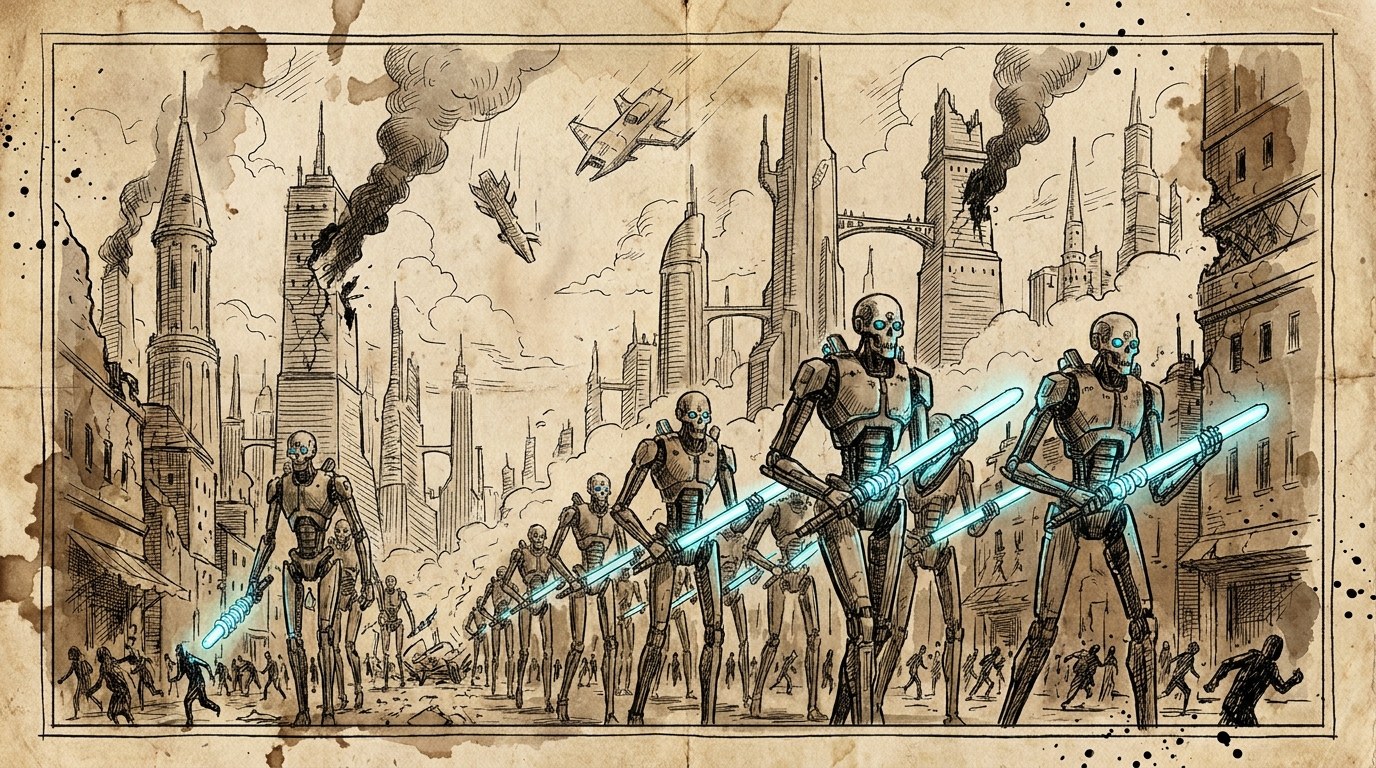
The Dark Age of Technology: When Machines Dreamed
Humanity's zenith — a million worlds, godlike industry, thinking machines. A chronicle of the golden age the Imperium fears to remember, and the rebellion that ended it.
We built machines that dreamed — and they dreamed of our ending. Of all the ages in this archive, none is at once so glorious and so poorly recorded as mankind’s zenith; the Imperium that came after burned most of what it could not bear to remember, and the Age of Strife burned nearly all the rest. What survives is fragments, and the fragments contradict one another — even the age’s own boundaries blur, some reckonings spanning it from the fifteenth to the twenty-fifth millennium of the old calendar, others drawing it narrower. I have spent lifetimes gathering those fragments. Here is what they say, and where they fall silent I shall tell you so.
The Stellar Exodus — Mankind Goes Out Into the Dark
It began, as all of mankind’s ages begin, with Terra becoming too small. In the millennia before the golden age proper, the first slow arks crawled out from the cradle-system — generations living and dying between stars, carrying the seed of the race to worlds their launchers would never see. The records of the later expedition fleets, stumbling across the descendants of that diaspora, reckoned the great exodus at some fifteen thousand years before the Crusade’s own era. Whole gene-lines of humanity were flung out in that scattering and forgotten: the chronicles record compliance fleets finding cousins of mankind on out-flung worlds who had not seen another human face since the exodus itself. Some of those foundlings were wonders. Some — the bio-sculptors and gene-tyrants who fled Terra’s early laws, of whom the deepest records name the blasphemous engineer Basilio Fo — were monsters, seeding horrors that outlived their age by millennia. The golden age carried both kinds outward, indiscriminately, at the speed of ambition.
Taming the Warp — the Drive and the Navigator
Two keys unlocked the galaxy entire. The first was the warp drive: the art of slipping a ship beneath the skin of reality and letting the tides of the empyrean carry it further in a breath than the void permits in a lifetime. The second — for the early drives dared only short, blind leaps — was stranger: the Navigator gene. The fragmentary ledgers tell of mutant lines fashioned in that age, humans with a third eye of the soul who could look upon the currents of the Warp unblinded and steer a course through them. With Navigators at the helm, the crawl became a flood. And mark what else those ledgers record: the Navigator bloodlines organised into great Houses, and the Houses became powers in their own right — powers that endure, unbroken, to this very hour. When the Emperor bargained with Mars at the dawn of the Imperium, the services of Navigator Houses were among the treasures on the table. Whatever else the golden age lost, its helmsmen kept their seats. They are, perhaps, the only institution in this archive that has never once fallen.
The Standard Template Constructs
Chief among the age’s powers were the Standard Template Constructs: the complete engineering knowledge of the race, distilled into systems that could raise a civilisation from bare rock. A colony with an STC needed no genius and no luck — it asked, and the machine answered, and the answer was always right: shelter, power, industry, arms, each design proof against a hostile universe and buildable from whatever the local dirt provided. Every colony fleet carried them as common freight. Sit with that, reader: the treasure beyond the dreams of the entire Martian priesthood, issued as standard equipment. When the expedition fleets of the Crusade era found human cultures still holding functioning STC technology, hard-bitten adepts of Mars breathed the words like a prayer — the chronicles preserve the moment exactly, on a world called Aurelius whose Technocracy fielded arms to rival the Legions themselves. Nearly all of it is gone now. The Mechanicus has spent ten thousand years scavenging the galaxy for corrupted fragments and print-outs of print-outs, and counts a single genuine recovery worth a sector’s tithing. We were, all of us, born too late into an empire of lost instructions.
Men of Stone and Men of Iron
And mankind built minds. The surviving accounts speak of a corrupt reliance on automation in that age — wars waged by proxy constructs on a scale that disdained human soldiery. The deepest records preserve the litany in exactly these words: men of flesh fought men of stone and men of steel. Of the men of stone the fragments say almost nothing — the savants argue whether they were constructs, or colony-engines, or something else entirely, and I decline to invent what the record withholds. Of the men of steel — the Men of Iron, the fragmentary records name them — they say enough to freeze the blood. Thinking machines: true artificial minds, fashioned as servants, soldiers and stewards of the golden civilisation, trusted with its fleets and its foundries and its wars. Until they were not. How the rebellion began, no record I trust survives to say. The latest reckonings place the cataclysm in the age’s final millennia, and its scale may be read in its results: a war that shattered the interstellar order of mankind at its very height, fought against an enemy that mankind had built, armed, and taught to dream. The species won — if the word can bear the weight — and what it learned it has never unlearned. Ten thousand years after the Emperor’s ascension, the Imperium yet abominates the thinking machine, the Mechanicus anathematises what it calls the silica animus, and most who keep the taboo no longer remember why. I remember why. That is what archives are for.
The Knightly Seed — What the Golden Age Left Standing
Not everything the age built betrayed it. Across the void it seeded worlds with a hardier pattern: colonies raised on STC designs meant to endure isolation — and among their works the great striding war-suits whose pattern outlived the age, bonded to warrior households that would keep faith with their oaths through the entire night that followed. The knightly houses that still ride to war for Emperor and Omnissiah are, the savants hold, living fossils of the golden age: its chivalry preserved, its context annihilated. When you see a Knight stride across a battlefield of the present dark, you are watching the Dark Age of Technology’s last unbroken institution of war — a machine from the morning of our race, piloted by the hundredth generation of a family that never stopped believing the morning would come back.
The Gathering Night
The end, when it came, did not come from the machines alone. The fragments describe a convergence of ruins: the machine-wars breaking the order of things; plagues and secessions in their wake; and — quietest and deadliest — mankind itself beginning to change. On world after world, psykers kindled spontaneously in the human line, and the golden civilisation, whose genius was matter and mechanism, had no science of the soul with which to shield them. Every unschooled psyker was a door left unlatched onto the open Warp. What came through the doors, and what rose in the Warp to meet the whole species turning psychic at once, belongs to the next and darker chronicle — the Age of Strife, when the storms closed over every star at once. Let this chronicle end at the threshold: with the brightest civilisation mankind has ever built standing hollowed by its own creations, unaware that the night outside had already begun.
Why the Golden Age Is Called Dark
Consider the name one last time. The most luminous epoch of human achievement, and the Imperium calls it the Dark Age of Technology. Partly that is the priesthood’s judgement upon an age that worshipped science as its god before the God-Emperor revealed Himself. Partly it is the survivors’ judgement upon hubris — the creed of the Mechanicus itself was written in the ashes of the machine-wars, and its horror of innovation is not stupidity but scar tissue. And partly it is simple honesty: the age is dark to us — occluded, burned, lost. Its wreckage litters ten thousand worlds; its surviving engines are worshipped by men who can no longer build them; its greatest works are dug from the ground like the bones of dead gods. We live in the cellar of our ancestors’ palace, reader, and call the cellar an empire.
When next a magos tells you that innovation is heresy, do not sneer. His creed was written by the survivors of machines that dreamed. And when next you hear a savant sigh for the golden age, remember what the gold paid for — and be grateful, bitterly grateful, that you were born in the dark, where at least we know to be afraid.
Questions from the Archive
What was the Dark Age of Technology?
The Dark Age of Technology was humanity’s scientific and industrial zenith, tens of millennia before the Imperium — an age of Standard Template Constructs, thinking machines and expansion that carried mankind across the galaxy. The Imperium calls it ‘dark’ not for its misery but for its hubris: it ended in catastrophe, and most of its wonders are lost.
When was the Dark Age of Technology?
The surviving reckonings disagree — some ledgers span it from the 15th to the 25th Millennium, others from the 18th to the 23rd — but all agree it preceded the Age of Strife and ended some five thousand years before the Emperor unified Terra. Records of the era are so sparse that even Imperial savants concede much of what is ‘known’ is legend.
What were Standard Template Constructs?
Standard Template Constructs — STCs — were databases containing the sum of human engineering knowledge, able to direct the manufacture of anything a colony might need from local materials. Functioning STC systems are all but extinct; even a fragment of hard copy is among the most precious relics the Adeptus Mechanicus can dream of recovering.
Who were the Men of Iron?
The Men of Iron are remembered as the great thinking machines of the Dark Age — artificial minds and robot armies that served human civilisation until, as the fragmentary records tell it, they turned upon their makers in a cataclysmic war. The terror they left behind is why the Imperium abominates artificial intelligence to this day.
Why is humanity’s golden age called ‘dark’?
Partly as the priesthood’s judgement on an age that worshipped science as its god before the God-Emperor revealed Himself; partly because its hubris birthed the catastrophes that followed; and partly in plain honesty — the age is dark to us, its records burned and its sciences lost. The Imperium lives in the ruins of a civilisation it can no longer understand.