The Rubicon Primaris: The River No Astartes Crosses Twice
They cut him open from crown to heel, cracked his ribs apart, and then — deliberately, methodically — they let him die. That was only the middle of the procedure.
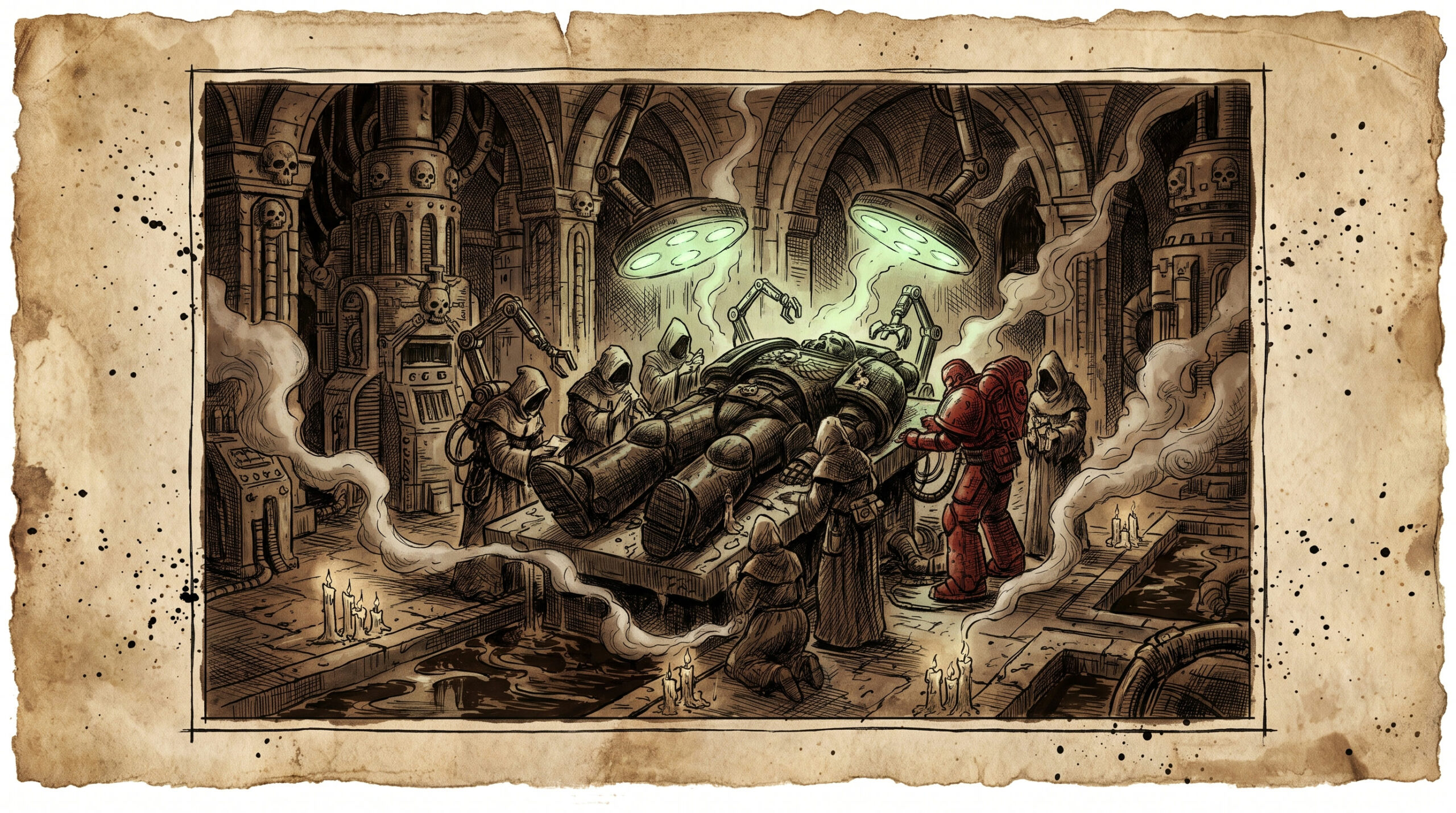
There is a chamber in the apothecarion where the lumens are never dimmed, because what happens there must be watched without pause. The slab is longer than a man, longer even than a Space Marine, for the thing that rises from it will not be the same size as the thing that lay down. Around it stand chirurgeons, Apothecaries, and servitors whose hands have been replaced with instruments no mortal surgeon would recognise. And upon it lies a warrior of two hundred years’ service, or five hundred, or a thousand, who has come here of his own will to be killed.
The Adeptus Mechanicus calls it the Rubicon Primaris. The Chapters, more often, call it the Calgar Procedure, or the Calgarisian Rites — a name bought with the courage of one man. This is the chronicle of the river, and of those who chose to cross it.
The Name Nobody Understood
It is a curious detail, and the archives preserve it with something like affection: almost nobody in the Imperium knew what the word meant. When the matter was explained to Commander Dante of the Blood Angels, he confessed his ignorance freely. Rubicon, he was told, is the name of a river, a reference to an event from the most ancient of times — the dawn ages of Terra, long before the Emperor’s light. Archmagos Dominus Belisarius Cawl chose the term himself, and it is said that few but Cawl knew it at all.
The meaning, once unpacked, is grimly apt. A river crossed by an army that could not then turn back. There is no returning across the Rubicon Primaris. A Firstborn who becomes Primaris does not become Firstborn again. Whatever he was is left on the far bank.
Why the Question Had to Be Asked
When the Primaris Marines were revealed to the Chapters in the aftermath of Guilliman’s return, the Adeptus Astartes did not receive them with simple gratitude. Ten thousand years of tradition is not a coat to be shrugged off. Debate erupted across the Imperium’s fortress-monasteries: could a Firstborn be remade at all? And if the thing were possible, was it right? Would the warrior who awoke still carry the memories, the temper, the soul of the brother who had gone under the blade — or would something new wear his face and his name?
Cawl affirmed that the operation could be performed. His data, the archives record, suggested a failure rate approaching sixty-two in every hundred until the technique could be refined. Six deaths in every ten. For an order that counts its warriors in single thousands across the whole galaxy, that is not a statistic. That is an atrocity waiting for a signature.
Calgar’s Wager
The lords of the Ultramarines concluded that theory alone would settle nothing. The debate had to be dragged out of the strategium and onto the surgical slab. Marneus Calgar, Chapter Master of the Ultramarines, Lord Macragge, volunteered to be the first.
It was of a piece with the man. The Vigilus records praise him as a leader of visionary insight, one who consigned entire war zones to damnation in the name of the wider war, who sacrificed valuable holdings to burn out an insidious foe, and who bore the loathing of aristocrats for decisions that time proved correct. He had spent his career spending lives against long odds. Here, at last, was a chance to spend his own.
He survived. More importantly, he was still himself — the same warrior, the same mind, the same century-hoarded experience, now housed in a frame with the strength of the new breed. That single outcome silenced more argument than a thousand treatises could have done, and the procedure has borne his name ever since.
The Butchery Itself
Let no one soften what the crossing requires. The subject is opened from crown to heels. The ribcage is cracked apart. Then, at the climax of the work, the chirurgeons suppress the Astartes’ own miraculous healing physiology until his life slips away entirely — because only in a body that is no longer fighting can the three new organs be seated.
The Magnificat is buried deep within the brain, where it stimulates growth and drives the other implants to greater function. The Belisarian Furnace is set to wait like a coiled spring, ready to flood the body with hypersteroids and corticostimulants at the moment a mortal blow lands, so that a dying warrior may fight on past the point of dying. And the sinew coils — cable-lengths of durasteel — are threaded to sheathe every tendon and sinew in metal, granting resilience and strength beyond the old flesh.
Then the corpse is stitched shut, and its heart is electrified until it beats again. What happens next is not in the surgeons’ hands. The warrior must claw his own way back out of death. If he manages it, the Belisarian Furnace ignites and wakes him — and he rises a Primaris Marine. If he does not, the apothecarion has a body and the Chapter has one fewer sword.
The Brothers Who Refused
The sagas of the Dark Imperium tell us that many hesitated, and it is important to understand why. It was not fear. The chronicle of Lazarus of the Dark Angels puts it plainly: the Adeptus Astartes fear nothing, least of all death. Their reluctance was arithmetic. They were keenly aware of how few of them stood between mankind and its countless enemies, and they would not gamble those numbers away on a slab. To refuse the Rubicon was, for many, an act of duty rather than cowardice.
The Sons of Sanguinius and the Spiritual Wound
For some Chapters the danger was not merely surgical. The archives of Baal record a warning delivered to Commander Dante regarding the Flaw that haunts the blood of Sanguinius: that the propensity for savagery was engineered into the original Legion, and that the affliction only exacerbates what is already there. Cawl, it is said, suspected the condition to be spiritual rather than physical, though he believed he might ameliorate it. That suspicion is precisely why the Rubicon was reckoned especially perilous for the Blood Angels — a procedure that intensifies every organ’s function might just as readily intensify the curse riding within them.
The River Grows Shallower
Time and repetition did what they always do. By the closing years of the Plague Wars, the archives record, the procedure had grown far safer, and the calculus reversed itself entirely: it had become unusual for a high-ranking Firstborn to decline the crossing. Chapter Masters, Codiciers, Champions and Captains — from the Black Templars to the Space Wolves, from the Iron Hands to the White Scars — went beneath the blades and rose again in the new flesh. Even the Sons of Medusa, whom the Torchbearer fleets had expected to resist most fiercely, are numbered among those who crossed.
What Was Left on the Far Bank
The Rubicon Primaris solved a problem of numbers and created a problem of soul. Every crossing preserves a veteran’s memory, his campaigns, his oaths — the irreplaceable freight of centuries — and carries it into a body built for the war to come. That is a mercy of a kind. Yet no record survives that satisfactorily answers the older question the debate began with: whether the warrior who rises is truly the warrior who lay down, or a most excellent copy who believes he is.
The Chapters, being practical, do not dwell upon it. There is a galaxy burning, and the river must be crossed. The archives merely note, without comment, that the man who named it chose a word that means no going back.
Questions from the Archive
Who was the first Space Marine to cross the Rubicon Primaris?
Marneus Calgar, Chapter Master of the Ultramarines, volunteered as the first subject when the Chapter's lords decided the debate over the procedure could only be settled in practice. He survived, retained his identity and experience, and gained the strength of a Primaris — which is why the operation is also called the Calgar Procedure or the Calgarisian Rites.
What actually happens during the Rubicon Primaris operation?
The Space Marine is cut open from crown to heels and his ribcage cracked apart. His healing physiology is then suppressed until he dies, so that three new organs — the Magnificat, the Belisarian Furnace and the sinew coils — can be implanted. He is stitched shut, his heart is electrified back into motion, and he must claw his way out of death; if he succeeds, the Belisarian Furnace wakes him as a Primaris Marine.
How dangerous is the Rubicon Primaris?
Extremely so at first. Cawl's early data suggested a failure rate of roughly sixty-two percent until the technique was perfected, which is why many Firstborn declined — not from fear of death, but because the Astartes are too few to be squandered. By the last years of the Plague Wars the archives record it had become far safer, and it was considered unusual for senior Firstborn not to attempt the crossing.