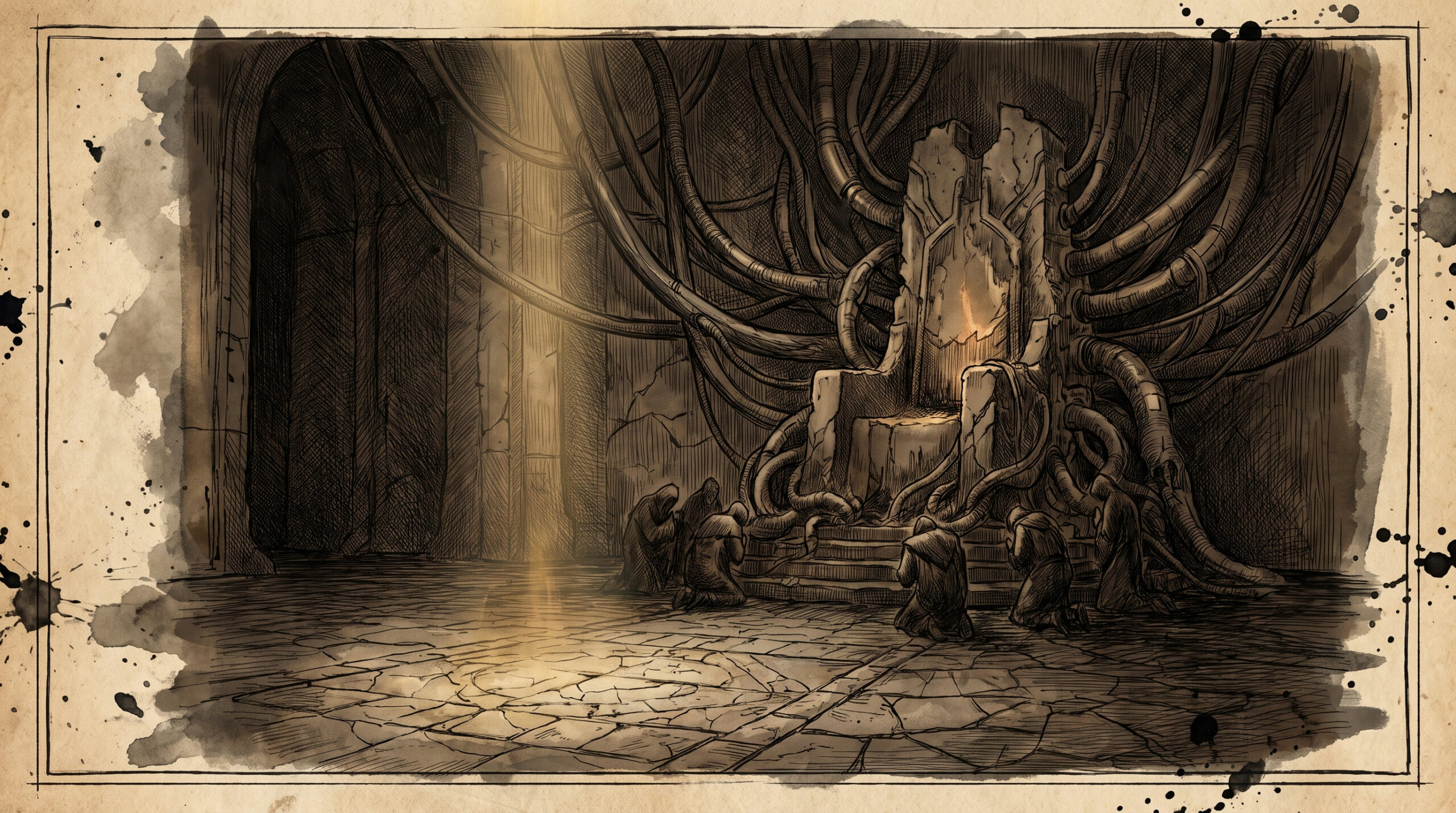
If the Emperor Died: The Heresy the Archives Cannot Speak Aloud
The Golden Throne is failing, and the Archenemy speaks of it openly while the Imperium forbids the thought. What, then, would the death of a god actually look like?
There is a question the Adeptus Terra does not permit to be written down, and which every archivist has nevertheless written down at least once, in a hand not his own, upon a page later burned. It is not a complicated question. A child could ask it. Many have, and been taken away for asking.
What happens if He dies?
The catechisms answer it before it can be finished: the God-Emperor cannot die. He is eternal. He is the Master of Mankind, deathless upon the Golden Throne. And yet the Imperium’s own institutions behave, in every particular, like a household holding its breath at a sickbed. Ten thousand psykers are consumed each day to feed a beacon. A thousand tech-adepts labour over an engine no one now living understands. The archives whisper that the Emperor has been dying for a hundred centuries, and that the only argument is about the pace.
The Broken Engine Beneath the Throne
Begin with the plain physical fact, insofar as anything on the Throneworld is plain. The Emperor’s body did not survive the Siege of Terra. What remains is interred within the Golden Throne, a device of the Dark Age whose function the Mechanicum can maintain but not comprehend, and which is failing by inches. The Codex Imperialis of old records the truth bluntly enough: the only man who might remember the Great Crusade and the Heresy is the Emperor Himself, and none can guess what thoughts revolve inside His carrion skull.
That phrase is worth sitting with. Not His radiant countenance. His carrion skull. The Imperium’s own scripture concedes the corpse while insisting upon the god.
So when we ask what would happen if the Emperor died, we are not asking about a heart stopping. We are asking what happens when the last thread of a will stretched across a galaxy finally parts — and what happens to every mechanism the Imperium has bolted onto that will over ten thousand years.
The Astronomican and the Long Dark
The first and most immediate consequence would be navigational, and therefore civilisational.
The Astronomican is the psychic beacon by which Navigators steer through the warp. It is sustained, so the Adeptus Astra Telepathica records, by the Emperor’s mind channelling the sacrificed souls of the Chorus. Without a fixed point in the sea, warp travel does not become difficult; it becomes short-ranged guesswork. A voyage of a hundred light years becomes a wager. Reliable interstellar traffic across a million worlds ends.
Consider what that means for an empire that feeds hive worlds from agri worlds a system away, garrisons frontiers from muster worlds a subsector distant, and holds itself together by tithe-fleets and astropathic writ. The Imperium would not be conquered. It would simply stop being one thing. Every sector would become an island, and then every system, and then every world — each convinced it alone held the faith, each certain the silence from Terra was the enemy’s work.
Some old records advance a stranger claim: that the beacon might endure without Him, that the Chorus and the machine could carry the light a while longer. No surviving document I trust makes that case convincingly, and the sagas of the Navis Nobilite are unanimous in dread. Treat it as a hope rather than a finding.
The Enemy Is Already Certain
Here the archive turns unpleasant, because the clearest statement on the matter in any record we hold does not come from an Imperial source at all. It comes from the Warmaster of Chaos, addressing a servant of the Inquisition on Terra itself.
Told flatly that the God-Emperor cannot die, Abaddon the Despoiler answered that everything dies — ideas, gods, and false gods especially. He named the Emperor the memory of a man enthroned on a broken engine of false hope. He said the Golden Throne is failing, and that no one knows it better than those who dwell within the Eye of Terror, because from there one can watch the Astronomican dying and hear the Emperor’s song fading away. He was careful to add that he had not come to laugh at the dying of that light, nor would he sweeten the truth to spare his listener.
Strip away the malice and what remains is a diagnosis, offered by the being with the strongest possible reason to be right about it. The Archenemy’s entire strategy in this last and darkest millennium is predicated upon a clock running down. That is not fan speculation. That is the Despoiler’s stated reasoning.
The Wars of Succession
Assume the light fails and the astropathic choir falls dumb. Who rules?
The honest answer is: nobody, and everybody. The High Lords of Terra hold authority delegated from a silent god; remove the god and the delegation becomes an assertion. The Adeptus Ministorum commands the faith of untold billions and would surely proclaim that the Emperor had merely ascended, that His death is a mystery rather than an absence. The Adeptus Mechanicus keeps its own counsel and its own deity, and might find Terra’s collapse a theological convenience. The Inquisition would fracture along the seams it already has: those who would suppress all knowledge of the death, and those who would remake the Imperium around whatever came next.
And the Adeptus Astartes would choose. Some Chapters would hold to the Codex and to Terra out of sheer discipline. Others would keep fighting in a void, as the sagas of the Indomitus Crusade already describe — warrior-serfs telling visitors that most mortal crew are dead, that only Angels remain, that the ruin around them is simply the will of the Emperor. Faith of that temper does not require its object to answer. It may not even notice when He stops.
The Apocrypha of the Star Child
No chronicle on this subject is complete without the forbidden texts, and none should pretend they are settled doctrine.
Certain suppressed traditions — condemned, hunted, and preserved chiefly in the confiscation vaults of the Ordo Hereticus — hold that the Emperor’s death would not be an ending. They speak of a soul released rather than extinguished, gathering itself in the warp as a nascent power: the Star Child, an infant god to be nurtured against the day the Four are cast down. Around this notion cluster older, stranger claims concerning hidden bloodlines and secret societies working towards that rebirth.
I record these because the archive records what it finds, not because I credit them. They are heresy by Imperial law and speculation by any honest standard. Yet note the shape of the thing: even the Imperium’s heretics cannot imagine a future in which the Emperor is simply gone. They will invent a resurrection rather than face an empty throne. That, more than any prophecy, tells you what the Emperor actually is to Mankind. Not a ruler. A load-bearing wall.
Whether He Is Already Dead
The most uncomfortable possibility is that the question is not hypothetical.
What sits upon the Throne is a corpse that has not decayed and a mind that has not spoken in ten thousand years, save in visions no two witnesses describe alike. Whether that constitutes life is a matter the Ecclesiarchy answers with fire and the Mechanicus answers with silence. The Imperium’s practical position is that the distinction does not matter: the beacon burns, the tithes flow, the Angels muster, and therefore He lives.
Which yields the true answer to our question, and it is not the answer the catechisms want. If the Emperor died, the Imperium would not fall on that day. It would carry on exactly as it does now — praying to a shuttered chamber, feeding a thousand souls a day into a machine, murdering anyone who says the light looks dimmer this year than last. It would carry on until the ships stopped arriving, and then it would carry on in the dark, world by world, each fragment certain it was still the Imperium of Man.
The archives whisper that this is what the last ten thousand years have been. I do not commit that judgement to the record. I merely note that no record survives which disproves it.
Questions from the Archive
Is the Emperor of Mankind alive or dead in Warhammer 40,000?
Officially He lives, enthroned and eternal. In practice His physical body was destroyed at the Siege of Terra and is sustained within the Golden Throne, a Dark Age device the Mechanicus maintains but cannot fully understand. Imperial scripture itself refers to His carrion skull. Whether that state counts as life is a question the Ecclesiarchy settles with fire rather than argument.
What would happen to the Astronomican if the Emperor died?
The Astronomican is the psychic beacon by which Navigators guide warp travel, and it is sustained by the Emperor's mind channelling thousands of sacrificed psykers. Without it, long-range warp voyages become near-impossible guesswork, and the Imperium would fragment into isolated systems unable to trade, reinforce or communicate. A few obscure records suggest the beacon might persist a while without Him, but the Navis Nobilite sagas offer no such comfort.
Does Abaddon the Despoiler believe the Emperor is dying?
Yes — explicitly. Speaking to an Imperial inquisitor on Terra, Abaddon declared that everything dies, named the Emperor the memory of a man upon a broken engine of false hope, and stated that from within the Eye of Terror the Traitor Legions can watch the Astronomican dying and hear the Emperor's song fading. The Black Crusades are built upon that conviction.