Imperium Secundus: The Second Throne at Macragge
When the Ruinstorm swallowed the stars and Terra fell silent, three Primarchs raised a new empire from the wreckage — and set a monster at its very heart.
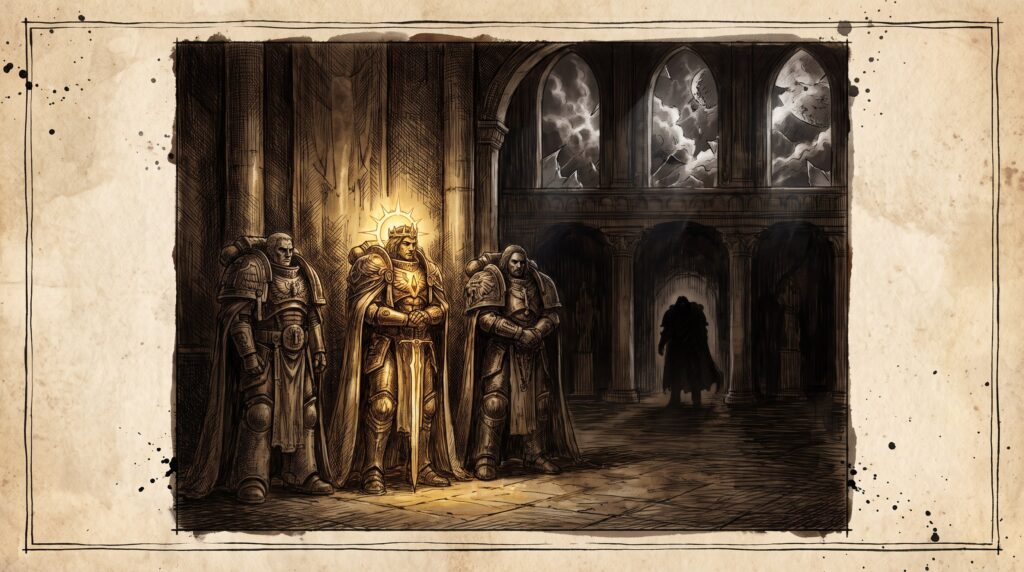
Consider the archivist’s difficulty. How does one record an Imperium that the Imperium would rather forget? For a span of dark years, while the Ruinstorm boiled across the heavens and no word came from holy Terra, there existed a second Imperium of Man — its capital not Terra but Macragge, its Emperor not the Master of Mankind but a golden-winged brother wearing a crown he never sought. The archives whisper its name in a lowered voice: Imperium Secundus. A second chance, or a second treachery? Even the Lion, sworn to protect it, was never entirely certain which.
What follows is the tale as the sagas preserve it — the raising of a throne in darkness, the strange triumvirate that ruled it, the terror that stalked its corridors, and the quiet dissolution that erased it from all but the most stubborn records.
The Ruinstorm and the Severing of Ultramar
It began with silence. When Lorgar’s Word Bearers and the treachery at Calth tore open the warp above the East, a great tempest — the Ruinstorm — descended and cut Ultramar off from the wider galaxy. Astropathic signals drowned. Warp travel became a matter of short, blind, agonising jumps. To Roboute Guilliman, master of the Five Hundred Worlds, the evidence pointed to a single terrible conclusion: that Terra had fallen, that his father was dead, that the Imperium he had helped build was already ash.
And so, being Guilliman, he did what he did best. He built. As he would later argue to his brothers, “Imperium Secundus represents continuity. Since Calth, it has been all I can do to hold the fractured parts of the Five Hundred Worlds together. Ultramar is all that we know we have.” If the true Imperium endured elsewhere, he reasoned, they would rejoin it when the storm died. If it had not — then they would have preserved it here, in the East, against the extinction of everything.
The Pharos of Sotha
No empire cut adrift can survive without light to steer by, and Ultramar found its beacon on the world of Sotha. There, beneath a mountain, lay the Pharos — an ancient device of xenos manufacture, its makers long dust, its purpose imperfectly understood even by those who wielded it. In the drowning dark of the Ruinstorm the Pharos became a lighthouse of the soul: a means to pierce the warp-tempest, to guide ships between worlds, to knit the scattered fragments of Ultramar into something that might hold.
The archives are frank that no one fully comprehended the machine. It was a borrowed miracle, and borrowed miracles have a way of turning upon those who lean too hard upon them — as the events at Sotha would grimly prove.
The Triumvirate: An Emperor Crowned in Darkness
Here the tale turns strange, and the records grow careful. Guilliman would not crown himself. To seize the imperial throne outright would have been the very treachery Horus had committed — and so a different arrangement was struck, one the sagas call the Triumvirate.
Sanguinius, the Angel of the IX Legion, was raised up as Imperator Regis — the new Emperor, styled by some “the leader that Horus was meant to have been.” Guilliman took for himself the title of Lord Warden, the architect and administrator, content to command what he called “an army of bureaucrats” while the Angel bore the crown and the burden. As the chronicles put it plainly: Sanguinius would be emperor, Guilliman the architect of the new Imperium.
The third seat belonged to Lion El’Jonson, who upon his arrival became Lord Protector — sworn upon his blade to command not merely his own Dark Angels but all the military forces of the second Imperium. Yet the Lion’s oath was heavy with doubt. Was it a second chance at mankind’s survival, or an act of treachery to rival the rebellion of Horus? The Lion himself was never sure — yet he swore his oaths upon his blade regardless, for Sanguinius was, he judged, a brother worthy of such oaths. Perhaps the only one.
The Terror at Its Heart: Konrad Curze
An empire raised against the darkness discovered, to its horror, that the darkness had come inside with it. Konrad Curze, the Night Haunter, Primarch of the Night Lords, was loose upon Macragge — and he did not merely hide. He hunted. He murdered. He left his grisly signatures where they would be found, for the archives note that his madness would not permit him to strike and simply vanish. “Curze’s insanity would not let him simply strike and fade away. He had a point to prove.”
And what a point. That the better part of three Legions — Ultramarines, Blood Angels, Dark Angels — were pinned to a single world by one solitary predator. The Lion resolved to end him, reasoning that to be rid of the Night Haunter would at last free him to fulfil his true role. So the fortress-world was turned inward upon itself. The Lion’s decree survives in the record, cold and total: “Macragge has been a fortress from without, but it must be fortified from within. Martial law… Curfew. Searches. Surveillance and investigation without limit. There will be no shadows to hide Curze, no cracks for him to move along… Nothing will pass upon the face of Macragge without my knowledge.”
The Fracture Between Brothers
It was not Curze alone who imperilled the second Imperium, but the strain between its rulers. When the Lion proposed the eradication of four million citizens on the mere chance that Curze hid among them, it was Guilliman who recoiled. His answer to Sanguinius endures as one of the noblest passages of that dark age: “On moral grounds I would argue that the eradication of four million citizens of the Imperium on the vague chance that Curze is amongst them is repugnant, and no action that would be undertaken by a leadership that professes to act on behalf of mankind’s best interests.”
What troubled the Lion most, tellingly, was not that Curze had killed — but that Curze had, on occasion, shown restraint. To a mind schooled in the necessity of the terrible, mercy from a monster was the most unsettling thing of all. The crown chafed too upon Sanguinius, who at length exercised the very authority Guilliman had given him — commanding both Lord Warden and Lord Protector to return to Macragge at once: “You made me emperor, Roboute, so either abandon the charade or make it real.”
The Dissolution
An empire born of a false conclusion cannot outlast the truth. Imperium Secundus rested upon a single premise — that Terra had fallen and the Emperor was dead. When word finally pierced the storm that the Master of Mankind yet lived and Horus marched upon the Palace, the second Imperium lost its entire reason to exist. To persist would have been treason; to dissolve was duty.
The sagas record that the Lion was cast out and the Dark Angels withdrew, the fragile confederacy of purpose coming apart as its factions lost contact and its rulers turned their eyes at last toward Terra. Sanguinius set down the crown he had never desired and flew to meet his doom aboard the Vengeful Spirit. Guilliman turned his empire’s machinery back toward its true master. The second throne was quietly unmade, its name folded away into the sealed and shadowed corners of the Imperial memory — a heresy that was never quite a heresy, a mercy that was almost a betrayal, remembered now only where the archives dare to whisper.
Questions from the Archive
What was the Imperium Secundus?
It was a second Imperium of Man, capital at Macragge, raised by Roboute Guilliman during the Horus Heresy when the Ruinstorm cut Ultramar off from the galaxy. Believing Terra had fallen and the Emperor dead, Guilliman consolidated the Five Hundred Worlds into a new empire to preserve mankind — intending, as he argued, to rejoin the true Imperium if it endured, or to have preserved it if it had not.
Why was Sanguinius made Emperor instead of Guilliman?
Guilliman refused to crown himself, knowing that to seize the throne outright would mirror Horus's treachery. Sanguinius was raised as Imperator Regis while Guilliman took the humbler title of Lord Warden and the Lion served as Lord Protector. The Lion admitted he would have ended the whole enterprise as heresy were it not for Sanguinius, whom he judged the only brother worthy of such oaths.
Why was the Imperium Secundus dissolved?
It rested entirely on the belief that Terra had fallen and the Emperor was dead. Once word pierced the Ruinstorm that the Emperor lived and Horus was marching on the Palace, the second Imperium had no reason to exist and to continue would have been outright treason. Amid the terror wrought by Konrad Curze and fractures between the Primarchs, the throne was unmade and its rulers turned toward Terra.
Sources and reading
- Dan Abnett, The Unremembered Empire, chapter 16 — Curze confronts Guilliman and the Lion.
- Dan Abnett, The Unremembered Empire, chapter 24 — Sanguinius arrives at Ultramar.