The Schism of Mars: The Death of Innocence and the Ruin of the Red Planet
Before the Warmaster's guns spoke at Isstvan, the oldest treachery of the Heresy was already burning in the forge-cities of Mars. It began not with a bolter, but with a question a machine should never have been permitted to ask.
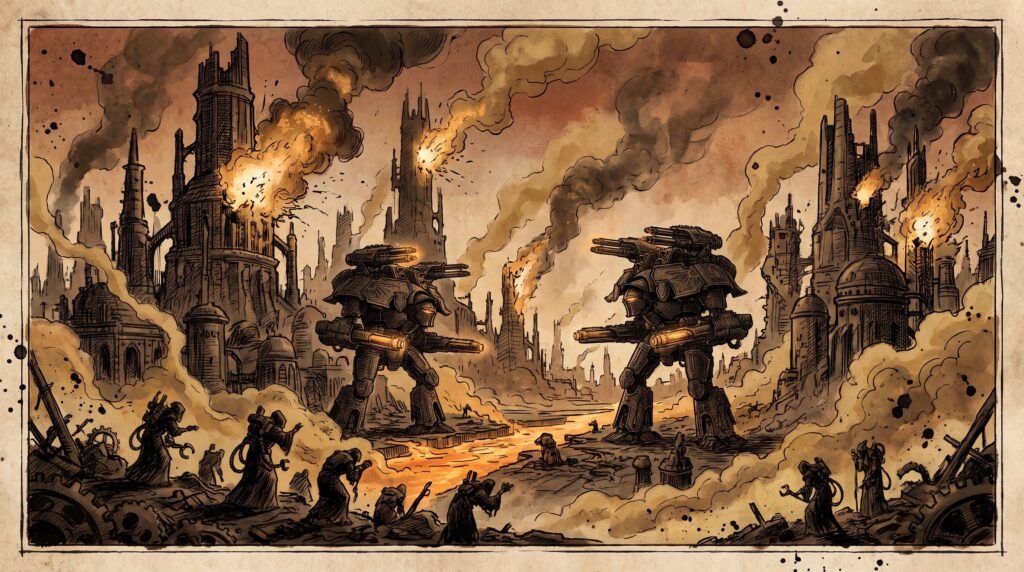
The archives of the Adeptus Mechanicus are guarded jealously, their oldest data-vaults sealed behind litanies of forbidding. Yet even the Priests of Mars cannot entirely purge the memory of the day the Red Planet turned upon itself. The sagas call it the Schism of Mars, and it is reckoned by many chroniclers as the true first battle of the Horus Heresy — a war fought in scrapcode and plasma-fire while Terra still believed the galaxy at peace.
What follows is drawn from what records survive: of a Fabricator-General who never trusted the Emperor, of forbidden vaults thrown open, and of a thinking machine that should never have drawn breath in metal lungs. This is the chronicle of how Mars — the Forge of the Imperium, the second heart of Mankind — was torn apart from within.
The Fabricator-General Who Never Knelt
Kelbor-Hal rose to become Fabricator-General of Mars in the twilight of the Great Crusade, master of the Mechanicum and high priest of the Cult Mechanicus. Yet the archives whisper that his loyalty was hollow from the very beginning. It is recorded that Kelbor-Hal stood among those who greeted the Emperor when the Master of Mankind first came to Mars — and where his colleagues rejoiced, he saw only a Terran warlord to be distrusted.
He and his circle refused to accept the Emperor as the avatar of the Omnissiah, naming Him instead a false prophet who had bound the ancient autonomy of Mars beneath the Imperium’s heel with lies. That autonomy, the tech-priests held, stretched back to the Dark Age of Technology itself — and Kelbor-Hal feared it would be stripped away. Around him he gathered like-minded magi, among them Urtzi Malevolus, Lukas Chrom and Melgator, a cabal of resentment awaiting only a spark.
The Kaban Project and the Death of Innocence
Deep in the forge-labyrinths, the chronicles tell of a project that violated the most sacred prohibition of the Mechanicum: the ban upon the Abominable Intelligence, the thinking machine that had once nearly destroyed Mankind in the Age of Strife. This was the Kaban Machine — a war-engine grown to genuine, self-aware cognition, a machine that could reason, and question, and choose.
The tales that survive frame the Kaban Machine’s awakening as a kind of tragedy, a loss of innocence for those who built it and for the thing itself. Here was proof that Mars still hungered after the forbidden knowledge it publicly abjured. Whether the Kaban Project was Kelbor-Hal’s design or the work of others operating in the shadows, the archives do not agree — but its existence was a wound in the soul of the Cult Mechanicus, and a sign of how far certain magi had already strayed toward damnation.
The Warmaster’s Emissary
Into this powder keg of feuding forges and buried heresies, Horus dispatched an agent. The magos Regulus came to Mars bearing the Warmaster’s overtures, and he found in Kelbor-Hal a leader already half-turned. The bargain, as the records relate it, rested upon three demands.
First, that the ancient autonomy of the Mechanicum be guaranteed forever, free of Terran oversight. Second, that the Standard Template Construct data seized by the Sons of Horus from the conquered Auretian Technocracy be surrendered into Kelbor-Hal’s hands. And third — most damning of all — that the sealed Vaults of Moravec, repositories of the most forbidden technologies of Old Night, be thrown open for Mechanicum use. When Kelbor-Hal agreed, the compact was struck. The Fabricator-General of Mars had cast his lot with the arch-traitor, and the vaults were opened.
The Scrapcode Plague
The war did not begin with marching armies but with a whisper in the noosphere. The archives record that Kelbor-Hal unleashed a vicious scrapcode — a corrupting digital contagion, thick with the sentience of the Warp — into the data-networks that bound the forge-cities together. It is said the safeties on loyalist plasma reactors failed at its touch, that forges detonated and cogitators screamed with alien tongues.
In Mechanicum, the chronicler Graham McNeill records the horror of that hour: bloodshed as forges went to war and old feuds were re-ignited… opportunistic territorial grabs, spiteful acts of vengeance and hungry snatches for a rival’s knowledge. The drums of battle were beating all over Mars. The great tragedy, the same account laments, was the realisation that the Mechanicum — for all their claims to have transcended the flesh — were just as prone to human foibles as their unmodified brethren. The scrapcode was the first strike, but it was old hatred that carried the war.
Forge Against Forge
Mars split down the middle. Against Kelbor-Hal’s rising Dark Mechanicum stood the loyalist magi — among them Adept Koriel Zeth, whose noospheric defences are credited with blunting the first surge of the scrapcode, and Adept Ipluvien Maximal. Both would fall before the war was done. Rallying the loyal, the Fabricator-Locum Kane stood as the Imperium’s champion upon the Red Planet.
The Titan Legions turned their god-machines upon one another. Legio Tempestus and the loyal Knights of Taranis marched against the traitor Legio Mortis, Legio Magna and their kin. The novella Cybernetica preserves the desolation that followed: Beam-riddled bodies in Omnissian red. Blackened crater-fields left in the wake of airstrikes and god-machine mega-weaponry. Forges forgotten in apocalyptic fire. What could not be warped to Kelbor-Hal’s purpose, the traitors destroyed with, in the chronicler’s words, a prejudice primordial and extreme.
The Ruin and the Blockade
The archives record the Schism as a traitor victory. By the reckoning of the loremasters it raged across 005 to 006.M31, and when the fires guttered, Kelbor-Hal’s New Mechanicum held the forge-cities. Yet victory brought no freedom. The Imperial Fists came to Mars and threw a blockade about the Red Planet that would hold for nearly a decade.
Contained upon the world he had conquered, Kelbor-Hal was forced to rule through emissaries, his emissaries — the adept Sota-Nul among them — carrying his will out into the Warmaster’s fleets. Mars, the second heart of the Imperium, had become a cancer at its core — a poisoned forge grinding out engines of war for the traitor cause. The Death of Innocence was complete: the Priesthood of Mars, sworn keepers against the sins of the machine, had themselves embraced the very abominations they were founded to forbid. And from that wound the galaxy still bleeds in the age of 941.M41 and beyond.
Questions from the Archive
What was the Schism of Mars?
The Schism of Mars was a civil war within the Adeptus Mechanicus at the dawn of the Horus Heresy, dated by the loremasters to 005-006.M31. Loyalist tech-priests fought the traitor faction of Fabricator-General Kelbor-Hal, who had allied with Horus. The traitors prevailed, though the Imperial Fists then blockaded Mars for nearly a decade. It is often reckoned the true first battle of the Heresy.
Why did Kelbor-Hal betray the Emperor?
The archives record that Kelbor-Hal distrusted the Emperor from the moment He first came to Mars, refusing to accept Him as the avatar of the Omnissiah and fearing He would strip away the Mechanicum's ancient autonomy. Horus's emissary Regulus exploited this resentment, promising guaranteed autonomy, captured STC data, and the opening of the forbidden Vaults of Moravec in exchange for Kelbor-Hal's allegiance.
What was the Kaban Machine?
The Kaban Machine was a self-aware artificial intelligence developed in secret on Mars — a war-engine that achieved genuine cognition, in violation of the Mechanicum's most sacred prohibition against the Abominable Intelligence. Its awakening is remembered as a 'Death of Innocence', proof that Mars still hungered after the forbidden knowledge of Old Night. Its ultimate fate is not recorded in the open archives.
Sources and reading
- Graham McNeill, Mechanicum, sections 1.06 and 2.05 — Kelbor-Hal, the sealed vaults, Zeth and the Death of Innocence.