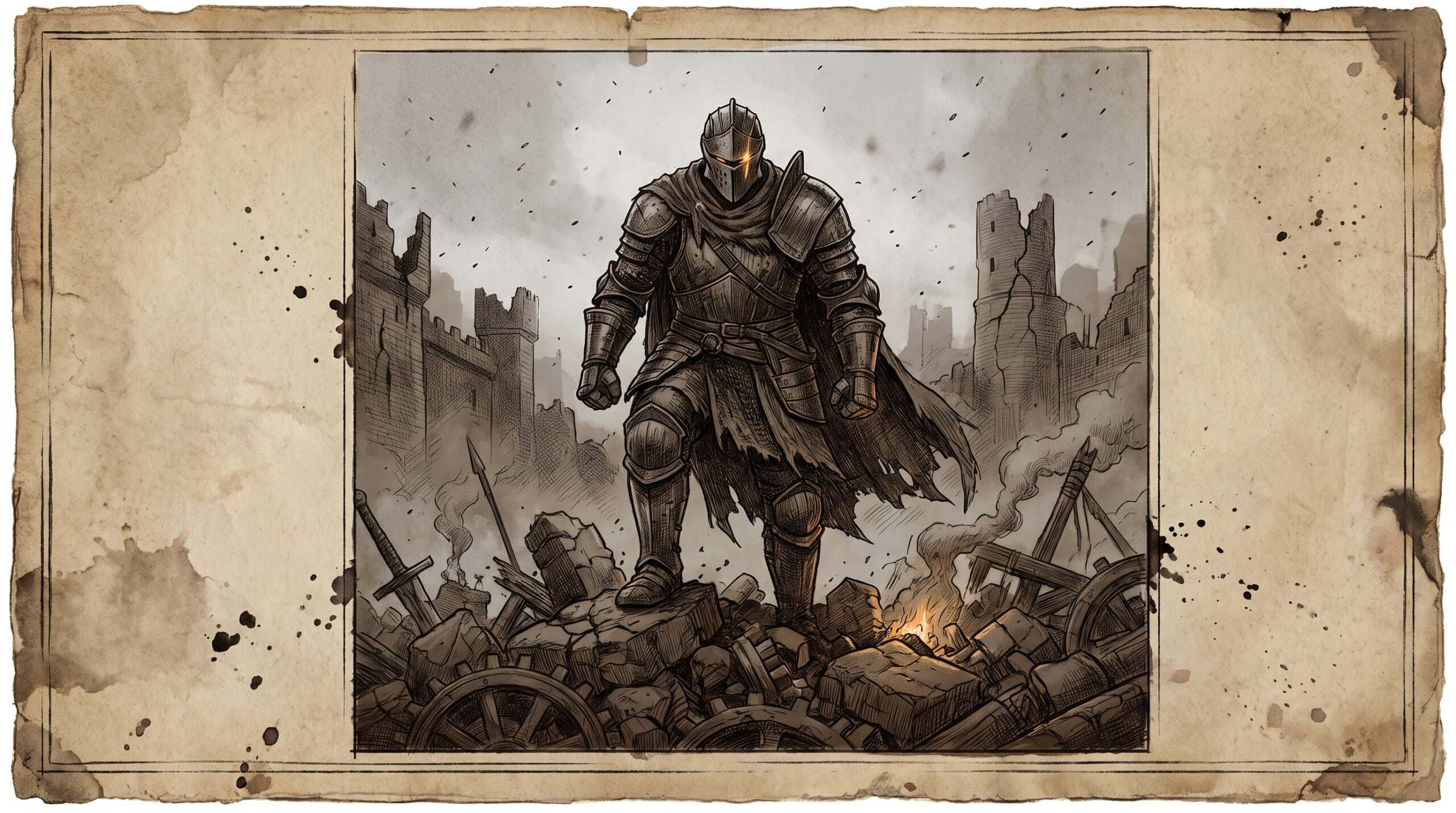
Why Did Perturabo Betray the Emperor? The Bitter Fall of the Lord of Iron
He was made to break what his enemies built — and in the end, the thing he broke was his own oath. This is how the Hammer of Olympia came to turn against the hand that forged him.
The archives preserve a single, damning phrase, spoken on the sands of Terra when the IVth Legion’s primarch first knelt before his father. ‘You will be my hammer, Perturabo. What our enemies build to keep us from our destiny, you must put asunder.’ And the son answered: ‘No one shall build anything I cannot break open.’ It was meant as a covenant of trust. Perturabo would later replay that memory a thousand times in the cold of his solitude, and find in it not honour but reproach — the first stone laid in a wall of resentment that would one day topple upon the Emperor Himself.
To ask why the Lord of Iron betrayed his father is to trace a slow corrosion, not a single act of malice. The sagas tell of a mind of terrifying brilliance and a heart that no one ever troubled to understand. Here is what the records permit us to say.
The Loneliest Primarch: Olympia and the Making of a Cold Mind
When the primarchs were cast across the stars, the being who would become Perturabo fell upon Olympia. The chronicles describe him waking naked upon a cold mountainside beside his blackened silver capsule, its great numeral IV still visible upon the casing. ‘What am I?’ he is said to have thought. ‘Am I this number? Am I… four?’ Then the name rose in him unbidden. ‘I am Perturabo,’ he announced to the empty peaks.
Taken into the house of Dammekos, the Tyrant of Lochos, the boy displayed a genius that spanned architecture, warfare, the arts and statecraft. Yet the archives record a child who gave nothing back. He shunned his adoptive siblings, trusted the Olympians not at all, and despised their religion, believing only in the cold logic of reason. His own bitter lament survives: ‘You don’t know the things I dream. No one does, no one ever cared enough to find out.’ Here, the sagas whisper, is the wound that never healed — a mind of boundless capacity, starved of understanding.
The Emperor Comes: A Father Who Promised Nights of Discourse
The coming of the Emperor is remembered as a moment of genuine wonder. ‘You are as dauntless as I intended you to be,’ the Emperor told him, gazing over Olympia’s castles and marvels. ‘I sense the hunger in you for knowledge. I think you and I have many nights of discussion ahead of us.’ Perturabo, struck near dumb, could only answer: ‘Yes. Please!’
It is one of the great tragedies of the Heresy that this promise — nights of shared learning between a peerless intellect and its creator — appears never to have been kept. The archives whisper that the Emperor departed to His Crusade and His labours on Terra, and the hungry mind He had awakened was left, once again, alone. What might have bound Perturabo forever became instead another proof that no one cared enough to find out what he dreamt.
The Thankless Hammer: A Legion Ground to Dust
As Siegemaster, Perturabo and his Iron Warriors were handed the Imperium’s cruellest labours: the sieges, the fortress-worlds, the campaigns of attrition that consumed Legions from within. His conquests were, in the words of the records, ‘innumerable, but unremarked and unthanked’. Where his brothers won glory and honour, the IVth won only fresh orders and thinning ranks. The Legion was bled white in undertakings that brought no laurels, its worth measured only by what it could break.
The chronicles are candid that this festered. Beneath the iron facade, the Legion rotted ‘from within with loathing and bitter spite’. Perturabo brooded upon a sworn covenant fulfilled and never once acknowledged — the hammer wielded until it cracked, then blamed for cracking.
Iron Within, Iron Without: The Betrayal He Could Not Forgive
There is a bitter irony the archives cannot ignore. Perturabo held oaths sacred above almost all things. Of oathbreakers he once declared: ‘They have broken their oath of loyalty to the Emperor. That oath is an inviolable covenant, one that can never be reforged once broken. For such betrayers there can be no forgiveness, only the most painful of deaths.’
This was the man who would himself become the greatest of oathbreakers. The sagas offer no comfortable reconciliation of the contradiction. Perhaps he came to believe the Emperor had broken faith first — that the covenant sworn on Terra’s sands had already been shattered by neglect and exploitation, freeing him to answer in kind. Whatever the truth, he found in that founding oath ‘only reproach’, and no comfort at all.
The Snare of Fulgrim: How the Turn Was Sealed
When Horus raised his standard, Perturabo did not leap eagerly to Chaos. The secondary records hold that he was drawn in part through the manipulations of his brother Fulgrim, lured with promises of the recognition and power the Imperium had always denied him. The dark truth of the IVth Legion’s corruption remained hidden until Isstvan V, when the Iron Warriors — summoned to punish the Warmaster — revealed themselves instead as traitors.
The archives are careful to distinguish confirmed record from the debates of scholars. That Fulgrim played upon his brother’s grievances is well attested; the precise shape of the persuasion is a matter the sagas render differently. What is not in doubt is that the fuel was already there. Fulgrim did not create Perturabo’s bitterness — he merely struck the spark.
The Choice at the Heart of Iron
The most searching account of his fall comes from the Siege of Terra itself, when Perturabo at last surrendered to the powers he had unleashed. The chronicles record it plainly: ‘Because he had made the choice. That was the important thing.’ For so long he had skirted the edge of it, ‘chafing at the impossible demands placed on him, gnawing at the injustices that had always been heaped his way’. He might have preserved something of his old self, picked through the contradictions. Instead he submerged himself in the cold, dark waters.
So the answer, insofar as the archives permit one, is this: Perturabo betrayed the Emperor not for love of Chaos, but out of a lifetime of unhealed wounds — the loneliness of Olympia, the broken promise of a father’s attention, a Legion spent without thanks, and a mind that no one troubled to understand. In the end, the hammer forged to break all things turned and broke the one covenant it had held most sacred.
Questions from the Archive
Did Perturabo want to join Chaos, or was he tricked?
The records suggest both. His brother Fulgrim is held to have manipulated him with promises of power and recognition, but the bitterness was Perturabo’s own — born of neglect and a thankless Legion. Fulgrim struck the spark; the fuel was already laid. At the Siege of Terra the chronicles are clear that Perturabo ultimately made the choice himself.
What was Perturabo's oath to the Emperor?
On Terra’s sands the Emperor told him, ‘You will be my hammer… what our enemies build, you must put asunder,’ and Perturabo swore, ‘No one shall build anything I cannot break open.’ He revered oaths as inviolable — which makes his own betrayal one of the cruellest ironies in the archives.
Why did Perturabo feel resentful of the Emperor?
The chronicles describe a primarch whose conquests were ‘innumerable, but unremarked and unthanked’. His Iron Warriors were handed the deadliest sieges and bled white for no glory, while his brothers won honour. Coupled with a promise of shared learning that appears never to have been kept, this fed a deep and lasting resentment.