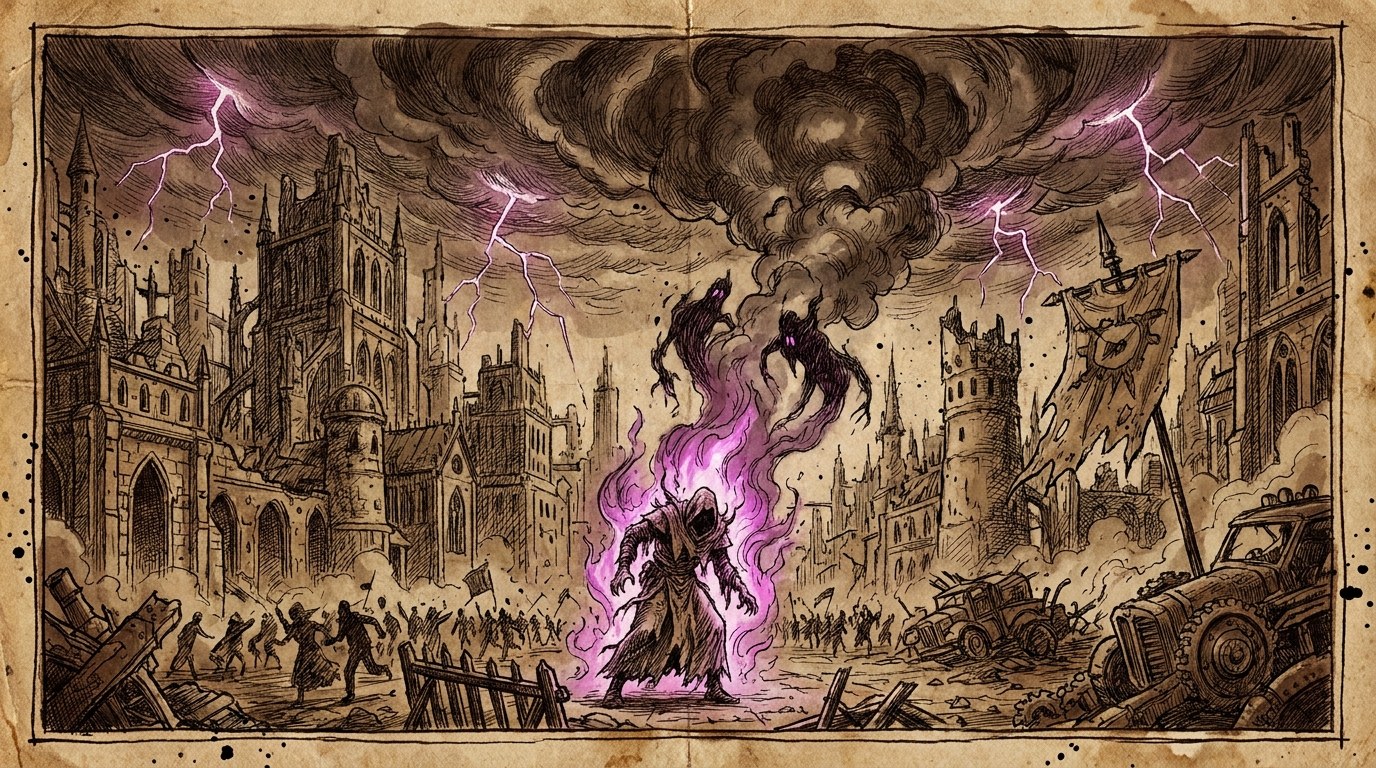
The Age of Strife: Five Thousand Years of Old Night
Warp storms drowned the stars and every world was an island. A chronicle of Old Night — the psyker plague, the warlords of Terra, and how mankind almost died in the dark.
Five thousand years of night, and every star an island. Of all the catalogue of catastrophes in my keeping, none did more to make the Imperium what it is than Old Night — for the Imperium is, before it is anything else, the survivor of that darkness, and it has never stopped flinching. Attend, then. This is the chronicle of how the brightest civilisation our species ever raised went into the dark, and of what crawled back out.
The Storms Rise — Every World Alone
The golden age did not end with a war lost or a throne toppled. It ended with the weather of Hell. As the ancient aeldari empire’s corruption swelled toward its catastrophe — a doom that belongs to that race’s own grim chronicle — the Warp itself began to boil. The sea through which every human ship sailed and every astropathic word travelled rose into storms without end: eternal tempests raking through true space, drowning whole sectors in a fiery twilight that no vessel could cross and no message pierce. The deepest records preserve the scale of it in a single merciless line — a million different worlds with no capacity to contact one another, each one alone. In the span of a generation, a species that had woven the galaxy into one civilisation became a million solitudes, each world fending for itself with whatever it had in its hands when the dark came down. The chronicle of one such world records what that meant in full: more than five thousand years of isolation. Five thousand years, reader. Terra’s whole recorded history before the stars, twice over, spent waiting for a sky that would not open.
The Psyker Plague — Doorways in the Dark
And the dark that came down was not empty. In those same generations, mankind itself began to change: on countless worlds, psykers emerged spontaneously from the human line — warlocks, the frightened folk of one famous ice-world called them — minds that touched the Warp without shield or schooling. Understand what that meant in the age of storms. The Warp was in full tempest, crowded with predators gorged on the aeldari empire’s long corruption; and every unschooled psyker was a lodestone for its touch, a door left unlatched in a world that could no longer call for help. The records are unanimous and unbearable: possession, madness, reality itself warping around the most powerful of the changed; societies that had survived the storms’ isolation unmade from within by their own children. The Emperor Himself, the deepest archives record, later named the danger in plain words — mankind was taking its first steps toward becoming a psychic race, and an unshepherded psychic race would suffer as the aeldari suffered. Old Night was the proof, written in a hundred thousand dead societies. Every pyre the Imperium has lit beneath a rogue psyker since, whatever else may be said of it, was lit by men remembering that lesson.
A Million Solitudes — How the Scattered Worlds Endured
No two worlds passed the night the same way. The chronicles the Great Crusade later gathered read like a catalogue of every fate a civilisation can suffer. Some worlds clung to fragments of the golden age’s science and became fortress-states, hoarding their machines like scripture. Some slid all the way down — from starships to steel, from steel to stone — until the descendants of void-farers hunted with flint beneath the wrecks of their ancestors’ orbital lifts. Some were harvested by xenos, who found mankind’s scattered children suddenly very small and very alone. Some fed their own psykers to the dark and called it religion; some worshipped them and died faster. And some few, by luck of geography in the Warp’s weather, prospered strangely in the silence and forgot the rest of the species altogether — the Crusade’s expedition fleets would spend two centuries being astonished by what the night had made of mankind’s lost cousins. An empire broken, one account has it, reduced to scrabbling fragments of civilisation clinging to the edge of existence by their fingernails, scattered like forgotten islands in a dark and hostile ocean. I have read ten thousand years of grim prose in this scriptorium, and that line still stops my hand.
Terra Under the Warlords of Old Night
Even the cradle fell. Terra — birthplace of the species, hub of the golden age — spent the long night as a fractured, poisoned ruin: the oceans long gone to dust, the soil harrowed, the last atmospherics of a dying world fought over by the broken tribes of mankind. The chronicles name the breed that ruled it techno-barbarians, and the litany of them reads like a fever: warlords and archpriestesses, magician-kings and clan chiefs, petty dynasts and ethnarchs, gene-septs and pan-continental tyrants beyond counting — men wielding the salvaged weapons of the golden age with the ethics of the stone one. The records preserve their monuments in ash: the Nordafrik Conclaves reduced to ashen desert by the warlord Shang Khal; the fallen bastions of the tyrant Narthan Dume; a hundred petty empires whose names survive only in the ledgers of their crimes. That was the Terra into which the Emperor at last stepped from the shadows at the head of His Thunder Legion — but His wars are another chronicle, already bound and shelved in this archive, and I commend it to you.
Luna and Mars — the Neighbours in the Night
Terra’s own system passed the night divided against itself. On Luna, the Selenar gene-cults endured — factions of gene-wrights whose helical mysteries preserved, through all the long dark, a mastery of the flesh that the deepest records say outstripped even the Emperor’s own; when Unity came at last, it came to Luna as war, and the price of the cults’ survival was the yoke: their art turned to the building of the Legions, whose warriors some old accounts still name sons of the Selenar. And on red Mars, the priesthood of the Machine God grew in the silence — a cult of preserved knowledge that would emerge from Old Night as a power in its own right, sovereign, armed, and indispensable. Mark these two well, reader. The night did not only breed warlords. It bred the very institutions from which the Imperium would be assembled — each with its own scars, and its own secrets, and its own price.
The Fall of the Aeldari — Dawn Out of Ruin
Endings and beginnings share borders. The aeldari fell — damned, their own seers admit, by their vices eating through the wards about their psychic souls, in a catastrophe so vast it tore a wound in the galaxy that has never closed. And in their fall, the storms that had drowned every human world for five millennia bled away, receding into final scarred clusters of ruin — the Maelstrom, the accounts name one, and the region the savants call the Ocularis Malifica another. The stars opened. The human race rose, one deep record has it, Old Night giving way to the dawn as the eternal storms receded. Consider the terrible symmetry of it, as I have considered it across many long nights: mankind’s darkness was ended by another species’ damnation. The dawn we rose into was lit by the pyre of the galaxy’s former masters — and the wound their fall tore in the heavens would one day be named the Eye of Terror, and cost us Cadia. In this archive, no debt is ever quite finished being paid.
What Old Night Made of Us
Understand Old Night and you understand everything the Imperium does. Why it chains its psykers to the Golden Throne’s light and burns the ones it cannot chain. Why it abominates the alien — for the night taught mankind what the galaxy does to the small and the scattered. Why it holds a million worlds in a single iron fist and calls the grip mercy — because the alternative is not freedom, in the Imperium’s memory; the alternative is a million solitudes, dying alone in the dark. I do not ask you to forgive the lesson’s applications. I ask you only to know where the lesson was learned. Mankind remembers Old Night in its bones. I remember it on paper, which is worse — for bones at least are spared the details.
Thus passed the Age of Strife: five thousand years in which mankind, scattered and screaming, all but died in the dark — and did not. Hold to that last clause, reader. It is the only comfort this chronicle offers, and the whole foundation of everything that came after: the storms lifted, and we were still here.
Questions from the Archive
What was the Age of Strife?
The Age of Strife — Old Night — was the roughly five-thousand-year collapse of human interstellar civilisation before the Imperium. Immense warp storms made travel between the stars impossible, severing every human world from its neighbours, and mankind’s scattered empire fell into isolation, war and regression.
What caused the Age of Strife?
The storms rose as the ancient Aeldari empire spiralled toward its catastrophic Fall, the Warp boiling with the corruption of that dying civilisation. At the same moment humanity itself was changing: psykers emerged spontaneously on countless worlds, and their uncontrolled powers — open doors for the Warp’s predators — tore isolated societies apart from within.
How long did the Age of Strife last?
The chronicles of one isolated world record more than five thousand years cut off from the rest of humanity, and the common reckoning spans Old Night across roughly five millennia — from the fall of the golden age to the Emperor’s unification of Terra. Precision is impossible: the age destroyed most of its own records, and every world’s night began and ended at a different hour.
What happened on Terra during the Age of Strife?
Terra fell furthest of all. The cradle of mankind became a poisoned, oceanless ruin carved up between techno-barbarian warlords — petty dynasts, gene-septs, magician-kings and pan-continental tyrants beyond counting — who fought over the harrowed territory of a broken world until the Emperor revealed Himself and crushed them one by one in the Unification Wars.
How did the Age of Strife end?
When the Aeldari empire finally fell — damned, their own seers admit, by their vices — the great storms bled away into final scarred clusters such as the Maelstrom, and the stars opened again. On Terra the Emperor unified the homeworld, forged His alliance with Mars, and launched the Great Crusade to gather mankind’s scattered worlds into the Imperium.