John Blanche: The Remembrancer Who Dreamed the Grimdark
Some remembrancers record what the Imperium is. This one showed us what it feels like to live in its shadow.
There are remembrancers who paint the truth of a thing, and there are those rarer few who paint its soul. The archives hold many hands, but few have shaped the way the faithful and the fearful alike imagine the forty-first millennium quite like the remembrancer known to us as John Blanche. His plates do not merely depict the Imperium — they exude its rot, its zeal, its terrible gothic weight. To look upon his work is to smell the incense and the corpse-smoke both.
Our archive holds some thirty of his works, and across them runs a single unbroken thread: a vision of the Emperor’s realm as a place of shadowed grandeur, where sanctity and corruption are separated by the thinness of a votive candle’s flame. Here we celebrate that vision.
The Hand Behind the Grimdark
It is said the tone of an age is set not by its scholars but by its artists, and few have set a tone so completely. The remembrancer’s plates lean into murk and menace — desaturated palettes broken by a single defiant accent, figures crowned with wax and parchment, servo-skulls and censers hanging in oppressive air. Where lesser hands render armour as clean steel, this remembrancer renders it as something ancient, encrusted, half-alive with the burden of ten thousand years.
The archives whisper that his approach favours mood over rigid geometry, the felt truth of a thing over its blueprint. This is not the sterile schematic of a tech-adept; it is the fevered vision of a pilgrim who has stared too long into the Astronomican.
The Master of Mankind, Rendered in Shadow
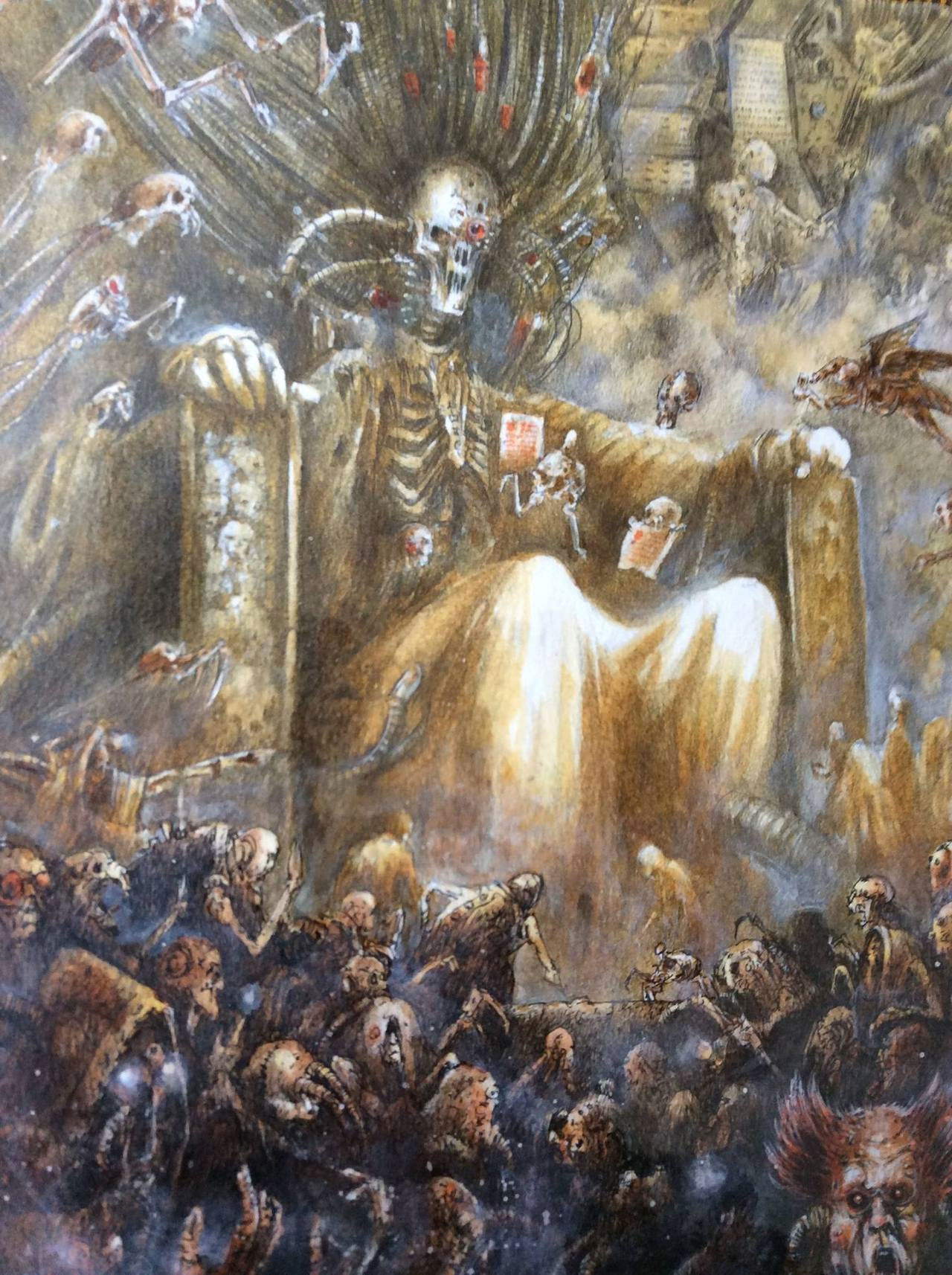
Among his works stands a depiction of the Emperor of Mankind Himself — no small undertaking, for how does one paint the unpaintable? The remembrancer’s answer is reverence draped in dread. His Emperor is not a bright golden idol but a presence of terrible antiquity, a figure who commands worship and inspires unease in equal measure. This, the sagas suggest, is closer to the truth than any triumphant banner-piece: the Master of Mankind as a god who is also a corpse, a saviour who is also a prisoner of His own throne.
Xenos and the Alien Grotesque
The remembrancer’s brush does not flinch from the alien. His archive includes the greenskin warlords — Nazdreg Ug Urdgrub among them — and the Orks entire, rendered with a brutish, gleeful menace that captures their crude vitality without softening their savagery. Bad Moons swagger in their finery; boyz crowd the frame in riotous ranks.
He turns his hand, too, to the abhuman and the beastman, to the stunted and hardy Squats of the deep holds. Where the Administratum’s records reduce such kin to census-figures and tithe-quotas, the remembrancer restores to them a strange dignity — the dignity of the overlooked, the persecuted, the enduring.
The Damned and the Possessed
No chronicler of this remembrancer’s work can ignore his dance with the Ruinous Powers. His depictions of the Possessed and the Black Legion render corruption not as cartoon villainy but as seduction and decay entwined. Traitor armour warps into daemon-flesh; the eye cannot always find where ceramite ends and blasphemy begins. This ambiguity is the heart of his genius. The archives teach that Chaos is not the opposite of order but its shadow, and his plates make that doctrine visible.
Iron, Machine, and the Cult of the Cog
The remembrancer’s eye is drawn also to the works of the Machine God. His Tech-Priest studies bristle with mechadendrites and ritual, more reliquary than robot. His Terminators stand as ancient warriors sheathed in relic-plate, each suit a treasure older than most worlds. He paints armour and vehicles, battle titans and bio-titans, the towering god-engines and the void-black battleships that crawl between stars. In every case the machine is holy, feared, and burdened — never merely mechanical.
Cathedrals of Rust and Faith
Beyond figures, the remembrancer conjures architecture: the vaulted gothic immensity of the Imperium’s spires and shrine-worlds. These are not backdrops but characters in themselves, structures that dwarf the mortals who scurry beneath them. In such plates one grasps the true scale of the Emperor’s realm — a domain where a single cathedral might swallow a hive, and where every buttress groans under the accumulated prayer of millennia.
The Enduring Vision
Thirty works survive in our archive, and through them the remembrancer offers a coherent testament: that the forty-first millennium is beautiful precisely because it is horrifying, sacred precisely because it is doomed. Whether he renders the Blood Angels or the Black Legion, a battle-titan or a lowly beastman, the same conviction burns through — that in a galaxy this dark, the light of art is itself an act of defiance. Let the faithful study his plates, and let them remember.
Explore every plate we hold from this remembrancer in the Archive — their own links live on their profile there.
Questions from the Archive
What kind of subjects does John Blanche paint?
Our archive holds works spanning the breadth of the forty-first millennium: the Emperor of Mankind, Orks such as Nazdreg Ug Urdgrub, the Possessed and Black Legion of Chaos, Terminators, Tech-Priests, Squats and other abhumans, battle titans, battleships, and the towering gothic architecture of the Imperium.
What makes his artistic style distinctive?
The remembrancer favours mood over precise schematic detail — dark, desaturated palettes broken by a single accent, encrusted and ancient-looking armour, and an atmosphere of oppressive gothic weight. His work is celebrated for capturing the felt truth and grimdark soul of the setting rather than a clean technical rendering.
Where can I see more of his work?
A dedicated gallery of the remembrancer's plates is preserved for study, and the profile link appended below leads to further collections of his archived works.