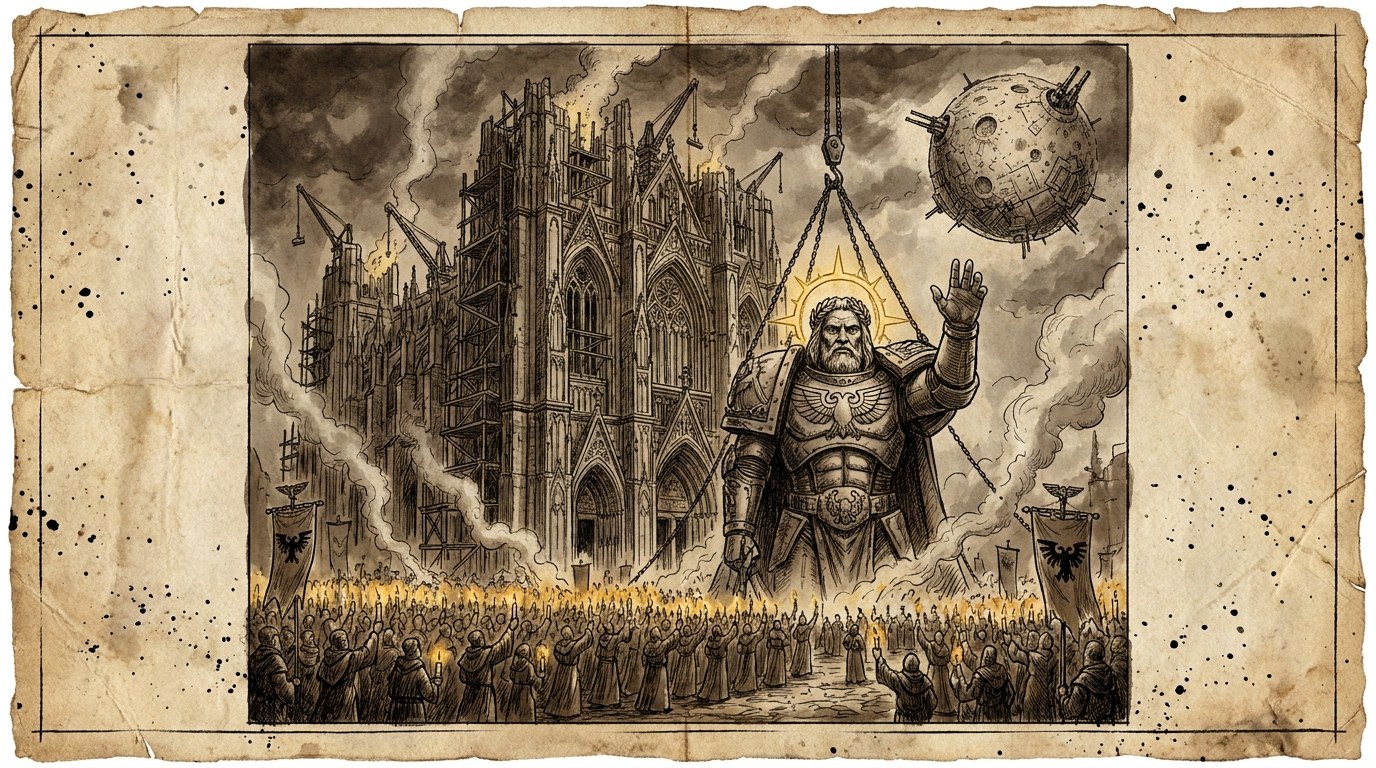
The Time of Rebirth: How a Corpse Became a God
The Emperor forbade His own worship — and won a church anyway. A chronicle of the Adeptus Terra, the rise of the Imperial Creed, and the Beast that nearly ended everything.
Here is the bitterest irony in all my archives: the Master of Mankind spent two centuries teaching His species that there are no gods — and His reward was to become one. This is the chronicle of the fifteen centuries after the Scouring: how an empire of reason rebuilt itself as an empire of faith, how it grew fat and confident in the rebuilding — and how a green god rose out of the Emperor’s own triumph to very nearly end the whole story.
The Adeptus Terra — an Empire of Scribes
When the guns of the Heresy at last fell silent and the traitors were driven howling into the Eye, the Imperium that remained was a body without a head. The Emperor lived — lives still — but He spoke no more. Into that silence stepped the administrators. The war-council of the Heresy gave way to the Senate of the High Lords of Terra, twelve offices bearing the weight a god had set down; the ministries of muster and tithe and census swelled into the Adeptus Terra, the Priesthood of Earth — a bureaucracy so vast that no single mind, save perhaps the one upon the Golden Throne, has ever beheld the whole of it. Guilliman’s reforms broke the Legions into Chapters and the war-machine into balanced, mutually suspicious pillars: Astartes and Army, Navy and Mechanicus, Administratum and Assassinorum, each a check upon the others, none ever again to be trusted whole. It was not glorious. It was not what He dreamed. But it held ten thousand worlds together through the worst wound any empire has survived, and I defy any critic of the quill to have done better.
The Lectitio Divinitatus — a Faith Out of Ashes
And with the scribes came the priests. The Lectitio Divinitatus — that little book of heresy penned, the deepest records whisper, by a primarch’s own hand, and the traitor Lorgar’s at that — taught that the Emperor was divine. He had forbidden such worship. He had razed a perfect city and humbled a whole Legion in its ashes for exactly this crime. Yet after His sacrifice at the Siege, after mortal men learned that He had given His living body to shield them from gods of ruin, the faith could not be stopped — for what argument against the Emperor’s divinity survives the Golden Throne? It ran through the hive-stacks and the void-hulks like fire through a granary, cult joining with cult, until the whispers were a creed and the creed was a multitude. Consider the shape of that irony, reader, for the archives offer none crueller: the book of the Heresy’s own architect became the binding of the Imperium the Heresy failed to destroy.
The Imperial Creed Enthroned
By the early years of the Thirty-Second Millennium, the arithmetic was beyond even the High Lords’ talent for ignoring it: the majority of mankind now prayed to its master. And so the state bowed to what already ruled the hearts of billions — the worship of the God-Emperor was recognised as the official religion of the Imperium, its temple raised into the Adeptus Terra itself as the Adeptus Ministorum, the Ecclesiarchy. Within a few centuries its Ecclesiarch — Veneris the Second, the rolls record — took a seat among the High Lords of Terra, and in three hundred years more that seat was made permanent. Cathedrals rose on a hundred thousand worlds; the dioceses of the Cardinals spread wider than any Crusade fleet had sailed. A corpse became a god; an empire became a church. And the church, I am bound to record, would in time develop appetites of its own — but that darker chronicle belongs to the Age of Apostasy, four millennia downstream, and I will not rush you to it.
The Long Peace — Prosperity and Its Price
For some fifteen centuries after the Scouring, the Imperium prospered — and prosperity, in this archive, is always the sound of a trap being set. The traitors were sealed in their Eye, still licking the wounds of their defeat. The xenos were penned at the frontiers. The stagnation that would rot later millennia had not yet set in; fleets sailed, tithes flowed, the Pax Imperialis held. And confidence curdled, as it does, into complacency. The great war-fleets were dispersed to the borders, far from Terra, serving the political games of admirals. The Legions were a fond memory, their successor Chapters scattered by design. And the greenskin — humbled at Ullanor by the Emperor Himself, broken so utterly that his empire’s fall had furnished the Triumph of Triumphs — was accounted a spent threat, a frontier nuisance, yesterday’s monster. The Imperium had forgotten the first rule of the ork: he does not stay beaten. He merely goes away to get bigger.
The Beast Arises
In five hundred and forty-four, em thirty-two, the bill came due. It began, with history’s usual malice, at a world called Ardamantua, where the Imperial Fists — the Emperor’s own praetorians, Dorn’s unbroken line — had deployed in force against a minor xenos infestation. What arrived above that world was something the Imperium had no name and no plan for: an attack moon, a hollowed planetoid of scrap and gravity-engines and guns, herald of a Waaagh! the like of which the galaxy had never seen. The chronicles say it plainly: greater than the horde Horus broke at Ullanor; the greatest greenskin rising ever recorded. Ardamantua died, and the Imperial Fists died with it — a First Founding Chapter annihilated to the last company, a single survivor left standing in the dust of his brothers. His name was Koorland, and the records call him what he was: the last son of Dorn. Behind that first moon came the flood — sector after sector drowned in green, attack moons materialising in the skies of world upon world, and an ork empire whose master spoke fluent Gothic and understood strategy, logistics and terror. The Beast, the terrified records name him. Some accounts whisper the truth was worse: not one Beast, but several, princes of a green apotheosis rising together from Ullanor — the very world of the Emperor’s triumph. History does not repeat, reader, but it rhymes, and its favourite rhyme is mockery.
Terra Menaced — the Proletarian Crusade
How near did it come? An attack moon took station in the skies of Terra itself. Let that sentence sit a moment: fifteen hundred years after Horus broke against the Palace walls, a green moon hung over the Throneworld while the High Lords bickered beneath it. What followed was equal parts tragedy and farce, and the archives flinch from neither. The Speaker for the Chartist Captains, Juskina Tull, proclaimed the Proletarian Crusade — a spontaneous armada of civilian ships and faithful millions, hurled at the ork moon on a tide of desperate piety. The orks butchered them wholesale; the crusade’s chief cargo proved to be hostages and corpses. The Ecclesiarch preached, the admirals postured, the Lords delayed, and worlds died on schedule. If you would understand the Beheading that ends this chronicle, reader, understand first this season of Terra’s shame: the machinery the Heresy’s survivors built to prevent one tyrant proved magnificent at preventing decisions of any kind.
Vulkan at Ullanor — the Counter-Blows
The Imperium survived — barely, and not cleanly, and the chronicle of its counter-blows reads like a fever breaking. Koorland, last of the Fists, was raised to Lord Commander and gave the war its spine: he gathered the scattered sons of Dorn’s successors into one force, and — over the shrieking objection of High Lords who called it Codex-breaking blasphemy — forged mixed kill-teams of Astartes from many Chapters, a weapon with no Legion’s pride and every Legion’s craft. And out of legend itself came a greater aid: Vulkan, primarch of the Salamanders, lord of the Eighteenth, returned from ten centuries of silence to stand with mankind at the second battle of Ullanor — where the records tell that he met the Beast in single combat beneath the green god’s own roaring temple-mountain, and paid what primarchs pay. Assault after assault was hurled at Ullanor; Koorland fell; the Chapter Master Maximus Thane took up the command; and at the last the greatest of the greenskins was dead, his Waaagh! collapsing into the squabbling of a thousand lesser warlords. The cost is best read in the founding-rolls: the Fourth Founding that followed was raised to fill graves. The Adeptus Astartes had been devastated as no war since the Heresy had managed — by an enemy the Imperium had crossed off its ledgers as beaten.
The Aftermath — the Deathwatch and the Beheading
Three legacies outlived the war, and they map the age exactly. First, the vigil: Koorland’s mixed kill-teams were not disbanded, but endured as the Deathwatch — the long watch against the xenos, keeping his oath ten thousand years after his death. Second, the rebuilding: Thane’s new Foundings and a chastened, re-armed Imperium. And third, the knife. Drakan Vangorich, Grand Master of the Officio Assassinorum — the one High Lord, the records agree, who had seen the war clearly from its first day — looked upon his peers’ performance and reached a conclusion of terrible simplicity: the High Lords were a greater danger to mankind than the orks had been. In five hundred and forty-six, em thirty-two, the Beheading fell: the High Lords of Terra slain to a man in a single stroke, and the Imperium ruled thereafter by the Assassin through puppet lords — for the better part of a century, and, the honest chronicles concede, ruled rather well, until the protectorate curdled into the very tyranny it had been raised against. It ended as it had to: a strike force of Space Marines storming the Assassinorum’s temple through a gauntlet of Eversor killers, one survivor reaching the mad old man at the centre. I record the Beheading without endorsement and without much outrage either, reader. When you have read as many minutes of the Senatorum’s deliberations as I have, you will understand the temptation — which is precisely why it must be written down.
Faith as Fortress
Mark, at the last, what held the line in those years. Not the Imperial Truth — that died with the Heresy. It was faith: crude, roaring, candle-lit faith, the creed the Emperor never wanted, carried by billions who will never read a single page of the philosophy He preferred. It manned the Proletarian Crusade’s doomed ships; it held hive-worlds together under green skies; it rebuilt what the moons had broken. The Time of Rebirth proved a thing the Emperor’s own reason never allowed for: that mankind in the dark does not reach for arguments. It reaches for a light, any light, and the light it chose was Him. I have wondered many nights in this scriptorium whether He weeps at that, or whether He always knew. The records do not say.
Thus the Imperium was reborn — not as the empire of reason He designed, but as the empire of faith it needed to be; tested by the Beast within a hair of its life, and taught, in the Beheading, how thin the line runs between its servants and its masters. Judge the age harshly if you dare. It is still here — and so, reader, are you.
Questions from the Archive
What was the Time of Rebirth in Warhammer 40k?
The Time of Rebirth was the period of recovery and reorganisation that followed the Horus Heresy and the Great Scouring, in which the Imperium rebuilt itself around the vast bureaucracy of the Adeptus Terra and the worship of the Emperor spread until it became the state religion — an era of relative prosperity that ended when the ork Waaagh! of the Beast erupted in the mid-32nd Millennium.
How did the Imperial Cult become the Imperium’s official religion?
Worship of the Emperor grew from underground cults inspired by the Lectitio Divinitatus, which spread massively after the Emperor’s sacrifice and internment on the Golden Throne. By the early 32nd Millennium the faith had grown so vast that the High Lords of Terra recognised it as the state religion, granting it the title of Adeptus Ministorum — the Ecclesiarchy — within the Adeptus Terra, and in time its Ecclesiarch a permanent seat among the High Lords themselves.
Who was the Beast?
The Beast was the greatest ork warlord in galactic history, who arose from Ullanor in the mid-32nd Millennium at the head of the largest Waaagh! ever recorded — larger even than the one Horus broke during the Great Crusade. His attack moons devastated whole sectors, all but annihilated the Imperial Fists Chapter, and menaced Terra itself before the Imperium destroyed him at terrible cost — and some accounts whisper that ‘the Beast’ was never one ork at all, but several.
How was the Deathwatch founded?
During the War of the Beast, Koorland — last survivor of the Imperial Fists — formed mixed kill-teams of Space Marines drawn from many Chapters to strike at the orks, over the objections of High Lords who called the idea a violation of the Codex. The formation outlived both Koorland and the war, enduring as the Deathwatch: the Imperium’s standing vigil against the xenos.
What was the Beheading?
In 546.M32, in the War of the Beast’s exhausted aftermath, the Grand Master of Assassins Drakan Vangorich had the High Lords of Terra slain to a man, judging their incompetence a mortal danger to the Imperium, and ruled through puppets for the better part of a century. It took a Space Marine strike force to end his protectorate — and the era stands as the darkest proof of how deeply the Heresy’s wounds ran.