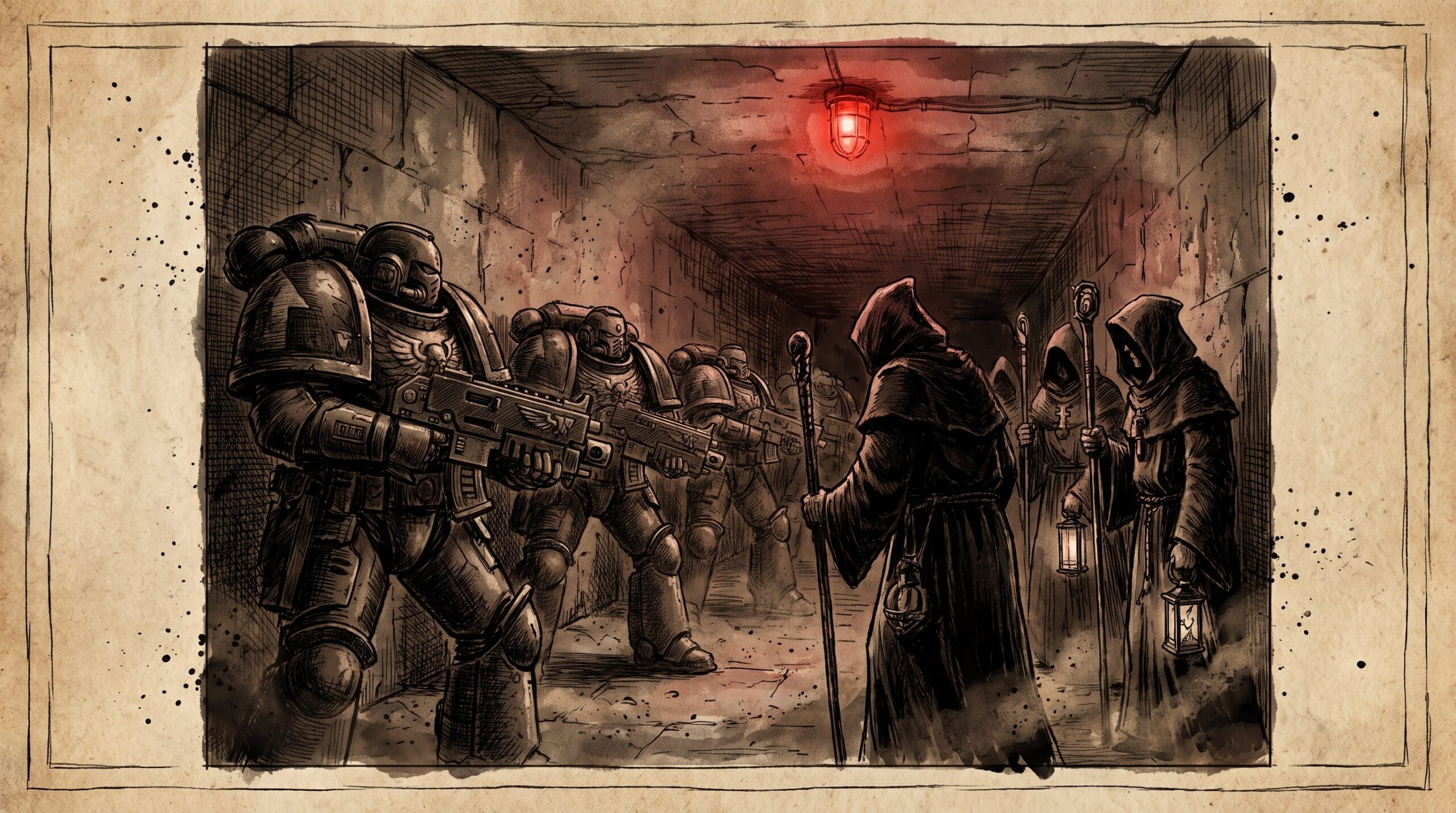
The Months of Shame: When the Inquisition Brought War to Fenris
Armageddon was saved. Then the saviours learned what the Imperium does to those who have looked upon the truth — and a Chapter of the Adeptus Astartes decided it would not stand aside.
There is a shelf in this archive that no acolyte is permitted to dust. The tithe-scrolls upon it record a war that the Imperium insists never happened: not a war against xenos, nor against the Archenemy, but between two arms of the Emperor’s own body. The Grey Knights, who fought in it, gave it a name that is itself a confession. They called it the Months of Shame.
It began, as such things so often do, with a victory.
The First War for Armageddon and the Truth That Followed
In 444.M41 the hive world of Armageddon endured an assault the histories still struggle to encompass: millions of cultists — remembered in fragmentary records as the Children of Sanguinary Unholiness — marshalled beneath the banners of the World Eaters Traitor Legion, and at their head the Daemon Primarch Angron himself, attended by twelve daemonic champions the sagas name the Cruor Praetoria. Against that horror stood the Space Wolves, and over them the Great Wolf Logan Grimnar, who commanded the defence of the world.
When the true nature of the foe was understood, the Inquisition came, and with it a force of Grey Knights — the silent Chapter whose very existence is a secret guarded with murder. Angron was banished. Armageddon held. By any honest reckoning it was a triumph purchased in oceans of blood, much of it mortal blood, spilt by Guardsmen and militia and hive-scum who had no business standing before a Daemon Primarch and stood there anyway.
And that, precisely, was the problem. Millions of Imperial citizens had looked upon daemons. Many had looked upon the Grey Knights.
Ghesmei Kysnaros and the Armageddon Containment
The Inquisitorial task force charged with sealing that wound answered to an Inquisitor Lord named Ghesmei Kysnaros. Of his origins the records are almost comically empty. He was, the archives note, an Unaligned Lord — beholden to none of the great Ordos, filing his reports and logs outside the usual channels, leaving no trail his peers could follow. Rumour within his own retinue whispered that he had risen by way of small crusades and street-level purges; the more sober chroniclers doubt it, for a man does not reach the rank of Lord without centuries of patronage and debt.
What is certain is his mandate. The truth of Chaos, and the truth of the Emperor’s secret weapons against it, could not be allowed to leave Armageddon. Containment, the archives record, was to proceed by several initiatives at once: the suppression of testimony, the sterilisation of the record, the quarantining of a whole world’s survivors — soldiers, priests, labourers, refugees — for processing. Mind-scouring for some. For others, no such mercy.
Read coldly, it was arithmetic. Contain the knowledge on one world and a few million must be dealt with; let it spread and the toll would be reckoned in systems. The Inquisition believed itself the ultimate arbiter of what the Imperium may know, and in strict law it was not wrong.
Grimnar’s Refusal
Logan Grimnar knew the Inquisition’s habits. He had ruled the Chapter of Russ for long enough to know exactly what “processing” meant. Yet he made it plain that he expected the Inquisitors to stay their hand, because of the valour of Armageddon’s defenders — because it seemed to him monstrous to save a world and then butcher its saviours for the crime of having seen what they had been ordered to fight.
Some in the Inquisition judged this naïve. Others judged it a pretext, one more instance of the Wolves’ long, insolent habit of holding Imperial authority in contempt. The archives suggest both readings were entertained at the time, and that neither much mattered. Grimnar meant it. The Space Wolves interposed themselves between the Inquisition and the survivors, and lifted mortals off Armageddon in defiance of a lawful Inquisitorial writ.
From that moment the Imperium had two masters on the same ground, and only one of them could be obeyed.
Blood Between Brothers
What followed is recorded, where it is recorded at all, in euphemism. There were boardings. There were void-actions. There were engagements in which the Emperor’s Angels of Death shed the blood of the Emperor’s Angels of Death, and in which Grey Knights — the Chapter that does not exist — died at the hands of the Sons of Russ. Lexicanum’s compilers note the grim consequence: the Space Wolves know of the Grey Knights, and know because they killed them.
No tally survives that this archivist would trust. What survives is the judgement of the survivors. The Grey Knights did not name this campaign for its battlefields or its dead. They named it for what it did to them. Months of Shame. Frustration, certainly; but the word chosen was not anger. Shame is the word a warrior uses when he cannot decide whether his own cause was righteous.
The Fleet Above Fenris
Kysnaros did not stop at Armageddon. He carried the matter to Fenris itself, bringing a battlefleet into the skies above the Space Wolves’ home world — and with it, an entire Space Marine Chapter mustered to stand in opposition to the Wolves. The reasoning, as Kysnaros himself is recorded to have framed it, was not merely martial: it was to deny the Wolves the moral high ground of their Astartes brotherhood, since another Chapter of that same brotherhood now stood against them. The Grey Knights, he complained, had marched with him out of tenuous loyalty alone, and too few of their number for his liking.
The archives are candid about the price of that gambit. Even had the fleet turned and fled at once, Fenris would never forgive it. To hang guns over a Chapter’s cradle is not a negotiation. It is a promise.
The Eldest, and the Kneeling Lord
And it was upon Fenris, so the sagas relate, that the Wolves produced the argument no Inquisitorial writ could answer: Bjorn the Fell-Handed, last of the Company of Russ, oldest living son of the Emperor’s making, who walked in the Age of the Emperor and fought at the Allfather’s side. The exchange preserved in the chronicles is brief and devastating. Bjorn spoke of having met the Allfather, of having fought beside Him, of believing that He rather liked him — and Ghesmei Kysnaros, Lord of the Inquisition, went slowly to his knees.
Whether that genuflection was faith, awe or calculation, no record settles. The archives whisper that it was all three, and that it broke him.
The Uneasy Truce
In early 445.M41 the matter ended, as most matters ending in Fenrisian company do. Ghesmei Kysnaros died at the hands of Great Wolf Logan Grimnar. The Imperium, which had come within a hair’s breadth of open civil war between the Inquisition and one of the mightiest Chapters of the Adeptus Astartes, stepped back from the precipice and called the result a truce.
It was an uneasy one, and remains so. No penance was performed. No wrong was formally conceded, by either party, for both had been right by their own laws. Armageddon’s people had their reprieve; Armageddon’s secret was kept, more or less, by the older method of simply never speaking of it. The Wolves added another grudge to a long ledger. The Inquisition added another name to its list of Chapters that require watching.
This chronicler records only this: of all the names the Imperium might have given those months — the Fenris Schism, the Armageddon Containment, the Grimnar Sedition — the one that endured came from the warriors who had won. They called it shame. Consider what that tells you about the victory.
Questions from the Archive
What were the Months of Shame in Warhammer 40,000?
The Months of Shame was the internecine conflict fought between the Inquisition and the Space Wolves Chapter in the aftermath of the First War for Armageddon (444.M41). The Inquisition, under Inquisitor Lord Ghesmei Kysnaros, moved to suppress all knowledge of Chaos on Armageddon by processing its survivors; the Space Wolves under Great Wolf Logan Grimnar refused to allow it. The dispute escalated into open fighting that nearly triggered an Imperial civil war, and ended in an uneasy truce in early 445.M41. The name was coined by the Grey Knights, who fought in the campaign and found no honour in it.
Did the Space Wolves really fight the Grey Knights?
Yes. The Grey Knights stood with the Inquisitorial task force, and blood was shed between the two Chapters. Indeed, it is because the Sons of Russ slew Grey Knights that the Space Wolves know the secretive Chapter 666 exists at all — a knowledge most of the Adeptus Astartes are denied, and which the Grey Knights ordinarily protect with telepathic scouring or outright execution.
How did Inquisitor Lord Ghesmei Kysnaros die?
Kysnaros died in early 445.M41 at the hands of Great Wolf Logan Grimnar of the Space Wolves, bringing the confrontation to its close. He was an Unaligned Inquisitor Lord, belonging to none of the established Ordos, and almost nothing of his life before Armageddon survives in the records — a secrecy remarkable even by the standards of the Inquisition.