The Legion of the Damned: Spectres in Bone and Flame, and the Riddle of the Lost Fire Hawks
They come unannounced and unlooked for, wreathed in spectral fury, and battle without a single warcry until the hopeless field is won. Then, as suddenly as they came, they are gone.
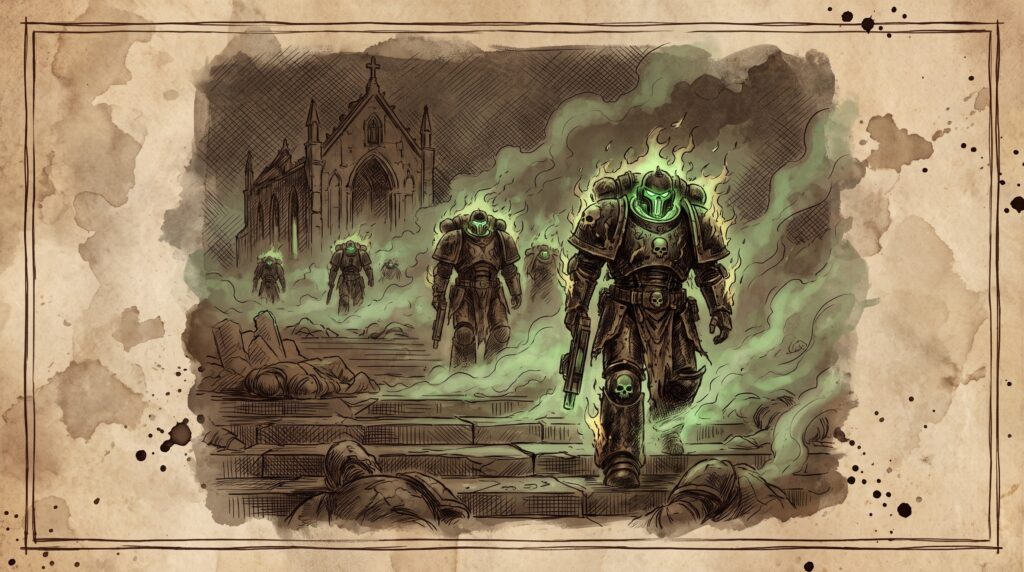
Consider the soldier who has already made his peace with death. His ammunition is spent, the enemy is upon him, and the sagas he half-remembers from the schola offer no deliverance. And then, from nowhere — from a place the archives cannot name — the black-armoured figures descend. Skulls grin from their helms. Bones twist amidst painted flames. They do not shout. They do not answer. They simply kill, and save him, and vanish before he can learn a single name.
The Inquisitors of Terra have amassed dozens of such reports. I have read many of them in the Vault, in hands that shake as they write. Every account agrees on one thing above all: no one knows what these warriors truly are. This is the chronicle of the Legion of the Damned — and of the lost Chapter whose banner may or may not answer the question.
The Warriors Who Come Unannounced
The Apocrypha are exact where so much else is vague. The Legion comes unannounced and unlooked for, upon battlefields where the warriors of Mankind fight without hope against impossible odds. Their aspect is frightening and bizarre — a ghostly apparition from some bygone era or a time yet to come, as the old expansion texts record. They are plated in black, marked with symbols of death and damnation, and they fight in silence, without warcry or battleshout, until the enemy is scattered and the day is saved.
Then they are gone. That is the pattern the Inquisition has traced across a hundred worlds and more: apparition, salvation, disappearance. They leave no dead of their own to examine, no wounded to interrogate, no fortress-monastery to petition. They answer to no Chapter Master the records can find. They are, in the coldest bureaucratic terms of the Administratum, a relief force with no origin.
The Banner of the Fire Hawks
Once, the archives say, they left something behind.
Among the sealed items recovered after one manifestation was a banner — the gnarled chapter flag of the Fire Hawks, a Chapter long counted lost. Inscribed upon it was a motto that has since become inseparable from the Legion’s legend: In dedicato imperatum ultra articulo mortis — for the Emperor, beyond the point of death. With the banner came a recorder and sundry other sealed relics, and all were shipped at once to Terra.
It is from that recorder that the Administratum claims to have determined exactly what befell the lost Chapter. And so the riddle of the Legion of the Damned becomes bound, perhaps forever, to the fate of the Fire Hawks.
The Fate the Recorder Told
The data tells a grim tale. Following a warp-jump, the entire Fire Hawks fleet was caught within a warp-storm of terrific intensity. Stunned by the raw power of the Immaterium, the Chapter was cast adrift. When at last they translated back into normal space, it became obvious within days that they had been exposed to some form of dangerous mutation or disease.
The archives do not spare us the details. Skins began to blacken and blister; flesh began to fester and putrefy. Slowly, the brethren began to die. It took many years to navigate a way back into the Imperium, and during that agonising passage almost half the Chapter succumbed to the malady. Those who remained were no longer sane — pain and despair had driven even their hardened minds beyond the point of rationality.
And here is the detail that chills the marrow. Doomed to agonising deaths, they became obsessed with their fate. They wanted only to die. But they were still Marines, still loyal to the Emperor and to humanity. They would not die uselessly. The records break off there, as such records so often do — but the implication hangs in the air like smoke.
The Theory of the Wandering Dead
The most popular reading, whispered in the scholam halls and echoed in more than one Inquisitorial file, is the simplest: the Legion of the Damned are the Fire Hawks, or what remains of them. A Chapter lost to the Warp, returned in some state between life and death, wandering the void to fight and die for the Emperor beyond the point of death, exactly as their banner swore.
I would caution the newcomer here, as an archivist must. This is a theory. It is a compelling one, and the recovered banner lends it more weight than most, but the Imperium has never confirmed it as certain truth. The honest archivist is careful here: the true origin of the Legion is unknown, and the Fire Hawks link is a matter of Inquisitorial suspicion, not established fact. The banner may be relic, or trophy, or lure. The archives whisper — they do not swear.
The Theories That Deny the Body
Other scholars refuse the wandering-dead explanation entirely, and their alternatives are stranger still.
A few students of the Astartes propose that the Legion is a psychic backlash made real — that events such as the Drop Site Massacre and the deaths of Primarchs scarred the collective psyche of every loyal Legion so deeply that the wound has passed down through hundreds of successor Chapters. By this reasoning, a Chapter’s burning conviction that the guilty must be punished gives the phantoms their physical form, whether the Librarians conjure them by design or by accident.
Radicals within the Librarius go further. They name the Legion a consensual hallucination — a manifestation dreamed into being by Mankind as a whole. The subconscious power of hope, they argue, when combined with the nascent psychic spark that lurks in every human mind and the stimulus of imminent death, can be made real. The uncounted trillions of the Imperium form a vast psychic reservoir; and to a beleaguered species, deliverance and vengeance alike wear the broad silhouette of a Space Marine. By this theory, the doomed soldier who prays for salvation may quite literally be summoning it.
Why the Question Cannot Be Closed
Here is what I believe the deepest truth of the Legion to be, and why the Inquisition has never filed a final answer. Every explanation demands that we accept something monstrous. Either a loyal Chapter still endures in undeath, its agony unended after ten thousand years. Or the grief of the Astartes is so vast it has learned to walk. Or hope itself has become a weapon so potent that the Imperium’s despair conjures armour and bolter from the air.
The secondary chronicles catalogue the contagion that destroys the Legion’s sanity, the decay that grants supernatural strength, the berserker peak that combat is said to unleash. These are secondary accounts, and I record them as such. The canon gives us only the certain things: the silence, the black armour, the death-imagery, the banner, and the recorder that told of a Chapter that would not die uselessly.
Perhaps that is the only honest ending. They come when hope is gone, and they leave a question in place of an answer. In a galaxy this dark, the Emperor’s beyond-the-grave saviours are not permitted to be understood — only witnessed, and survived, and remembered by those who should not have lived to remember them at all.
Questions from the Archive
Are the Legion of the Damned really the Fire Hawks Chapter?
It is the most popular theory, and the recovered Fire Hawks banner and recorder lend it real weight, but the Imperium has never confirmed it as certain truth. The Inquisition has only ever drawn a link between them; the Legion's true origin remains officially unknown. Treat it as a strong suspicion, not settled canon.
Why do the Legion of the Damned fight in silence?
Every recovered account agrees they battle without warcry or battleshout, appearing unannounced and vanishing once the day is won. The archives offer no confirmed reason. They answer no hails and leave no dead to question, which is precisely why their nature has never been established.
Are the Legion of the Damned loyal to the Emperor?
The evidence points strongly to yes. Their banner reads 'for the Emperor beyond the point of death,' and the Fire Hawks records describe brethren who, though driven mad by a warp contagion, remained loyal Marines who refused to die uselessly. They appear only to aid Imperial forces, never to harm them.
Sources and reading
- Rob Sanders, Legion of the Damned, parts one and four — Kersh, the revenant and the defence of the mission house.