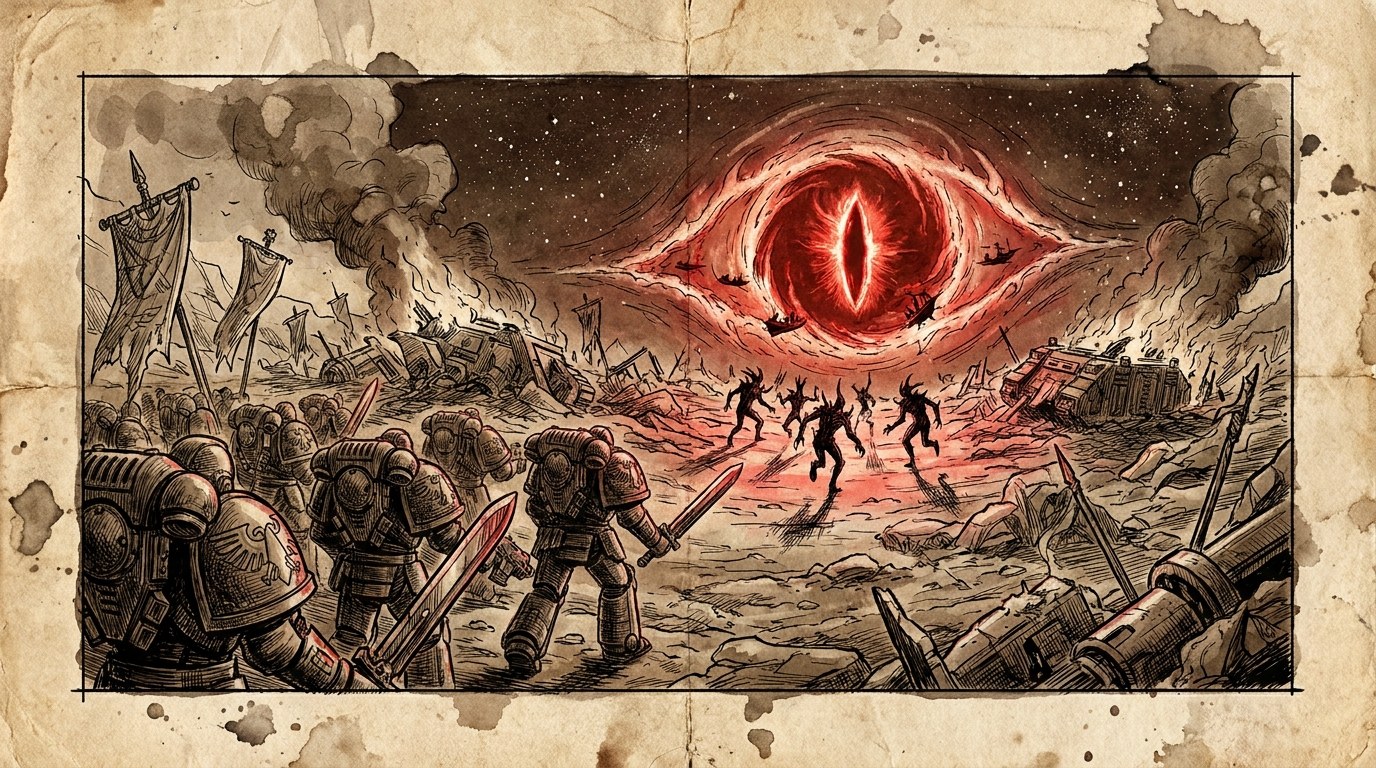
The Great Scouring: Vengeance Unto the Eye
The Warmaster was dead, and grief became wrath. A chronicle of the retribution fleets, the traitors driven into the Eye of Terror, and the breaking of the Legions.
There is a kind of grief that files its teeth. When the guns fell silent over Terra — the Angel dead, the Warmaster unmade, the Emperor broken upon His Throne — the Imperium did not weep. The chronicle of what it did instead is called the Scouring, and it is not a chronicle for the faint. Attend anyway. The age we live in was shaped as much by this vengeance as by the treachery that provoked it.
The Enthronement — Grief Puts On Armour
Begin where the Heresy ended: in the ruin of the Sanctum Imperialis, where Rogal Dorn found the broken bodies of his brother and his father, and — following the Emperor’s final whispered directions — installed the Master of Mankind upon the life-sustaining machinery of the Golden Throne. The records of those first months are a study in how demigods mourn. Dorn brooded amid the rubble of the Palace he had fortified and failed to keep inviolate, his sorrow quick to turn to rage, struggling — the chronicles put it with terrible gentleness — to find one stone large enough to place upon another. Guilliman, his Legion largely unbloodied on Terran soil, filled the vacuum with order: courting the nobility in the banquet halls, drafting the shape of the age to come, shaping — the same chronicles note, with an archivist’s dry suspicion — the propaganda of the next age. And on a Terra that echoed, one account says, with the weeping of a populace left forever in fear of its protectors, one resolve hardened above all others: the traitors would be repaid. By 015.M31 they had been driven from the Sol System entire. A year later, Dorn launched his crusade to scour them from the face of the galaxy.
The Traitors Break and Run
With Horus dead, the thing he had built died with him. The traitor alliance shattered into warring warbands — nine Legions’ worth of the damned, suddenly leaderless, each seizing what ships and plunder it could hold — and they retreated toward the Eye of Terror, that great wound in the veil where their new gods waited, relentlessly hunted across the stars by the vengeful survivors of loyal mankind. But do not imagine a simple rout, reader. In the Heresy’s shadow the traitors had carved out empires, and the chronicles name them like a roll of plague-sores: the Iron Warriors’ empire of fortress worlds; the Word Bearers’ satrapy of enslaved systems; the Night Lords’ carrion realm about Nostramo; the New Mechanicum’s forge-fiefs. Each had to be reduced. The Scouring was not a pursuit. It was the demolition, world by world, of everything treachery had built.
The Retribution Fleets — Forbidden Weapons Unsealed
The records name the year the hammer fell at full weight: in 017.M31 the hosts of the Emperor swept outwards from Terra in vengeful pursuit of the Warmaster’s broken hordes, the first great retribution fleets — composed largely of squadrons from Baal, from Ultramar, from every loyal enclave with ships to send — reaching even the north-eastern fringes where traitor strength ran oldest. And the Black Books record, without flinching, what those fleets carried: a full panoply of weapons once forbidden from use — rad-phages and virus weaponry of terrible potency — unsealed now for kin who had forfeited kinship, alongside battalions of legionaries honed by the fires of heresy to the pinnacle of human skill at arms. Such measures, the record adds with soldierly understatement, were considered barely adequate for the work ahead. The Imperium had learned the Heresy’s ugliest lesson: against brothers, nothing less than everything suffices.
World by World — the Reckoning
The Scouring was not one war but a thousand, and this archive can only gesture at the ledger. In the Nostramo sector the Night Lords, who had fortified their dark domain for nearly a decade and knew no clemency awaited them, met the retribution fleets from behind entrenchments that had to be reduced position by position. The Iron Warriors, besieged in their turn, were forced at last — the records note it with grim satisfaction — to bargain with the same dark powers they had once scorned as fodder, merely to survive the age. And with the sword came the eraser: by decree, all records and memory of the traitor Legions were to be expunged from the Imperial archives, their names struck from monuments, their deeds unwritten; worlds too stained to cleanse — Isstvan V of terrible memory, Davin where the Warmaster fell to shadow — were scoured of all life outright. As an archivist I am obliged to confess my complicity: the blank spaces in my own shelves were cut by that decree, and I have spent lifetimes reading around the scar tissue. It would be as if the traitors had never existed. It is not, of course. Erasure is just memory wearing a hood.
The Iron Cage — Vengeance Meets Its Limit
One battle of the Scouring the chronicles cannot leave alone, for in it the age’s whole character stands revealed. In 019.M31, on Sebastus IV, Perturabo of the Iron Warriors — denied his siege of the Palace by the Warmaster’s fall — built a fortress with no purpose but hatred: the Eternal Fortress, mile upon square mile of bunkers, trenches, minefields and killing grounds arrayed in an eight-pointed star about a command bunker that was, deliberately, worth nothing. It was a trap built for one Legion. Dorn took the bait — he had vowed, the records say, to dig Perturabo out of his hole and bring him back to Terra in an iron cage — and led the Imperial Fists into a maze designed to murder them, some accounts whispering that he half-invited the mauling as penance and proof both, his Legion still resisting the reorganisation Guilliman decreed. For days beyond counting the Fists bled in the works of the Eternal Fortress, until Guilliman’s Ultramarines forced the relief. Neither primarch won. Perturabo withdrew to the Eye with his harvest of loyal gene-seed and was rewarded by his gods with daemonhood; Dorn brought out a hardened remnant that thereafter accepted the Codex and the breaking of his Legion. Mark it well, reader: the Iron Cage is where the Imperium learned that vengeance, pursued to its end, is a fortress with a worthless bunker at the centre.
Guilliman and the Second Founding
On Terra, meanwhile, the future was being drafted. Roboute Guilliman — Master of Macragge, Lord of the Five Hundred Worlds, named in the chronicles of later ages Lord Commander of the Imperium — set his hand to ensuring the Heresy could never happen twice. His edict of the Second Founding rendered the Legions down into Chapters: a thousand battle-brothers each, no more — a thousand small blades where once there had been twenty swords, so that no single warlord could ever again hold a blade to mankind’s throat. The treatise of war he had penned in the Crusade’s years became the pattern of the new age, the codex by which the Adeptus Astartes lives still. And let the record hold the bitterness alongside the wisdom, for the Black Books preserve both: veterans returning from long crusades found the Legion they once knew no longer existed, replaced — their own words — by a bastard creation of necessity. Among the Ultramarines themselves, the so-called Unmarked of Calth were quietly assigned away from their brethren until the Founding renamed them; even a cleansed traitor flagship, the Chronicle of Ashes, was tech-exorcised and handed in 022.M31 to a Chapter newly named Nemesis. The old world was not reformed, reader. It was dismantled, catalogued, and reissued — and the men who had bled for it were expected to salute the inventory.
Theogranth — the Last Battle of the Legions
The chronicles close the age with a small, terrible coda. In 087.M31 — the Scouring long won, the Legions long since Chapters — the White Scars Brotherhood of the Blue Hawk came home at last from decades charting the southern rim for a Crusade that no longer existed, one hundred and thirty-two warriors emerging from the Warp at the remote way-station of Theogranth. Waiting for them were renegade warbands of the scattered Alpha Legion, come to pillage supplies. The Brotherhood prevailed, at the cost of most of its strength — twenty-eight riders lived to reach Chogoris, there to learn of the Heresy entire, the crippling of the Imperium, and the vanishing of their own primarch — and the annalists mark that skirmish as the last battle of the Legiones Astartes: the final stroke of the Horus Heresy, the last betrayal of brother against brother, fought by men who had set out at the height of the Imperium and returned to find it crushed. I defy any reader to find, in ten thousand years of records, a lonelier homecoming.
From Wrath to Watchfulness
And then the wrath ran out of road. Vengeance pursued the traitors into the very Eye of Terror — where time itself, the savants attest, abandons the damned — and there it stopped, because even vengeance must garrison what it holds, and no fleet returns from the Eye. The later annalists still argue what the ending truly was: whether the traitors were cast down and caged, or whether they chose their sanctuary and wait there, unaged and unforgiven, serving the galaxy’s longest sentence with the patience of the damned. Both readings are true enough to keep a chronicler awake. The Imperium turned from wrath to watchfulness — fortress-worlds raised about the Eye’s mouth, a vigil set that would hold ten thousand years and be named Cadia — and has never since been permitted to turn away. The Eye does not close. Neither, now, do we.
Thus the Scouring: seven years of fire, a century of embers, and a watch without end. The Imperium calls it victory, and I will allow the word — but write this in the margin, reader, where honest history lives: it was the kind of victory that must be stood guard over forever, and we are standing guard still.
Questions from the Archive
What was the Great Scouring?
The Great Scouring was the Imperium’s campaign of retribution after the Horus Heresy. With the Warmaster dead, the traitor alliance shattered into warring warbands, and the loyalist Legions hunted them from Terra’s gates across the galaxy — the records tell of retribution fleets sweeping outward from 017.M31 — until the traitors were driven into the Eye of Terror.
How long did the Great Scouring last?
The core campaigns ran from roughly 015.M31, when the traitors were driven from the Sol System, to 021.M31 — some seven years of galaxy-wide war — but the chronicles record fighting against traitor holdouts continuing for more than a century afterwards. The last battle of the old Legions was fought as late as 087.M31.
What was the Battle of the Iron Cage?
The Iron Cage was the great grudge-battle of the Scouring, fought in 019.M31 on Sebastus IV, where Perturabo built his ‘Eternal Fortress’ — square mile upon square mile of trap-works around a worthless decoy bunker — to bleed the Imperial Fists. Dorn had vowed to drag his brother back to Terra in an iron cage; instead his Legion was mauled in the maze until Guilliman’s Ultramarines relieved them, and Perturabo was rewarded by his dark gods with daemonhood.
What was the Second Founding?
The Second Founding was Roboute Guilliman’s edict that rendered the old Space Marine Legions down into smaller Chapters, each a thousand strong, so that no single commander could ever again wield a Legion’s power. The Black Books record how bitterly some returning loyalists took it — finding the Legion they had left ‘replaced by a bastard creation of necessity’.
When was the last battle of the Legiones Astartes?
The Forgeworld chronicles record it in 087.M31, when the White Scars Brotherhood of the Blue Hawk, returning at last from a decades-long crusade in the southern rim, was ambushed at the way-station of Theogranth by renegade warbands of the scattered Alpha Legion — the final betrayal of brother against brother, fought after every other Legion had already been broken into Chapters.