The Great Rift: Half an Imperium Lost Beyond the Storm
When Cadia's pylons died, reality tore from the Eye of Terror to the galaxy's edge. A chronicle of the Cicatrix Maledictum, the Blackness, and the Dark Imperium beyond it.
Every map of the Imperium in my scriptorium is now a lie. Ten thousand years of careful cartography, rendered obsolete in a single scream — for when Cadia’s pylons died, the wound they had held closed for ten millennia tore open across the whole breadth of the galaxy. This is the chronicle of the Great Rift: what it is, what it did in its first terrible days, and what it means to live — as every soul now living does — in a galaxy cut in half.
The Wound Opens
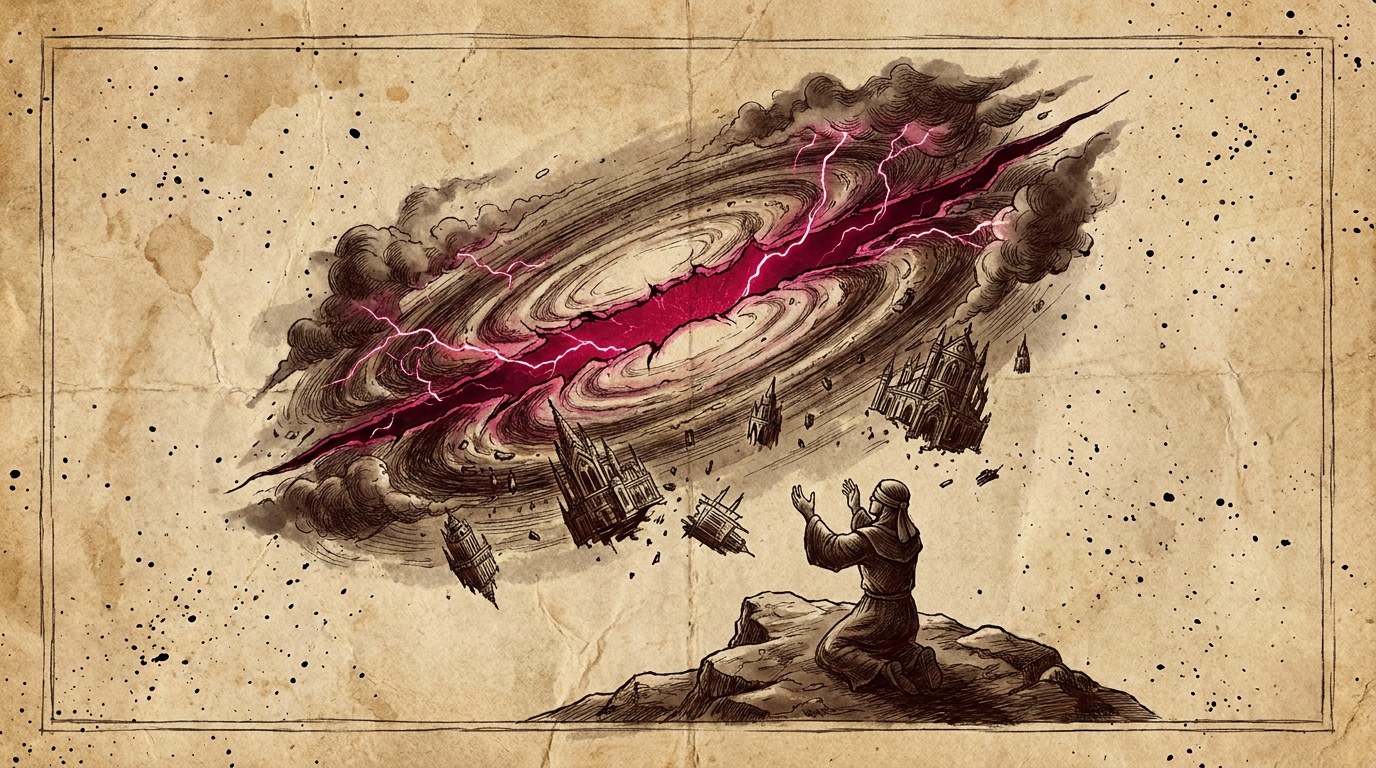
It has many names in many records: the Great Rift, the Crimson Path, the Mouth of Ruin. The High Gothic of the savants names it Cicatrix Maledictum — the accursed scar — and for once the savants’ poetry is equal to the thing itself. When the pylon-cage of Cadia failed, the Eye of Terror did not merely widen; it reached. Warp-storm chained to warp-storm across the void, old wounds in reality tearing open to join the new, until a continuous storm-front of the empyrean bleeding into real space ran from the Eye in the galactic north-west to the Hadex Anomaly in the far east — a scar across creation wide enough to swallow sectors whole. The savants still argue whether the Rift was cause or consequence: whether Cadia’s fall opened it, or merely opened the door to something the Ruinous Powers had spent ten millennia preparing. The Despoiler’s thirteen crusades argue for preparation. I record the debate and decline to settle it; from beneath the scar, the distinction is academic.
The Anatomy of the Scar
Understand what the Rift is, for it is not merely a storm. Along its whole burning length, the veil between reality and the Warp is torn: daemons pour into real space unbidden, needing no summons and no psyker’s failing; worlds close to its path vanished outright in the first convulsions, or were remade into things the archives refuse to describe and the cartographers mark only as lost. Near the scar, the laws that make navigation, chronology and sanity possible all run soft. And of all its corruptions, time’s is the cruellest to a chronicler: the Rift’s opening broke the consistency of hours themselves, so that the same event is dated differently on worlds a system apart, and this archive must carry contradictory records that are each, locally, true. I ask the reader’s patience with the pages that follow. History is written in time, and time in this age has a wound in it.
The Noctis Aeterna — When the Emperor’s Light Went Out
Worse followed the tearing. As the Rift opened, the light of the Astronomican — the psychic beacon by which every Navigator steers, the fixed star of mankind’s whole civilisation — guttered and, across vast swathes of the galaxy, went dark. The archives name what followed the Noctis Aeterna: the Blackness, the Days of Blinding. No astropathic word — the choirs struck dead or mad at their stations in the moment of the tearing. No Navigator’s star. Every world alone in the dark with whatever the Rift had let in. And the Warp’s mockery of time turned even the darkness inconsistent: on Terra the Blackness is recorded at roughly a solar month; the accounts from Baal, half a galaxy away, speak of a single terrible day or two; between and beyond, worlds endured months or years — and there are worlds, the fearful records hint, where it has not ended yet. Mankind had known such a silence once before, reader. We named it Old Night, and it nearly killed us when we were a younger and hardier species. This time the silence fell on an Imperium already bleeding from every border of the Time of Ending — and it fell everywhere at once.
Terra in the Days of Blinding
Of all the Blackness’s chronicles, none is stranger to write than the Throneworld’s own. For the first time in ten millennia, daemons walked upon Terra: with the Astronomican convulsed and the veil thinned, incursion broke into the Palace precincts themselves — the records speak of the Lion’s Gate contested by things with no place in real space, of the Sisters of Silence recalled from their long dispersal, and of the hour the Adeptus Custodes, the Ten Thousand, marched in force beyond the Palace walls to war for the first time in living record. The shock of it can be read in everything the Throneworld did afterwards: doctrines a hundred centuries old were broken in a season; the Emperor’s own praetorians accepted that the walls they guarded now included the whole galaxy. When the chronicle of this age is finally bound, I suspect that hour — not any battle of fleets — will mark where the old Imperium ended: the moment the untouchable centre learned that nowhere, any longer, is far from the war.
Imperium Sanctus, Imperium Nihilus
When the Astronomican struggled back to strength, the galaxy it revealed was a divided one. Sunward of the Rift lies the Imperium Sanctus — the ‘blessed’ half, blessed only by comparison, where Terra’s light still reaches, and where the resurrected primarch Roboute Guilliman was even then marshalling the counter-offensive that would become the Indomitus Crusade. Beyond the storm lies the other half: the Imperium Nihilus, the Dark Imperium — most of the Segmentum Obscurus and Ultima, half of mankind’s realm, cut off from Terra’s light and Terra’s aid alike. Between them, the crossings: a few comparatively stable channels through the storm-front, chief among them the Nachmund Gauntlet, a haunted corridor hard by the Eye itself, its passage stalked by empyric phantasms and wolf-pack raiders; lesser gaps open between the storm-belts without warning and sweep shut, the records say, like a monster’s jaws on those desperate enough to dare them. Every stable crossing has become a campaign in its own right — for whoever holds the doors between the halves of the Imperium holds the age by the throat.
Life Beyond the Rift
And in Nihilus? The chronicles that cross the storm come years late or not at all, and every one is a small miracle of survival. They tell of worlds that fight on with no reinforcement, no guidance, and no certainty Terra still stands — holding by faith, stubbornness, and whatever garrison the Blackness caught upon them. They tell of daemon-tides and xenos harvests, of hive worlds turned fortress-states rationing hope as strictly as water, of Astartes Chapters ruling war-fiefs alone for want of any command to answer to. In time — the chronicle of the Devastation of Baal and what followed belongs to its own page — the Lord Commander would cross the storm himself and set a regent over the dark half: Dante of the Blood Angels, oldest and most grimly proven of the Chapter Masters, charged with a realm larger than the old Segmentum commands and darker than any of them. But no regent can be everywhere in a realm without light. The truest record of Imperium Nihilus is statistical, and it shames the pen: some of its worlds, it must be assumed, still fight for an Imperium they have not heard from in a century. Some, it must equally be assumed, have stopped. The dark half’s roll-call cannot be taken. That silence is the Rift’s most complete victory.
The New Reckoning of Time
One administrative fact, dry as dust and heavier than worlds, completes this chronicle. The Imperial dating system — the great em-forty-one by which ten millennia of these archives are ordered — had grown ragged with error across the centuries; the scribes of the Ordo Chronos, who once policed it, vanished from history with fitting irony some millennia past. After the Rift, the Lord Commander ordered a new reckoning, and its epoch is not the Emperor’s ascension. The new chronicles count from the Rift itself. Think on what that means, reader, for it is the whole age in a single clerical decision: the galaxy now numbers its years from the day it broke. Every date I write hereafter is, in its bones, a measurement of distance from this wound.
Thus the Cicatrix Maledictum: the Long War’s masterstroke, Old Night’s return engagement, the scar that will define every chronicle this scriptorium binds for centuries to come. And yet — write this in the margin, and write it stubbornly — the wound is not the whole of the body. Half an Imperium was lost beyond the storm, and the other half’s answer was not despair but the greatest muster since the Heresy. That chronicle stands next on the shelf, and for once, reader, the next page is the brighter one.
Questions from the Archive
What is the Great Rift in Warhammer 40k?
The Great Rift — the Cicatrix Maledictum in High Gothic — is a galaxy-spanning tear in reality that opened after the Fall of Cadia in 999.M41, stretching from the Eye of Terror to the Hadex Anomaly. It cleaved the Imperium in two: the Imperium Sanctus, still lit by the Astronomican, and the Imperium Nihilus beyond the storm.
What was the Noctis Aeterna?
The Noctis Aeterna — ‘the Blackness’ — was the period immediately after the Rift opened, when the light of the Astronomican was blotted out and astropathic communication failed across the galaxy. Because the Rift distorts time itself, it lasted days on some worlds and months or years on others; on some benighted worlds, records suggest it has never truly ended.
How long did the Noctis Aeterna last?
There is no single answer, for the Rift’s opening broke time’s consistency along with everything else. On Terra the records count the Blackness at roughly a solar month; the accounts from Baal speak of only a day or two; other worlds endured months, years, or — the darkest reports insist — endure it still. Even after the Blackness lifted, the Astronomican remained dim and unreliable across the Imperium Nihilus.
What is the Imperium Nihilus?
The Imperium Nihilus, or Dark Imperium, is the half of the Imperium cut off beyond the Great Rift — most of the Segmentum Obscurus and Segmentum Ultima. With the Astronomican obscured and only a handful of perilous passages such as the Nachmund Gauntlet crossing the storm, its worlds fight on largely alone; Roboute Guilliman later named the Blood Angels’ Commander Dante its Regent.
Can ships cross the Great Rift?
Barely, and at terrible risk. Only a few comparatively stable channels pierce the storm-front — the chronicle names the Nachmund Gauntlet chief among them, a haunted corridor near the Eye of Terror — while lesser passages open and snap shut like a predator’s jaws. Every stable crossing has become a war zone in its own right, contested by every power that understands its worth.