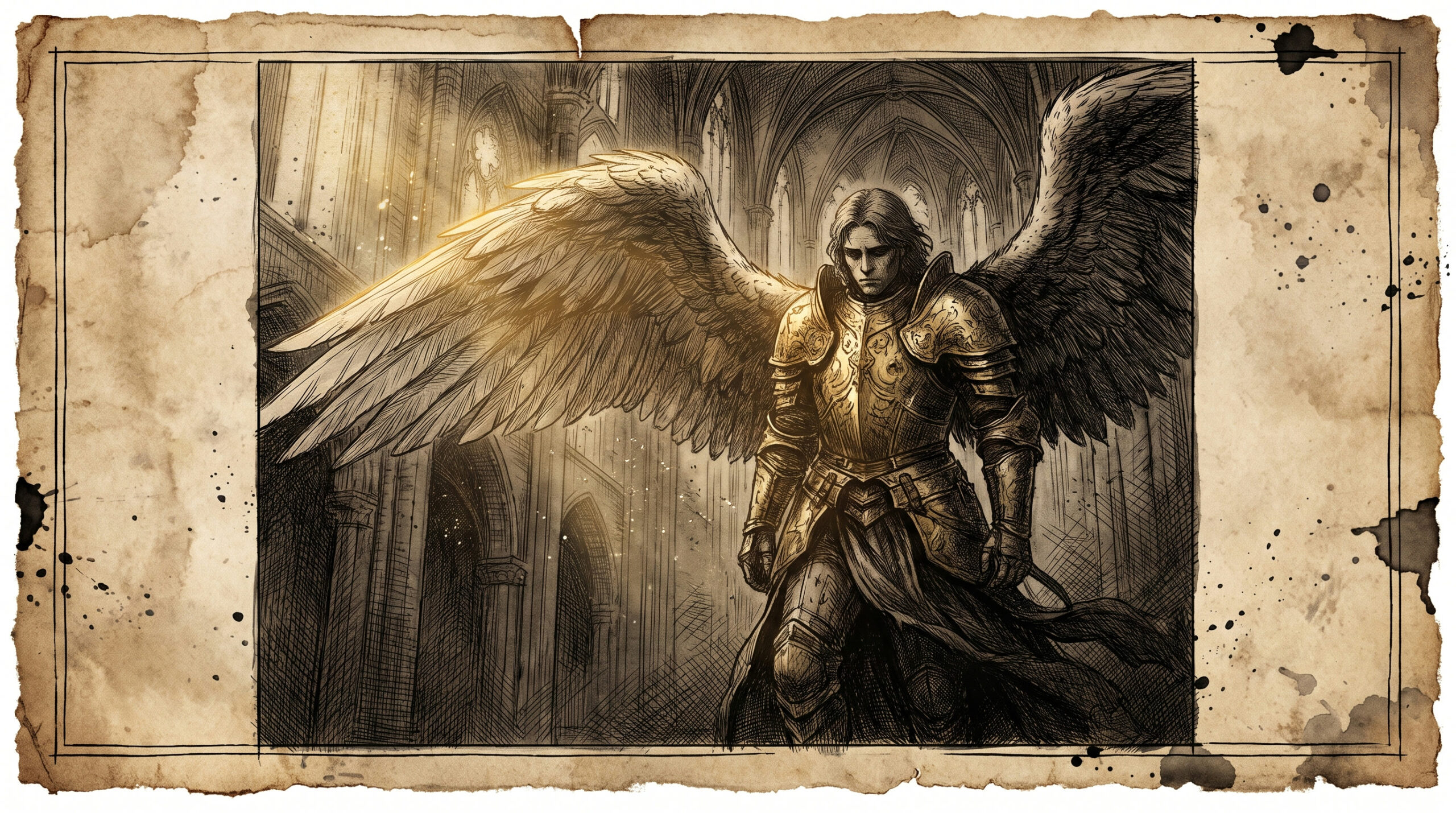
The Angel’s Burden: How Sanguinius Felt About His Wings
Among twenty sons, only one was born with wings — and the Angel could never be certain whether they were his father's gift or the Ruinous Powers' brand upon his soul.
Ask the archives what made Sanguinius beloved above all his brothers, and they answer with a single word: wings. No other primarch bore them. No other primarch soared. Yet the sagas that survive the fire whisper a stranger truth — that the very feature which made the Angel a symbol of hope was also the seed of his deepest and most private torment. He loved his wings. He feared them. And, so far as the records tell, he never once learned what they truly were.
The Only True Freak Among Twenty Sons
The chronicles are blunt where they might have been kind. His wings were a teratology, reads one account of the Angel’s inner thoughts. The simple fact of Sanguinius’ wings was that among all the primarchs, he was the only true freak. It is a word that startles, coming from a being so venerated — but it was the Angel’s own judgement upon himself, not another’s slander.
Consider the company he kept. Nineteen brothers, each a masterwork of the Emperor’s craft, each shaped in the image of a perfected man. And then Sanguinius, alone, with two great pinions of flesh and feather rising from his back. He was the exception in a brotherhood of paragons, and he knew it. The archives suggest that this singularity weighed upon him in ways his flawless features never betrayed to those who worshipped him.
Gift of the Emperor or Blight of Chaos?
Here lies the heart of the Angel’s unease. Exactly how he was able to fly, the records admit, would have been impossible to determine without dissection — and his father never spoke with him about his wings. Not once. That silence became a wound.
Sanguinius had often wondered, the sagas say, whether the wings were part of the Emperor’s design, or whether they were the outward sign of Chaos’ blight upon his soul. It is no small thing for a primarch to doubt his own origin. If the Emperor had wrought them, then Sanguinius assumed a musculature of the most inspired design had been woven into his body — for the wings were broad, and strong, and glorious to look upon. But the Master of Mankind never confirmed it, and into that void the Angel poured his fears.
The Whispers of the Ruinous Powers
The servants of the Dark Gods were not slow to seize upon so tender a doubt. They intimated to him that his wings were their mark — that the flesh he bore aloft was proof of corruption already rooted in his being. It was a lie crafted with cruel precision, aimed at the one uncertainty the Angel could never resolve for himself.
The records preserve his answer. Wheeling through Terra’s tortured heavens in the final days, his words torn from his mouth by the wind of his own passage, Sanguinius said through gritted teeth: ‘They lie.’ Three words, spoken against the roar of the sky. Whether he believed them wholly, or spoke them as much to himself as to his tormentors, the chronicles do not say. But he refused the whisper. That refusal, perhaps, was the truest measure of the Angel.
Love Despite the Fear
For all the doubt, the archives are clear on one point above all others: he loved them. His wings had been his flesh and blood since birth, and though a fragment of him feared the truth of their provenance, the entirety of him loved them. That is the paradox at the centre of Sanguinius — a being who could hold terror and devotion in the same breath, for the same feature, without either consuming the other.
He found peace in them, too. The sagas recall his lonely flights through the skies of Macragge during the dark years of Imperium Secundus, when he soared alone above the fortress-world and turned the great questions over in his mind. To fly was, it seems, both his burden and his solace.
The Wings That Stayed the Hands of Baal
Much good had come of them, the Angel reminded himself, and the archives bear him out. When he fell to the irradiated wastes of Baal Secundus, among tribes who hunted and slew mutants without mercy, it was his wings — deemed so beauteous — that stayed their hands. The very feature he feared to be a mark of corruption spared him from a people who abhorred corruption above all things. There is a bitter symmetry in that, and Sanguinius seems to have grasped it.
More still, he entertained a stranger consolation. Perhaps, he thought, it was the very fear of the corruption his wings represented that prevented him from becoming corrupted — that his constant vigilance, born of doubt, was itself the armour that kept the darkness out. Tested on Signus Prime and tested again on Macragge, the Angel came to suspect that his greatest vulnerability was also, somehow, his shield.
A Symbol Beyond the Angel Himself
Whatever Sanguinius believed in his private heart, to those who followed him the wings meant only one thing: hope made manifest. The archives whisper that in the Warp’s long shadow, his winged image would rise again and again — a reminder, to the fallen, of noble beginnings abandoned; a spear of accusation to the wicked. In visions granted to the desperate, the feathers of his wings were said to scream through the air, each one sounding a different judgement upon those who had strayed.
His sons carry the symbol still. The Blood Angels and their kin bear the Angel’s iconography into the darkness of the 41st Millennium, and the Sanguinary Guard descend from the heavens on jets of flame, wearing wrought wings in memory of the primarch who truly flew. Sanguinius may never have learned what his wings were. But the Imperium learned what they came to mean — and that meaning outlived the Angel by ten thousand years.
So we are left with the Angel’s own unfinished question, one his father never answered and death sealed forever. Gift or blight? Design or corruption? The archives offer no verdict, only the Angel’s defiance against the lie. And perhaps that is the only answer that ever mattered.
Questions from the Archive
Did Sanguinius know where his wings came from?
No. According to the chronicles, the Emperor never spoke with Sanguinius about his wings, and their true origin could not have been determined without dissection. The Angel wondered all his life whether they were part of the Emperor's design or a mark of Chaos, but he never received a certain answer.
Were Sanguinius' wings a sign of Chaos corruption?
The servants of the Ruinous Powers claimed they were, hoping to exploit the Angel's doubt. Sanguinius rejected this, declaring plainly, 'They lie.' The archives never confirm the wings as corruption — indeed, the Angel suspected that his very fear of corruption was what kept him pure.
Why was Sanguinius the only primarch with wings?
The records call him 'the only true freak' among the twenty primarchs — the sole brother born with wings. Why this was so is never explained; the Emperor's designs remained his own secret. Yet the wings became central to the Angel's legend and to the iconography of his sons, the Blood Angels.