The Age of Apostasy: Vandire’s Reign of Blood
One man held both throne and pulpit — and drowned ten thousand worlds in righteous blood. A chronicle of Goge Vandire, Sebastian Thor, and the birth of the Sisters of Battle.
Beware the man who tells you he speaks for the Emperor. I have catalogued ten millennia of horrors, and the worst of them did not come through the Eye of Terror. It sat on a throne on Terra, wearing the robes of the faithful, and it signed death warrants by the world. This is the chronicle of the Age of Apostasy: how the church the Emperor never wanted grew mighty enough to devour the state, what it cost to wrench the two apart again — and what was born, armoured and candle-lit, from the wreckage.
The Church Ascendant — Power Without Check
To understand Vandire you must first understand the throne he climbed to reach his second one. By the Thirty-Fifth Millennium’s close, the Ecclesiarchy had grown into something no drafter of the Decree that founded it would have recognised. Its cathedral-palace sprawled across a continent of Terra; its tithes rivalled the Administratum’s own; its word, on ten thousand worlds, outranked the Governor’s. The Ministorum had begun, the records say plainly, to dictate policy to the High Lords of Terra themselves. And the rot ran downward as well as up. The Schola Progenium — raised to shelter the orphans of Imperial servants — had in that age become a harvest: progena sold as labour and worse, the ablest culled into the church’s private armies, the Frateris Templar, swelling a military no law had ever sanctioned. Wealth without audit, arms without oversight, and the Emperor’s own name as licence. The Age of Apostasy was not an accident, reader. It was an architecture, waiting for its tyrant.
Goge Vandire — High Lord and Ecclesiarch Both
He arrived punctually. Goge Vandire, three hundred and sixty-first High Lord of the Administratum, was a man of genuine brilliance and bottomless appetite — the most dangerous combination this archive knows. The records trace the method: Vandire engineered the elevation of a degenerate cleric, Paulis the Third, to the Ecclesiarch’s throne, let the man’s excesses ripen into scandal, then toppled him and assumed the office himself — retaining, in defiance of all precedent and sanity, his High Lordship too. For the first and only time in Imperial history, one man held both the quill and the pulpit: the whole apparatus of state and the whole machinery of faith, in a single grasping fist. The other High Lords, who might have stopped it, discovered too late that every instrument of stopping it now reported to Vandire.
The Reign of Blood
What followed, the archives name the Reign of Blood, and even their driest ledgers read like scripture of damnation. Worlds that questioned a tithe were declared apostate and given to the torch. The Purge of Lastrati slaughtered billions at the hands of Vandire’s so-called Divine Army; on Jhanna, when the hive cities defied him, he had the ice caps melted and drowned them entire — the tallies of the dead vary between chronicles only in which billions they count. The Frateris Templar marched wherever his paranoia pointed. His death lists grew long enough to constitute a literature of their own — I have shelved excerpts, and the hand of the copyists shakes worse with every volume. And every atrocity — this is the part I require you not to look away from — was performed in the Emperor’s name, beneath His aquila, to the sound of His hymns. The Imperium had survived the enemy without and the traitor within. Vandire taught it a third terror: the believer above.
The Brides of the Emperor
Vandire’s cleverest theft was not gold but devotion. Word reached him of a warrior cult on the far agri-world of San Leor: the Daughters of the Emperor, an all-female order who venerated the Master of Mankind with a purity the Ecclesiarchy’s marble had long forgotten. Vandire went to them in person. When they declined his authority — they served the Emperor, not His self-appointed voice — he staged his miracle: he ordered a soldier of his own retinue to shoot him where he stood, and the hidden field of his rosarius, of which no witness knew, turned the blast harmlessly aside. To the Daughters it was the Emperor’s own judgement made visible. They swore themselves to Vandire on the spot. He renamed them the Brides of the Emperor, and set them about his person — the finest faith of the age chained to its foulest man, and no assassin in the galaxy able to pass them. The archives have preserved many lessons at great cost, reader; here is one of the dearest: a miracle is not evidence. It is theatre with the lights left on.
Sebastian Thor and the Confessor’s War
The Emperor answers, in His way. The answer’s name was Sebastian Thor: a preacher of no rank and no army, from the unremarkable world of Dimmamar, whose sermons said the simple, unsayable thing — that Vandire had betrayed everything the Creed held holy, and that faith owed tyranny nothing. His Confederation of Light spread from world to world faster than the death lists could keep pace. Vandire, incandescent, despatched a war-fleet to erase one preacher; the chronicles record that the Warp itself seemed to refuse the errand, storm and mutiny swallowing the fleet — and news of the ‘miracle’ made Thor’s cause a flood. Sector by sector, the Imperium fell into open civil war between the Temple and the Light. And the iron institutions turned at last. In three hundred and seventy-eight, em thirty-six, a strike force of Space Marines — the Imperial Fists among them, with the Black Templars, the Fire Hawks and the Soul Drinkers, and the forges of the Adeptus Mechanicus beside them — fell upon the Ecclesiarchal Palace on Terra. But the palace’s last ring was the Brides, and no loyal blade wished to cut down faith deceived. It was the Adeptus Custodes who ended it — without ending anyone at all.
The Judgement of the Golden Throne
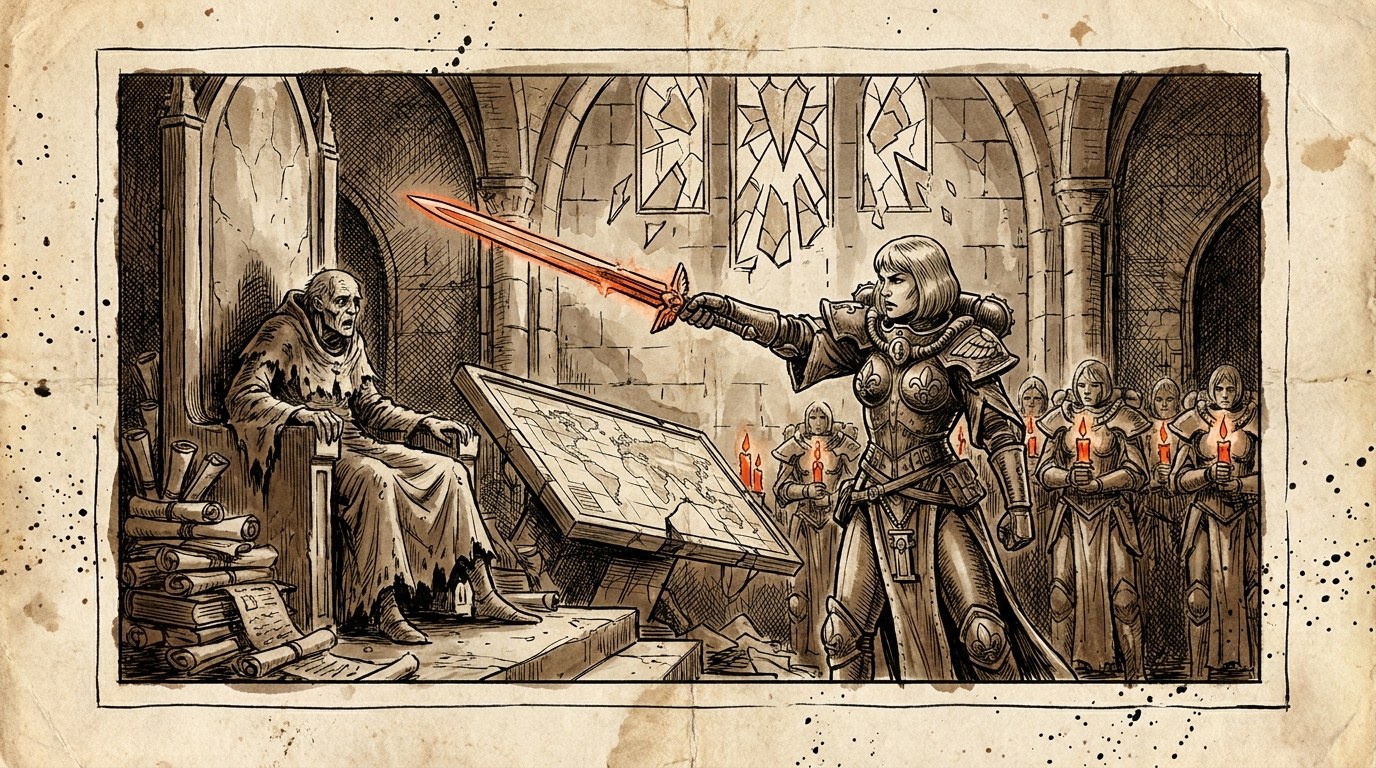
What the Custodes did next is, to my mind, the most remarkable act of restraint in the age’s whole blood-soaked ledger. They came to the Brides not with weapons but with an invitation: they led Alicia Dominica, first among the Brides, with her chosen sisters, down into the Sanctum Imperialis — before the Golden Throne itself. What was said or shown to her in that room, no archive holds; she and her companions were sworn to eternal secrecy, and kept it to their graves. The record resumes only when she walks out. Dominica returned to Vandire’s audience chamber, where the tyrant — his empire collapsing, his scribes fled — was still raving orders at maps of worlds he no longer ruled. She listened. The accounts say he lectured her, to the last, on his own indispensability. Then she pronounced his crimes and his sentence in the same breath, and took his head where he sat. Thus ended the Reign of Blood: not by fleet or Legion, but by one deceived believer shown the truth and permitted to judge. There are nights I find that comforting, reader. There are nights I do not.
The Decree Passive and the Birth of the Sororitas
In the reforms that followed, the church was broken to heel. Sebastian Thor — dragged, by every account protesting, to the Ecclesiarch’s throne he had never sought — dismantled the machinery of abuse: the Ministorum’s fleets and armies dissolved, its finances audited, its power fenced with law. Chief among the fences stood the Decree Passive: never again would the Ecclesiarchy maintain men under arms. And in that careful wording lies one of history’s sharpest ironies — for the Daughters of the Emperor, renamed no more for any man, were no men. Reconstituted as the Adepta Sororitas, the Sisters of Battle became the church’s shield and its watchers both: a militant sisterhood, armoured in faith that had been deceived once and would never be deceived again, sworn to see that no Vandire ever rises twice. Their orders bear the names of that judgement’s witnesses; their war-hymns remember San Leor; and every candle in their chapels is, if you know how to read it, a small vigilant flame against the ambition of priests.
After the Blood — the Long Convulsion
Vandire’s head did not end the age; wounds of that depth close slowly. The chronicles of the decades that followed record schism upon schism as the reformed Temple fought its own shadow — apostate cardinals who preferred the old appetites, chief among them the arch-heretic Bucharis, whose so-called Plague of Unbelief carved a rebel empire from the Imperium’s flank before it was broken. Thor himself spent a long life visiting order upon diocese after diocese, and died revered as the greatest saint of the age he had saved. And the Imperium, in its slow tectonic way, absorbed the lesson into structure: church and state lashed into mutual restraint, the Sisters standing guard along the seam. The arrangement has held, more or less, for four thousand years. In this archive, ‘more or less’ is high praise.
Remember the Age of Apostasy when the preachers grow too loud. The Imperium’s records call Vandire a traitor and a madman, and he was both. But he was also, first, a servant who was trusted — and every ledger of his crimes opens with pages of his competence. That is how it always begins, reader: not with a monster, but with a man no one thought needed watching.
Questions from the Archive
What was the Age of Apostasy?
The Age of Apostasy was a period of civil war and religious schism that consumed the Imperium in the 36th Millennium, at its height when High Lord Goge Vandire seized control of both the Administratum and the Ecclesiarchy and unleashed the Reign of Blood — a tyranny that slaughtered billions in the Emperor’s name.
When was the Age of Apostasy?
Its roots run through the late 35th Millennium, as the Ecclesiarchy’s power swelled beyond all check, and it broke upon the Imperium in the early-to-mid 36th — the chronicles record the Space Marine assault on Vandire’s palace in 378.M36. Even after Vandire’s death the age’s convulsions continued for generations, through schisms and apostate wars such as the Plague of Unbelief.
Who ended Goge Vandire’s Reign of Blood?
The preacher Sebastian Thor and his Confederation of Light raised the Imperium against Vandire, while a strike force of Space Marines — the chronicles name the Imperial Fists, Black Templars, Fire Hawks and Soul Drinkers, with the Adeptus Mechanicus — besieged his palace on Terra. Vandire was finally executed by Alicia Dominica, leader of his own bodyguard, after the Adeptus Custodes brought her before the Golden Throne and she learned the truth of his treachery.
How were the Adepta Sororitas founded?
Vandire had recruited an all-female warrior cult from the world of San Leor — the Daughters of the Emperor — as his personal bodyguard, renaming them the Brides of the Emperor. When they learned the truth and executed him, they were reconstituted under the Ecclesiarchy’s reforms as the Adepta Sororitas, the Sisters of Battle.
What was the Decree Passive?
The Decree Passive was the great reform law that followed the Reign of Blood: the Ecclesiarchy was forbidden ever again to maintain ‘men under arms’. Its careful wording is the famous loophole through which the Sisters of Battle march — the Daughters of the Emperor were no men — giving the church a shield while denying it an army of the kind Vandire had turned upon the Imperium.