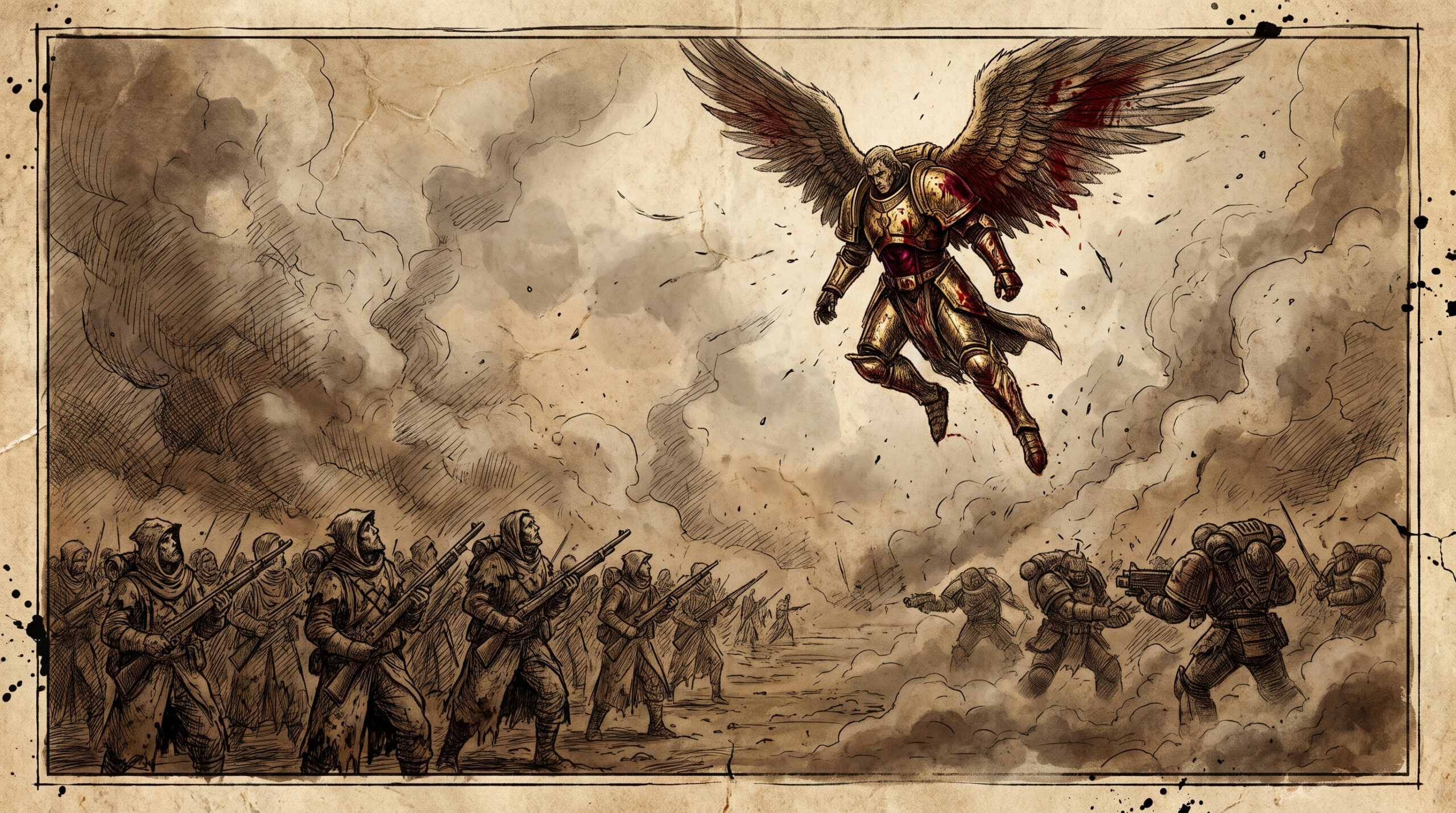
Teghar Pentarus: The Battle That Named the Blood Angels
Before Baal was a shrine and before the Angel had a Legion worth the name, there was a nameless world of dust and gunfire — and a host of grey warriors who looked up and saw wings.
There are worlds the Imperium remembers for their harvests, and worlds it remembers for their martyrs. Teghar Pentarus is remembered for neither. No pilgrim fleet burns fuel to reach it. No cardinal has raised a basilica upon its plains. Its entry in the older compliance ledgers is brief to the point of insult — a designation, a date, a tally of the dead — and yet the archives whisper that the whole subsequent character of the IX Legion was forged there, in a single planetary campaign, beneath a sky that no remembrancer thought worth painting.
What follows is drawn from fragmentary sources, and I set it down with the caution such fragments demand. The chroniclers of the Ninth were never a modest brotherhood, and their earliest records were written long after the events they describe, by men who had already begun to worship the subject of their tale. Where the sagas and the sober ledgers disagree, I shall say so.
The Revenant Legion Before the Angel
To understand Teghar Pentarus, one must first understand what the IX Legion was before it had a father. In their earliest days they were not called Blood Angels at all. The oldest surviving citations name them the Revenant Legion — a title that speaks less of beauty than of attrition, of a formation that had been broken and reconstituted and broken again in the Unification Wars and the first decades of the Great Crusade. They fought in the plain colours of the early Legiones Astartes. They took no wings upon their shoulders. They were, by every honest measure, competent, obedient and unremarkable.
They were also, the archives suggest, dwindling. Legions without primarchs bled in the way that all such formations bled during the long search: reinforced from Terran stock, deployed hard, and never quite replenished. Whether the Ninth were close to expiry as a fighting force is a matter upon which the sources do not agree, and I will not pretend otherwise. But they were a Legion waiting for something. That much every account concedes.
The Angel Found: Baal and What Came After
The rediscovery of Sanguinius upon the irradiated moon of Baal Secundus is the better-known half of the story, and I shall not retell it at length here. The infant primarch cast into the warp; the tribe called the People of the Pure Blood who took him in; the wings that grew from his back, whether by the Emperor’s design or by the mutagenic mercy of Baalite radiation — no record settles that question, and the Ninth themselves never cared to.
What matters for our purposes is the interval that followed. A primarch and a Legion are not fused by ceremony. They are fused by war. The rites of recognition on Baal made Sanguinius the master of the IX Legion in law; the sagas hold that it took a campaign to make him their father in fact. That campaign, most accounts agree, was Teghar Pentarus.
The World Itself
Of Teghar Pentarus as a place, the archives are miserly. It was a compliance target of the expanding Imperium, resisting the coming of the Emperor’s truth with sufficient vigour to require Legion deployment rather than Army auxilia. Beyond that, the surviving material offers little that I would swear to before a Lord Inquisitor. Some later Blood Angels texts speak of dust, of hard light, of ground that drank fluid and gave nothing back — but such imagery recurs so often in the Legion’s devotional literature that one suspects the poets were describing Baal and calling it Teghar.
What is not disputed is that the fighting there was close, sustained and savage. It was not a war of orbital arbitration and clean surrenders. It was a war of blades and boarding-actions and the sort of murder that happens within arm’s reach.
The Reunion in Blood
Here the chronicle turns from geography to something stranger. The Legion had a primarch. They had heard him speak, seen him stand before their assembled companies with that terrible, radiant assurance that all the sons of the Emperor carried. But at Teghar Pentarus they fought beside him — and both parties, it seems, learned something they had not expected.
The Ninth learned what their father was in battle: not merely a general but a storm with a face, a being of surpassing beauty who moved through massed enemies as a scythe moves through standing grain. The sagas say his wrath, once loosed, was total and unstoppable, and that his warriors who witnessed it understood at last that they had not been given a commander. They had been given a nature.
And Sanguinius, for his part, learned what his sons were. The accounts agree on this much, though they differ wildly on the detail: somewhere in that campaign the primarch saw his Legion’s bloodlust in full flower. Not discipline. Not zeal. Something older and hungrier that rose in them when the killing went on too long and too close. Whether he recognised it as a shadow of his own gene-legacy, or as the first faint whisper of the affliction later generations would name the Red Thirst, no record survives that can be trusted. The Legion’s later scribes, writing in the shadow of Signus and the Flaw, had every reason to read prophecy backwards into that day.
The Naming
Out of Teghar Pentarus, the Legion carried a new name. The Revenants were gone. What emerged were the Blood Angels — a title that yokes together, with the brutal economy of the Great Crusade, precisely the two things witnessed on that battlefield: the angel, and the blood.
Who first spoke it aloud is disputed. Some traditions credit the mortal auxiliaries who fought alongside the Legion and saw a winged figure descending through smoke above men soaked to the gorget. Others insist the Legion named itself. I note only that the name was not one the Ninth had to be persuaded to accept. They took it as a diagnosis and wore it as a crown.
Why a Forgotten World Still Matters
The Imperium remembers Signus Prime. It remembers the Siege of Terra and the death aboard the Vengeful Spirit, and the golden sarcophagus, and the long ten thousand years of grief that followed. Beside those, a compliance action on an unremarkable world is nothing.
Yet everything the Blood Angels became was legible at Teghar Pentarus for anyone with the eyes to read it. The sublime and the savage, bound in one gene-line. A Legion that would produce both the Sanguinary Guard and the Death Company. A father who could inspire love in every one of his brothers and still see, in his sons’ faces, something he could not entirely cure.
The archives whisper that Sanguinius understood this from the very first, and said nothing. No record survives to confirm it. But he was a primarch given to foresight, and he was, by every account that matters, a merciful man. If he saw what was coming, silence would have been the kindest gift he had to give.
Questions from the Archive
What is Teghar Pentarus in Warhammer 40,000?
Teghar Pentarus is the world associated with one of the earliest campaigns fought by the IX Legion alongside their newly rediscovered primarch, Sanguinius, during the Great Crusade. Accounts hold that it was there that primarch and Legion truly bonded in battle, and that the Legion's ferocity was first witnessed by Sanguinius himself. Details of the world are sparse in surviving sources.
Did the Blood Angels get their name at Teghar Pentarus?
The traditions say so. Before their reunion with Sanguinius the IX Legion was known as the Revenant Legion, and the name 'Blood Angels' is generally held to have arisen from what was seen on that battlefield — the winged primarch, and the blood-soaked warriors who followed him. Who first spoke the title is not reliably recorded.
Is Teghar Pentarus where Sanguinius first met the Blood Angels?
Not quite. Sanguinius was found and reunited with his Legion on Baal, in the Baal system, where he had been raised by the People of the Pure Blood. Teghar Pentarus is remembered as the campaign that followed — the war in which primarch and Legion first fought as one, which many chroniclers treat as the true beginning of his leadership.