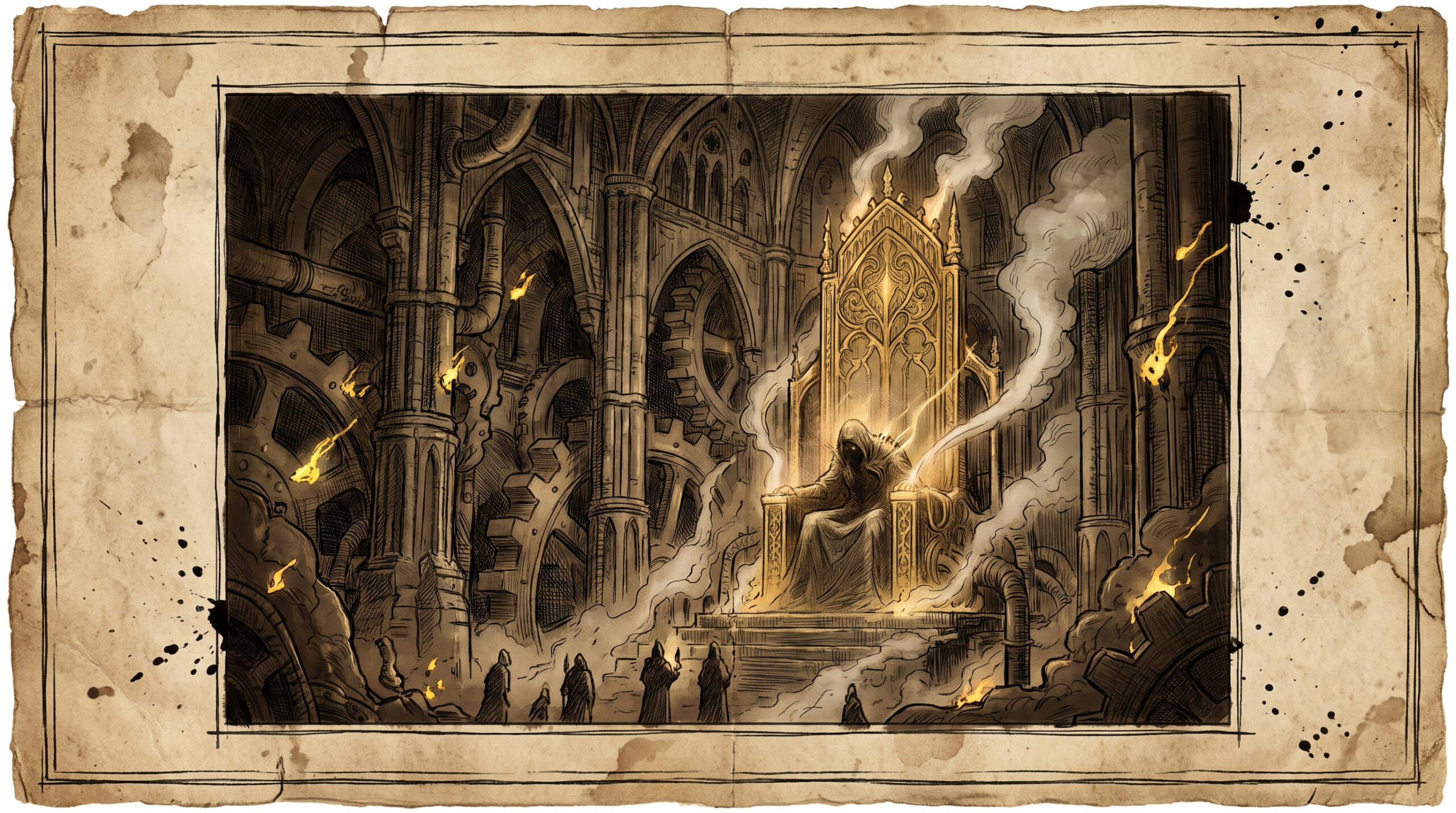
Is the Golden Throne About to Fail?
Ten thousand years it has cradled a dying god. But the sagas whisper that the great engine beneath the mountain is faltering at last — and no one living knows how to mend it.
Deep beneath the ruin of what was once Mount Everest, in a chamber vast enough to house whole companies of the Adeptus Astartes, sits a machine older than the Imperium it sustains. It is called the Golden Throne, and upon it rests the crumbling shell of the Master of Mankind. For over ten thousand standard years it has kept Him tethered between death and life — unborn and yet reborn, ended yet unending, as the sagas of Malcador the Sigillite are said to record. But the archives whisper an unquiet truth: the great engine is failing. And should it fail, the light of Humanity may gutter out with it.
What follows is drawn from the chronicles as they survive to us. Much is contested. Much is hidden even from the Adepts who tend the machine. But the question echoes through every scriptorium of the age: is the Throne about to break?
What the Golden Throne Actually Is
The records name the Golden Throne an ancient and arcane device, its origins reaching back at least to the Dark Age of Technology and perhaps far beyond. The Emperor is said to have discovered it in sunken ruins beneath the deserts of old Asia — though even He, the archives concede, was unsure whether the design was His own or an inheritance from some elder hand. Some among the loremasters point to the Aeldari, or to the Old Ones before them; a passage from the saga Ghost Warrior is cited as naming the Throne’s technology as stolen from the aeldari. No firm record settles the matter, and we should be wary of asserting fan speculation as truth.
Whatever its makers, its purpose was singular. The Emperor rebuilt it to open a fixed gateway into the Webway — to free Mankind from its perilous reliance upon Warp-ships and astrotelepaths. It was also bound to the Astronomican, the great psychic beacon by which His will guides ships across the void. To this day the two are entwined: extinguish one, and the other may die.
The Wound That Made the Throne a Tomb
The Throne was never meant to be a sarcophagus. The chronicles of the Horus Heresy tell that when Magnus the Red hurled his sorcerous warning across the galaxy, he shattered the Emperor’s carefully wrought psychic wards. Daemons poured into the human-built stretch of the Webway, and the Custodes and Sisters of Silence were left to hold a war that could not be won. The great project was undone.
Then came Horus. Mortally broken in the final duel aboard his flagship, the Emperor was borne back to Terra and installed upon the Throne. Malcador’s own testimony, as preserved in the sagas, frames the terrible bargain plainly: the throne may stabilise him and suspend him — but he is the only one who can stabilise it. The god and the machine now sustain one another. Sever that bond, and both are lost.
The Daily Sacrifice
The Throne’s hunger is well recorded and grim beyond telling. Each solar day a thousand psykers are led to the chamber and their life-energies consumed to feed the mechanism. This is no metaphor of the Ecclesiarchy but the cold accounting of the Imperium’s survival. Through this sacrifice the Emperor’s mind endures in the Immaterium, casting forth the Astronomican and warring endlessly against the things that batter at the wards of the Imperial Palace. His body, meanwhile, slowly rots — a decaying husk kept whole only by cables, conduits and stolen arts no living Adept fully comprehends.
The Signs of Decay
Here the archives grow uneasy. The chronicles record that in the closing years of the 41st Millennium the ancient mechanisms began to fail. The Adeptus Mechanicus, who have tended the Throne for millennia, could not halt the rot; their knowledge of the device is imperfect, cobbled from ritual and rote rather than true understanding. The sagas whisper of desperate measures — of outsiders summoned to the sacred chamber in hope of a cure. It is said a Haemonculus of the Drukhari was once brought before the machine, though the tale insists he had no intention of mending it and met his end for the deceit. Such accounts are contested, and we set them down only as the archives report them.
What seems more certain is this: no surviving record confirms the Throne has been repaired. The urgency of its collapse has, in the reckoning of some loremasters, settled into a longer and slower rot — but rot it remains.
What Happens If It Fails
The prophecies of ruin are dire and, disturbingly, consistent across the chronicles. Should the Throne fail, the Emperor dies. The Webway gate He holds shut — the very breach Magnus tore open — would burst wide, and daemonic hordes would flood the Imperial Palace and, in time, perhaps all of Terra. The loremasters speak too of a dead man’s switch, said to have been set by Vulkan of the Salamanders, that would obliterate Terra should the Emperor perish, taking much of the Sol System with it. This last is a claim we cannot fully verify, and prudence bids us name it as such.
Worse still for the wider galaxy: the Astronomican would vanish. Without its guiding light, Warp travel would become near-impossible, and vast reaches of the Imperium would be severed and left to fend for themselves — a return, the archives fear, to the darkness of the Age of Strife.
Is There Any Hope?
The chronicles offer thin threads. The Emperor is named a Perpetual, one who has died before and returned — and some argue a fragment of His will proved potent enough to preserve Roboute Guilliman when the Primarch fell during the Plague Wars. Others note that Guilliman has, in ages past, prepared a contingency: a second Imperium, seeded from Ultramar, should Terra ever fall. Whether the Master of Mankind could truly return, and in what broken state, no record can say. The archives whisper only that He waits — as He has always waited — upon the brink of death and the verge of life.
So we return to the question that opened this chronicle. Is the Golden Throne about to fail? The honest answer, drawn from all that survives to us, is that it is already failing — slowly, inexorably, and beyond any known cure. Whether that final hour comes tomorrow or in ten thousand years more, none but the Emperor may know. And He does not speak.
Questions from the Archive
Is the Golden Throne actually failing right now?
According to the chronicles, yes. The Throne's ancient mechanisms began breaking down in the late 41st Millennium, and no surviving record confirms it has been repaired. The Adeptus Mechanicus tend it constantly, but their understanding of the device is incomplete. The archives suggest the collapse has become a slow, inexorable rot rather than an imminent explosion — but it remains a decline with no known cure.
What would happen if the Emperor died?
The sagas warn of catastrophe. The Webway gate the Emperor holds shut would burst open, flooding the Imperial Palace and Terra with daemons. The Astronomican would vanish, crippling Warp travel and potentially severing vast regions of the Imperium — a return to the horrors of the Age of Strife. Some accounts also claim a dead man's switch would obliterate Terra itself, though this remains unverified.
Who built the Golden Throne?
No record settles the matter with certainty. The chronicles say the Emperor discovered it in sunken ruins beneath old Asia's deserts, dating to the Dark Age of Technology or earlier. Some loremasters credit the Aeldari, others the Old Ones before them, and one saga names its technology as taken from the aeldari. We should treat any single answer as contested rather than confirmed canon.