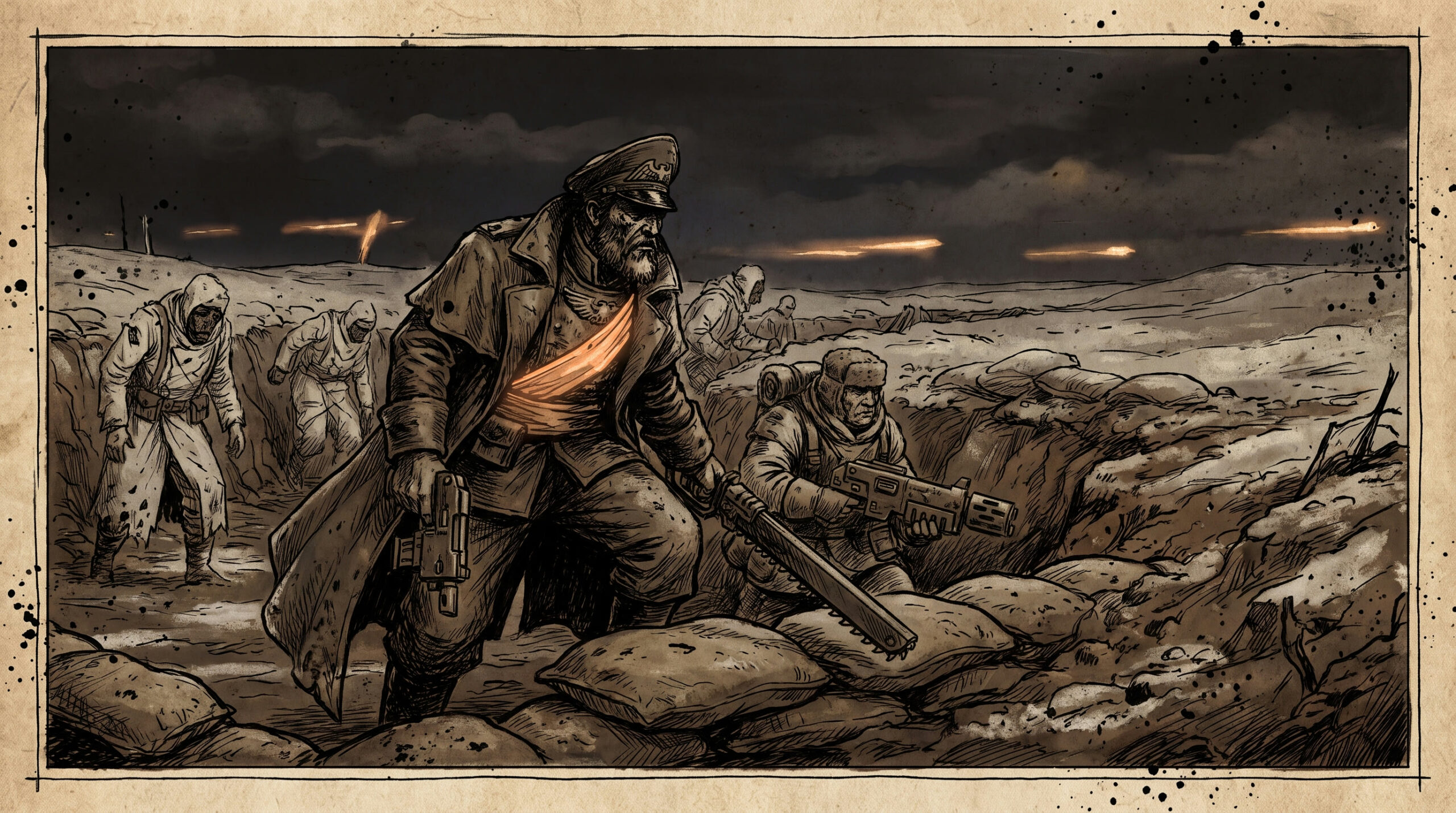
Ciaphas Cain: Hero of the Imperium?
A single dataslate, stuffed with files in no discernible order, sequestered by the Holy Ordos — and within it, the confession of the Imperium's most beloved fraud.
The archives of the Imperium are built upon monuments. Marble commissars with bolt pistol raised. Litanies of valour recited by shivering conscripts in the hour before the whistles blow. Names carved into the plascrete of a thousand schola halls, offered to children as a promise: be as he was, and the Emperor will know your face.
And then, somewhere in the vaults of the Ordo Xenos, there is a dataslate.
It is not a monument. It is barely a document. By the admission of the Inquisitor who assembled it, the thing consists of a single slate crammed with files arranged with what she calls a cavalier disregard for chronology, and to no scheme of indexing she could determine despite prolonged examination. What can be stated with certainty is the identity of the author. Commissar Ciaphas Cain — pronounced, we are told, Kai-a-fass Kane — Hero of the Imperium, wrote it in his retirement, while serving as a tutor at a Schola Progenium. He wrote it, apparently, for no eyes but his own. He wrote it honestly. That is the scandal.
The Commissar the Propaganda Built
The official record is glorious and thin. A commissar of the Departmento Munitorum’s Commissariat, in active service through the last century of M41, credited with a succession of victories across a dozen war zones; an inspiration to his men, respected by his peers, his very presence a stiffener of spines. By the middle of his career his reputation preceded him wherever he travelled, so that a troopship three days out from anywhere would know within hours that Cain the Hero of the Imperium was aboard, and would settle into the two available postures: pretending not to be impressed, or failing entirely to pretend.
Cain’s own account of that reputation is more interesting than the reputation itself. He describes it as a thing that smoothed his path — and, as though the universe insisted upon balance, periodically dragged him into life-threatening situations of, in his phrase, bowel-clenching terror. The hero was a door that opened onto rooms he had no wish to enter.
What the Cain Archive Actually Says
Inquisitor Amberley Vail of the Ordo Xenos, who edited the archive and who knew Cain across decades of sporadic personal association, sets out the heresy plainly in her introduction. Some of her fellow inquisitors, she writes, may be shocked to learn that one of the Imperium’s most venerated heroes was, by his own admission, a scoundrel and a self-seeking rogue. She goes further. She contends that it was precisely this combination of character flaws that made him one of the most effective servants the Imperium has ever had.
Read the archive and the shape of the man emerges. Cain was chiefly, doggedly, professionally concerned with staying alive. He avoided battle where he could contrive to avoid it. He bluffed, dissembled, redirected and withdrew. And yet — the distinction matters, and the sources are careful to preserve it — he differed from a great many of his brother commissars in that he would not spend soldiers’ lives freely. He would spend them, the record suggests, when his own survival required it. But not for the pleasure of the ledger, and not to decorate a report. In the Commissariat, that modest reluctance amounts almost to sainthood.
Vail appends a warning to her own edition, and the archivist is bound to repeat it. Cain was a gifted liar. Anything in his memoirs that is not independently corroborated may well be an invention laid down to protect the legend. The scoundrel’s confession is itself the work of a scoundrel.
Jurgen, and the Aroma of Providence
No account of Cain survives without his adjutant. Gunner Ferik Jurgen, first assigned to him among the Valhallan 12th Field Artillery, follows him through practically the whole of the archive: malodorous, unlovely, monumentally unbothered, and — this is the detail that ought to make an inquisitor sit up — a psychic blank. A living null in the warp, at the elbow of a man who kept blundering into daemonic and xenos horrors and kept, inexplicably, walking away.
The sagas of the Guard would call that luck. The archives whisper that luck of such consistency deserves another name. Jurgen’s other talents were of a humbler order. Even in the anthologies he is found eyeing the panniers of a borrowed motorbike, calculating how many extra ration bars might be stowed away, because one never knows when they might come in handy. There is more of the true Imperial Guard in that sentence than in a hundred recruitment hymns.
From the Valhallan 12th to the 597th
Cain’s first posting after the schola was the Valhallan 12th Field Artillery, under Colonel Mostrue — an officer who, the records indicate, grew suspicious of his commissar’s blossoming reputation and tested it repeatedly by handing him missions of the most lethal sort. The archive also preserves Lieutenant, later Major, Toren Divas: the nearest thing Cain kept to a friend, eager for combat and a devout believer in the legend.
Later came the Valhallan 597th, the regiment with which Cain is most closely associated, and whose officers — Colonel Kasteen among them — appear throughout the archive addressing him simply as Ciaphas. It is a small word, and it does something the propaganda never manages: it makes him a man. In one such passage, hanging beneath a dying aircraft over an abyss with the clouds below glowing red as a setting sun, he steadies his voice as best he can and tells her he is fine. Jurgen too. Whether he was fine is another matter entirely.
The Long Career and the Late Recall
The secondary records place his birth at around 896.M41 upon a hive world whose name has not come down to us, and his active service from 919.M41 onward. He was, they say, past two centuries of age when the Imperium remembered him and called him back for Abaddon’s 13th Black Crusade — for even a reluctant hero is an asset when the Eye of Terror empties itself upon the galaxy.
Of his end, the accounts are not perfectly reconciled. It is held that he survived well into M42, and that his death came in the early years of that millennium; where the sources disagree on the span, this archivist declines to adjudicate. What is agreed is that he retired to teach at a Schola Progenium — a scoundrel set to raise the orphans of the Emperor’s wars — and that it was there, in his own hand and for no audience, that he set down the truth.
Why the Ordos Buried Him
The archive was circulated among the Inquisition in M42 and then sequestered by order of the Holy Ordos, kept and organised by Vail herself. Consider why. The Imperium does not require heroes to have existed; it requires that they be believable. A galaxy of ten thousand worlds runs on the fiction that courage is a natural human resource, endlessly renewable, and that men like Cain are common. To publish the dataslate would be to inform a hundred billion subjects that their finest example was a frightened man who wanted a quiet life and a decent drink.
And here is the darker reading, the one the Inquisition presumably could not print. Cain’s record of service was real. The campaigns were won. The worlds were held. Whatever his motives, the outcomes stand. Which suggests, in an Imperium that worships martyrdom, that a man who intends to survive may serve it rather better than a man who intends to die.
Hero of the Imperium? The propaganda says yes. The dataslate says no. The archivist’s verdict is less comfortable than either: that in the 41st millennium the two answers are not in conflict at all, and never were.
Questions from the Archive
Is Ciaphas Cain actually a coward?
Not quite — though he would cheerfully accept the label if it got him out of a fire-fight. The Cain Archive presents a man overwhelmingly concerned with self-preservation, who avoided combat wherever he could contrive it, yet who repeatedly acted when cornered and who, unusually among commissars, was reluctant to expend his soldiers' lives except where his own survival demanded it. Inquisitor Amberley Vail's own assessment calls him a scoundrel and a self-seeking rogue, and argues that these very flaws made him one of the Imperium's most effective servants.
What is the Cain Archive, and can it be trusted?
It is a single dataslate of files, written by Cain during his retirement as a Schola Progenium tutor, arranged in no discernible order and edited by Inquisitor Amberley Vail of the Ordo Xenos. Circulated within the Inquisition in M42, it was subsequently sequestered by order of the Holy Ordos. Vail herself warns in her footnotes that Cain was a skilled liar, and that anything he records which is not independently documented may be a fabrication intended to preserve his reputation.
When did Ciaphas Cain live, and which regiments did he serve with?
The records place his birth at around 896.M41 on an unnamed hive world, with active service from 919.M41 onward. He served first with the Valhallan 12th Field Artillery under Colonel Mostrue, and later — most famously — with the Valhallan 597th. He was over two hundred years old when recalled for Abaddon's 13th Black Crusade, survived into M42, and the accounts hold that his death came in the early part of that millennium.