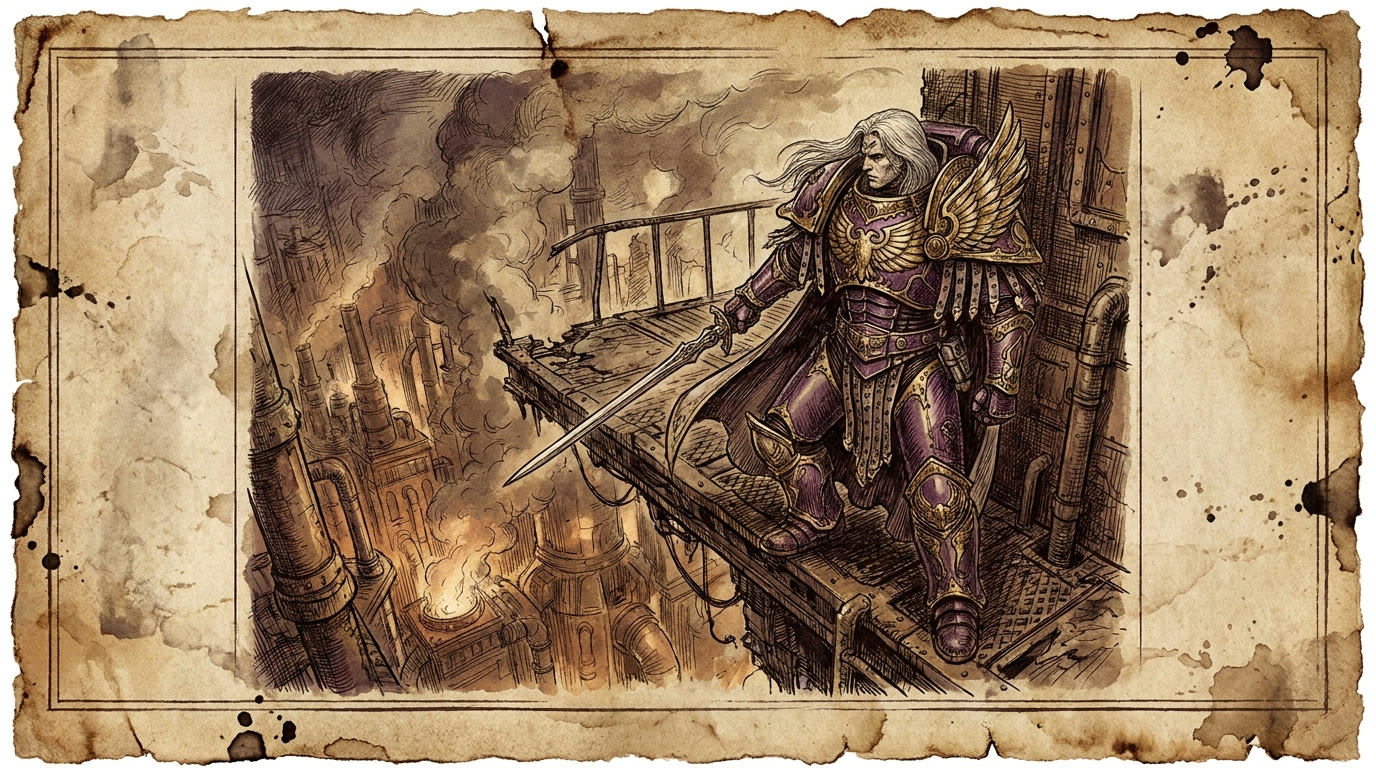
Fulgrim: Primarch of the Emperor’s Children
The perfect son. The histories name Chemos, a dying factory-world he raised from ruin — and a Legion that nearly died before he found it.
If you had seen him then, you would understand. Before everything after, Fulgrim was simply the most splendid thing the Crusade possessed, and he knew it — a vainglorious, deadly peacock, and beloved for it.
The Histories Name Chemos
Of his finding, the archives I trust say strangely little. The histories name Chemos, a grey and dying factory-world, and tell that the boy who fell there dragged it back to life before his father came. I record the claim as the histories give it, no more. What is certain is what he was when he stood among his brothers: the epitome of physical perfection, a pale sculpted face framed in a mane of albino-white hair, in brilliant purple war-plate edged with gold, one pauldron worked into a sweeping golden eagle’s wing.
The Pursuit of Perfection
His Third Legion pursued perfection as other Legions pursued victory — to them the two were the same thing. There is a whisper, which I will neither confirm nor deny, of a Legion nearly extinguished before its primarch came, of a First Blade of the Two Hundred. However few they had been, under Fulgrim they became the pattern of what a Legion should be. Horus himself called the Emperor’s Children the living embodiment of the Adeptus Astartes, and Horus did not flatter easily.
Perfection, child of the Throne, is a blade with no hilt. Remember him as he was, holding it safely, for a while.
Questions from the Archive
Where was Fulgrim found?
The histories name Chemos, a dying industrial world that Fulgrim restored before the Emperor’s arrival — though the chronicler notes the deepest archives say little of his finding.
What legion did Fulgrim command?
The Third Legion, the Emperor’s Children, who wore purple and gold and pursued absolute perfection in the art of war.
What did Horus think of Fulgrim’s legion?
Horus held them in exceptional esteem, calling the Emperor’s Children the living embodiment of the Adeptus Astartes.