The Months of Shame: Why the Space Wolves Defied the Inquisition
In 444.M41 the Inquisition moved to silence Armageddon's survivors and the Space Wolves refused. A sourced history of the Months of Shame, from Armageddon to Fenris.
The Months of Shame were a war inside the Imperium. After the First War for Armageddon in 444.M41, the Inquisition moved to erase every trace of what the planet’s people had seen. The Space Wolves under Logan Grimnar refused to let it happen. What began as an argument over the fate of a few hive cities became months of purges, blockades, a broken armistice and finally a battle in the skies above Fenris itself. The Grey Knights, bound to the Inquisition, fought on the wrong side of their own consciences.
The fullest account of these events is Aaron Dembski-Bowden’s novel The Emperor’s Gift, chapters 14 to 26 and its epilogue. This chronicle follows that account closely, says where it is relying on a single narrator, and does not invent death tolls, dates or dialogue that the source does not give.
At a glance
- When: in the aftermath of the First War for Armageddon, 444.M41, and the months that followed. The sources give no exact end date.
- Who: the Space Wolves under Great Wolf Logan Grimnar, against an Inquisitorial task force led by the unaligned Lord Inquisitor Ghesmei Kysnaros, with Grey Knights of the Eighth Brotherhood under Grand Master Joros and, at the end, the Red Hunters Chapter.
- Why: the survivors of Armageddon had witnessed a daemonic invasion led by the Daemon Primarch Angron. The Inquisition judged that knowledge too dangerous to survive. The Wolves judged the survivors innocent.
- How it ended: above Fenris. Grimnar killed Kysnaros aboard the warship Corel’s Hope, and Bjorn the Fell-Handed, the oldest of the Space Wolves, forced both sides to stop.
- Who tells it: Hyperion, a Grey Knight who served through the whole affair and wrote his record years afterwards.
Who is telling this story?
Almost everything we know about the Months of Shame comes from one witness. Hyperion was a young Grey Knight of Squad Castian who served alongside the Fenrisian inquisitor Annika Jarlsdottyr. He was at Armageddon, aboard the warship Karabela during the blockades, at the armistice, at Kysnaros’s side above Fenris and in the room when the war ended. He sets the record down years after the fact, by then a senior warrior who advises captains and Grand Masters, and he says plainly at the outset that he would rather not speak of Armageddon at all.
That matters. Hyperion is honest about his own part. He obeyed orders to cripple fleeing transports, and he admits he once went to Kysnaros meaning to kill him. But he is still a Grey Knight writing about his own order’s darkest season. He sees inside other minds, and he sometimes reports what he sensed there as fact. Readers should treat his judgements of Kysnaros, Joros and Grimnar as the views of a participant, not of a neutral historian.
Armageddon, 444.M41: a victory with a price
The Imperial chronology places the First War for Armageddon in 444.M41. The hive world was invaded by Angron, the Daemon Primarch of the World Eaters, and his host. Defeating him took the Astra Militarum, the Space Wolves and the Grey Knights together, and the human cost was immense. For the background to the daemon-prince himself, see our chronicle of Angron, Primarch of the World Eaters, and for the later Ork invasions of the same world, The Wars for Armageddon.
In the novel, Logan Grimnar fights the campaign with one eye on what will come after. Before the decisive battle at the River Styx he tells the Grey Knights that the hives of Helsreach and Infernus have seen nothing of the true enemy. He means to keep it that way, so that their people cannot be “processed” by the Inquisition once the fighting stops. The Wolves choose a costlier battle in the field to keep the daemons away from the cities. One Grey Knights captain grasps the point at once: why save a world if all its people are then put to death for having seen the enemy?
Hyperion’s own part ends in the wreckage of that battle. He is found alive among the dead by the Wolf Guard Brand Rawthroat, and the Wolves have already given him a name: Bladebreaker. In the novel he broke the black blade of Angron, a deed he later confirms to Bjorn himself. Angron was banished. Armageddon survived.
The containment
What followed was not a standard purge. When Hyperion returns to duty after about a hundred days of recovery, Annika tells him the scale of the Inquisition’s decision. The entire population is to be rounded up, sterilised and committed to labour camps. Armageddon will later be resettled with colonists brought in from elsewhere. Even the hives Grimnar shielded are included. In Hyperion’s private reckoning, the world escapes Exterminatus only because its industry is too valuable to the region’s Imperial Guard.
The people are told that their cities must be evacuated for a sacred cleansing and that they will be allowed home afterwards. Annika, who has been to the camps herself, tells Hyperion what the injections given on arrival really do. Men, women and children are told they are being protected against disease. In fact they are being made the last generation of Armageddon’s original colonists.
This is the heart of the Months of Shame. The Inquisition’s reasoning was not sadism. It was the old Imperial arithmetic of secrecy: knowledge of daemons, and of the Grey Knights, spreads like contagion. Kill the knowledge on one world, or risk having to burn many more later. The novel never pretends that this logic is absurd. It shows instead what it costs when it is carried through.
Grimnar refuses
The Wolves’ first answer is a message. For hours the Space Wolves flagship Scramaseax loops a recorded request from the Great Wolf to every Inquisition vessel: stand down from these plans, and take this request in the spirit in which it is offered, because he would not like to have to repeat it as a warning.
The decisive confrontation comes in orbit. Imperial Guard troop transports carrying soldiers off Armageddon try to run, escorted by Fenrisian warships. Kysnaros speaks to Grimnar across the whole fleet. His argument is chilling because it is coherent. Every ship that escapes will have to be hunted down, he says, and every listening station that logs its passage and every world where it docks may have to burn, at a cost of billions of lives. Grimnar’s reply is that these soldiers fought for the Imperium and the Imperium will not turn its back on them. Kysnaros escalates to the gravest threat in Imperial law: surrender, or face the excommunication of the Chapter and the Exterminatus of Fenris.
The Karabela is ordered to cripple the transports, and Hyperion obeys. He describes sawing through the engine decks of a ship carrying, in his estimate, close to half a million people. When Kysnaros then orders the Grey Knights to destroy any ship that obstructs the Inquisition, Hyperion refuses to open fire on an Adeptus Astartes vessel. Over the vox, Brand Rawthroat of the Runefyre tells him the Wolves are not making a point. They are doing what is right.
A cold war across the sectors
The war that follows is fought mostly in reports. Hyperion reads them as a grim ledger. On one side are colonies, cities and stations annihilated by the Inquisition because ships from Armageddon had passed through them. On the other are the occasions when Grey Knights or Inquisition vessels arrived to find overwhelming Space Wolves blockades already in place. The Wolves rarely stayed long. They did not return fire when fired upon. They evacuated everyone they could and scattered them out of the purgers’ path.
The novel shows two of the purges in detail, and neither lets the Grey Knights off lightly. The world of Jendara Quintus is bombarded by the Grey Knights warships Ruler of the Black Skies and Fire of Dawn. Warning beacons are left in orbit blaming a xenos invasion. The agricultural world of Tybult is killed by virus bombs dropped from Corel’s Hope, a Navy warship rearmed under Inquisitorial mandate. Whatever Hyperion and Annika felt about it, this was the order they served.
The Space Wolves’ long friction with Imperial authority runs through all of this. Hyperion notes that the Chapter has been censured by the Ecclesiarchy and investigated by the Inquisition before. Our chronicle of Leman Russ traces where that independence began.
The broken armistice
The Grey Knights are ordered to join Kysnaros’s armada at Haikaran, where terms are to be offered to Grimnar. Annika does not trust Kysnaros’s intentions, and she is right. During the armistice, Inquisition ships open fire on the Wolves’ unshielded, unarmed vessels. Grimnar later accuses them of killing thousands of his Chapter’s servants. Kysnaros will admit the aim was to take the Great Wolf captive, in the belief that his capture would end the war.
Grimnar comes aboard by gunship with only three Wolf Guard, Brand Rawthroat among them, to hear what Kysnaros calls the terms of his surrender. He asks which of them gave the order to fire on his ships. Grand Master Joros of the Eighth Brotherhood says that he did. Grimnar refuses to surrender, and Joros, a renowned duellist, dies before his blades have cleared their scabbards. “That’s for my ship,” Grimnar says.
The capture still fails. When the wounded flagship Scramaseax tries to teleport its jarl away, the Grey Knights reach through the warp together and hold the Wolves in place. Grimnar and his Wolf Guard answer by shooting four justicars dead, and with their squad leaders killed the knights’ combined hold breaks. The Wolves vanish in a flare of light. Standing over Joros’s body, Kysnaros orders his forces to let them go.
Kysnaros: no simple villain
It would be easy to make Ghesmei Kysnaros the monster of this story, and Hyperion clearly expected to. When Hyperion confronts him, the Lord Inquisitor turns out to be something more troubling: an exhausted man who has lost control of a war he did not understand. He confesses that he had never met one of the Adeptus Astartes before. He followed Joros’s advice to threaten, posture and finally seize Grimnar, and every step made things worse. He insists the blame is his alone and says he has recorded his own culpability in the archives.
His reasons for not simply dominating Grimnar’s mind are political, not merciful. A Great Wolf shackled to the Inquisition would be repudiated by his Chapter, and other Chapters might follow. He refuses to preside over another Reign of Blood or a second Nova Terra Interregnum. “Some stories have no villain,” he tells Hyperion. Readers can decide whether that is wisdom or self-justification. The novel lets it be both.
He is also losing his own side. When Hyperion goes to Annika to announce that he means to kill the Lord Inquisitor, he finds she is already meeting with other inquisitors, Malchadiel and several Grey Knights to plan the same thing. In the end Hyperion does not kill Kysnaros: the man he finds is not the one he expected.
The fleet above Fenris
Kysnaros’s answer is the most dangerous move of the war. He takes a battlefleet to Fenris, the Space Wolves’ home world, while, as far as Hyperion can tell, most of the Wolves’ fleet is engaged elsewhere. He brings an entire Chapter with him: the Red Hunters. By his own account they are there to make a point with their presence, not their guns. If another Chapter stands against the Wolves, the Wolves cannot claim the moral high ground of the Adeptus Astartes. Hyperion tells him that even if he turned back immediately, the Wolves would never forgive the Inquisition for bringing a fleet into their skies. When Kysnaros remarks that the Grey Knights stood with him only out of “tenuous loyalty”, Hyperion gives the order’s losses. Its warriors, once around a thousand, now number little more than eight hundred, in the aftermath of Armageddon and the Months of Shame.
Fenris is almost undefended. A lone strike cruiser, scarred and badly in need of repair, sits docked at the Fang. In the Fang, the Wolves wake the one warrior whose authority no inquisitor can dismiss. Bjorn the Fell-Handed, interred in his Dreadnought, is the first Great Wolf of the Chapter and a warrior who fought in the Emperor’s own age. When Kysnaros realises who he is facing, he asks whether Bjorn truly walked in the Age of the Emperor. Bjorn answers that he met the Allfather and fought at his side, and he believes the Emperor liked him. The Lord Inquisitor slowly goes to his knees.
How it ended
Kysnaros tries to bargain with Bjorn. His proposed compromise is a penitent crusade, a century or perhaps two of Wolves sent out into the stars to appease the Inquisition. Bjorn scorns it and tells him to try harder. Before Kysnaros can, the Wolves’ entire fleet breaks out of the warp over Fenris, weeks before Hyperion thought it could arrive. Grimnar later says Rune Priests gave their lives to bring it home. Kysnaros pleads over the vox that this does not have to end in war. Grimnar’s answer is that the Lord Inquisitor sowed this harvest and must now reap it. Boarding pods launch from every Fenrisian warship. Kysnaros orders the Red Hunters to counter-board, and the fleets fight at point-blank range. Three Imperial ships crash into the walls of the Fang, and the fortress burns. Bjorn later says it burned hotter than it did under the sorcery of Magnus One-Eye, an echo of the Thousand Sons’ assault described in our chronicle of Magnus the Red.
Grimnar teleports onto the command deck of Corel’s Hope in Terminator armour and beheads Kysnaros with the axe Morkai. He maims Malchadiel, taking his legs and then his arm, and Hyperion fights him, striking with enough psychic force to crack the ancient axe. Then Bjorn himself teleports aboard, the first time in all his years he has used a teleporter. The Wolves kneel. Bjorn tells them the Fang is aflame, the orbital docks are crippled and the fleet is in ruins. Grimnar has acted with honour, he says, but pride and righteousness will take them all to their graves, and it is time to call off the attack. When Grimnar tries to object, Bjorn tells him to watch his tongue.
Bjorn then sets the terms. Annika steps forward to speak for the Inquisition. Every bearer of the Inquisition’s seal is to hear that if one of its ships ever darkens the skies of Fenris again, the Wolves will tear it down. And before Hyperion is allowed to leave, he must walk the halls of the Fang and tell the Wolves about his order. There will be no more secrets: the Space Wolves will know the Grey Knights from that day on. As Hyperion observes, both sides had to break their own laws to end the war.
Aftermath
The peace did not bring reconciliation. Six hours after the guns fell silent, Annika relayed Bjorn’s words to the surviving inquisitors aboard the drifting wreck of Corel’s Hope. The first reply was simply “No.” Hyperion insisted that the battle was over before it could become a war, but the inquisitors were already trading glances. One proposed exploring “alternate avenues” against the Chapter. Another suggested that the next time Fenris was besieged, Battlefleet Solar might be slow to come. A biologis adept asked what was known of Space Wolf gene-seed. Hyperion counts their scheming, and the Wolves’ bitterness, among the things he most regrets witnessing.
The Karabela stayed in orbit for weeks, sinking wrecks too broken to salvage into the seas of Fenris. Annika had gone, and Malchadiel had been taken back to Titan. The Grey Knights were barred from setting foot on Fenris. Hyperion kept to the letter of that order while breaking its spirit: he drifted unseen through the minds of the Fang’s servants. Through one thrall’s eyes he watched Grimnar return Bjorn to his stasis sleep beneath the Fang. The old Dreadnought’s last warning was that the Inquisition would not leave the Wolves in peace, and that his brothers should watch the skies.
The cost fell on every side. Armageddon’s people were sterilised and scattered, and whole worlds died to protect a secret that ended the war in Space Wolf hands anyway. The Grey Knights lost warriors, a Grand Master and a measure of their honour; Hyperion remembers the following months as “a blight” on their code. The Space Wolves saw the Fang burn and their fleet ruined. Years later, when an old comrade asks whether he ever saw Annika again after the Months of Shame, Hyperion says yes and will say no more.
Was anyone right?
This section is interpretation, not canon. The Months of Shame endure in Warhammer 40,000 because each side can make a serious case. The Inquisition’s doctrine of secrecy is the doctrine that keeps the Imperium functioning, and Kysnaros was right that a fractured Imperium could cost billions of lives. The Wolves were right that the Imperium cannot keep demanding sacrifice from people it is willing to exterminate for having made it. The Grey Knights had the hardest position: sworn to the Inquisition, sharing the Wolves’ sense of honour, and asked to do the killing.
Hyperion never settles the question. He records his own obedience and his own refusals side by side. That may be the most honest thing about his account.
Timeline
- 444.M41: the First War for Armageddon. Angron invades. The Space Wolves, Grey Knights and Astra Militarum defeat him, and Grimnar keeps the battle away from Helsreach and Infernus.
- The containment begins. About a hundred days after the battle, by Hyperion’s count, the Inquisition is rounding up the planet’s population for sterilisation and the labour camps.
- The stand-off over Armageddon. The Wolves broadcast their demand, escort fleeing troop transports and receive Kysnaros’s threat of excommunication and Exterminatus.
- The cold war. Purges of worlds touched by Armageddon’s ships, including Jendara Quintus and Tybult, are met by Wolves blockades and evacuations.
- The broken armistice. Inquisition ships fire on the Wolves’ unshielded vessels on Joros’s order. Grimnar kills Joros, his Wolf Guard kill four justicars, and the attempt to capture him fails when he teleports back to the Scramaseax.
- Fenris. Kysnaros arrives with a battlefleet and the Red Hunters. Bjorn is woken and confronts him in the Fang.
- The battle above Fenris. Grimnar’s fleet returns and boards the armada. Grimnar kills Kysnaros on Corel’s Hope, and Bjorn halts the fighting and sets the terms.
- Aftermath. The surviving inquisitors reject the terms in private and talk of revenge. The Grey Knights are barred from Fenris, and Bjorn returns to his sleep with a warning to watch the skies.
Common misconceptions
- “The Grey Knights were the villains.” Not simply. Grey Knights ships did purge worlds, and they obeyed orders to cripple fleeing transports. But Hyperion refused to fire on an Astartes ship, and Grey Knights were among those ready to move against Kysnaros.
- “The Wolves saved everyone.” They did not. Armageddon’s camps went ahead, and worlds such as Tybult died anyway. The Wolves saved those they could reach.
- “Kysnaros was a cartoon tyrant.” In the novel he is frightened, out of his depth and convinced that the alternative is civil war. He also ordered the betrayal at the armistice.
- “There is an official death toll.” The sources give none for the war as a whole, and this chronicle does not invent one.
Read the source
If this chronicle has done its job, you will want the original. The Emperor’s Gift tells the whole story from Hyperion’s side, from his service alongside Annika Jarlsdottyr to Armageddon and the war with the Wolves. Battle of the Fang covers the earlier assault on Fenris that Bjorn invokes when he describes the Fang burning.
Ad / affiliate links: The Emperor’s Gift by Aaron Dembski-Bowden (Kindle edition) · Battle of the Fang by Chris Wraight (Kindle edition). As an Amazon Associate I earn from qualifying purchases. About these links.
Sources
- Aaron Dembski-Bowden, The Emperor’s Gift (Black Library), chapters 14 and 16 to 26 and the epilogue. This is the primary source for every event above.
- Codex: Militarum Tempestus and Waaagh! Ghazghkull, for the 444.M41 dating of the First War for Armageddon.
- Earlier summaries of the Months of Shame on fan wikis were checked against the novel. Where they disagreed, the novel was preferred.
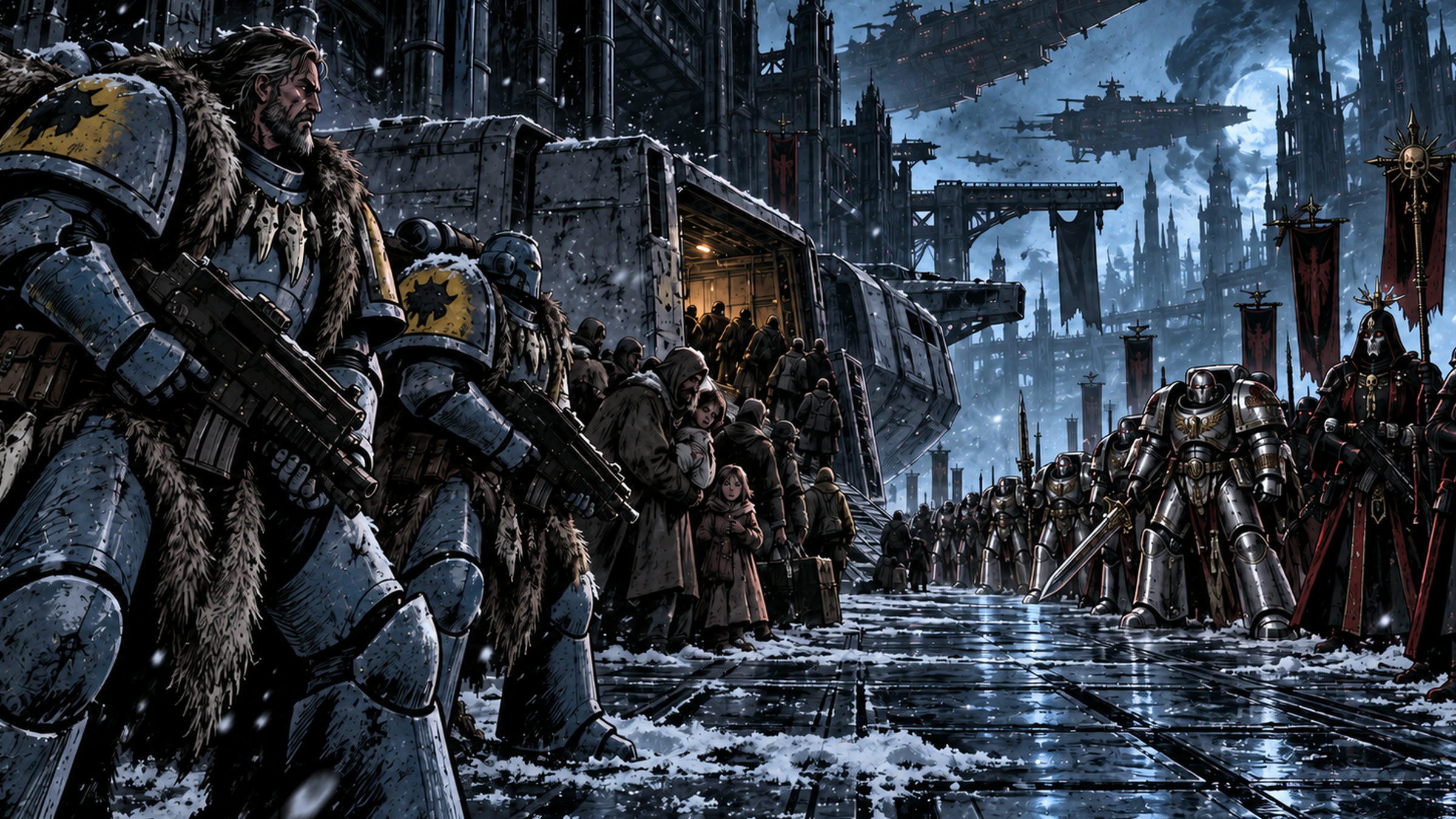
The Golden Scriptorium is an unofficial fan project, not affiliated with or endorsed by Games Workshop. Warhammer 40,000 and associated names are trademarks of Games Workshop. The cover image is AI-assisted artwork made for The Sigillite’s film of this story. Watch The Sigillite’s Months of Shame film on Facebook (scheduled for 8 October 2026 at 18:00 BST).
Questions from the Archive
What were the Months of Shame in Warhammer 40,000?
The Months of Shame were the conflict between the Space Wolves and an Inquisitorial task force, with Grey Knights bound to it, after the First War for Armageddon in 444.M41. The Inquisition, led by Lord Inquisitor Ghesmei Kysnaros, set out to destroy all knowledge of Angron's daemonic invasion, including by sterilising Armageddon's survivors and purging worlds their ships had touched. Logan Grimnar's Space Wolves refused to allow it. The struggle ran for months and ended in a battle above Fenris. The fullest account is Aaron Dembski-Bowden's novel The Emperor's Gift.
Did the Space Wolves really fight the Grey Knights?
Yes, though not as simple enemies. Grey Knights ships enforced the Inquisition's orders, crippled fleeing transports and took part in purges. After the Inquisition fired on Space Wolves vessels during an armistice, Logan Grimnar killed Grand Master Joros of the Eighth Brotherhood, and his Wolf Guard shot four justicars dead as they escaped. Yet the novel's narrator, the Grey Knight Hyperion, refused to fire on a Space Wolves ship, and he and other Grey Knights were ready to move against Kysnaros himself.
How did Ghesmei Kysnaros die?
In The Emperor's Gift, Kysnaros brought a battlefleet and the Red Hunters Chapter to Fenris while most of the Space Wolves' fleet was away. When it returned and boarded his armada, Logan Grimnar teleported onto the command deck of Kysnaros's flagship, Corel's Hope, and beheaded him with the axe Morkai.
What did Bjorn the Fell-Handed do in the Months of Shame?
The Wolves woke Bjorn, their first Great Wolf, in his Dreadnought when Kysnaros's fleet arrived above Fenris, and Kysnaros knelt on learning that Bjorn had fought beside the Emperor. After Kysnaros's death Bjorn teleported aboard Corel's Hope and ordered the Wolves to stand down. His terms: any Inquisition ship that again darkened the skies of Fenris would be destroyed, and the Grey Knight Hyperion had to tell the Wolves about his order, so that the Space Wolves would know the Grey Knights from then on.
Who tells the story of the Months of Shame?
Almost everything comes from Hyperion, a Grey Knight who took part and wrote his record years later. He is candid about his own obedience and his refusals, but he is one participant from one order. His judgements of Kysnaros, Joros and Grimnar should be read as his view rather than a neutral verdict.