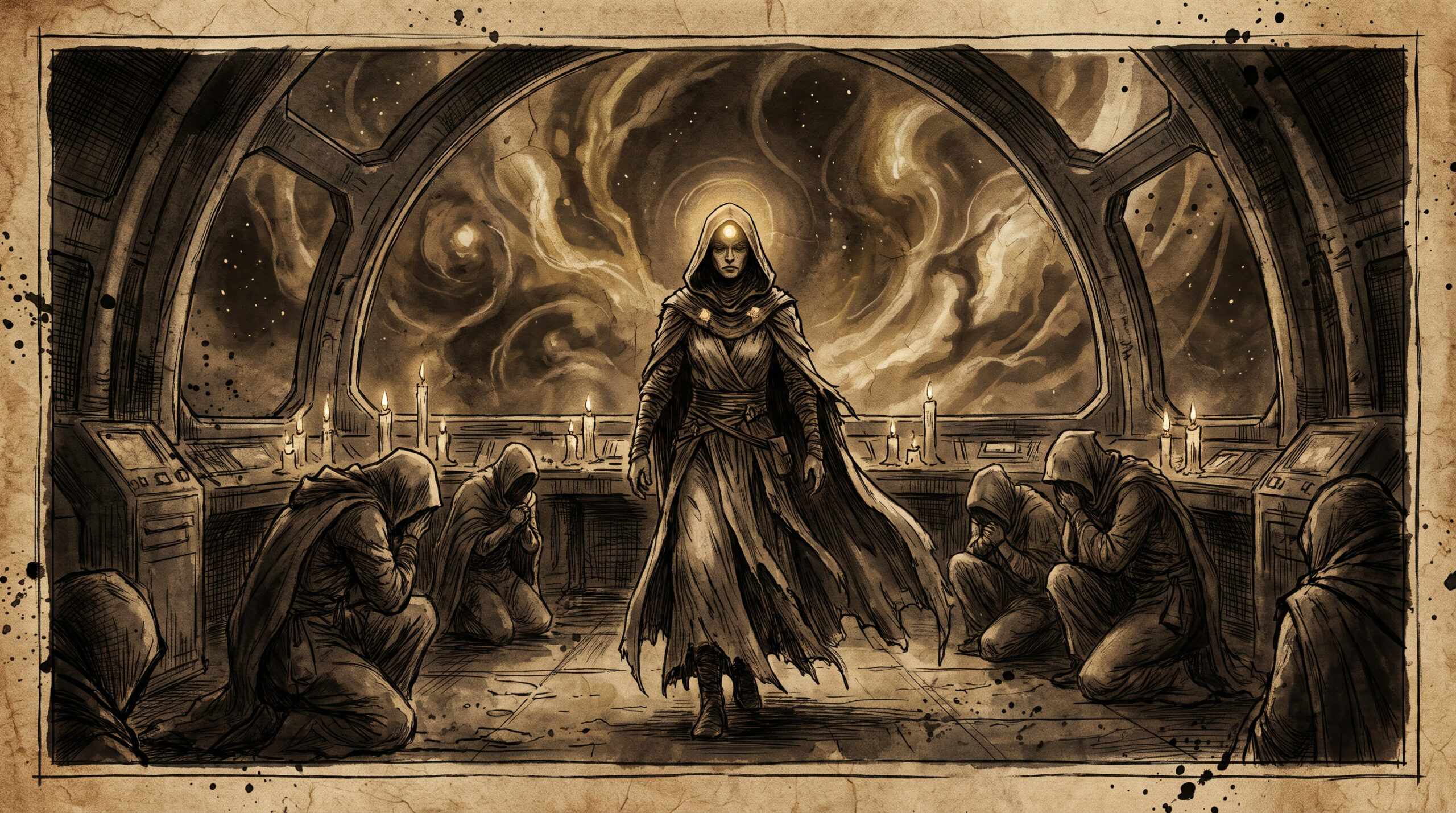
Who Are the Navigators? The Mutant Nobles Who Steer the Imperium
They are mutants, and the Imperium burns mutants. Yet without them not a single grain of promethium, not a single regiment, not a single word of command would ever cross the void.
Consider the arithmetic of the Imperium, as this archivist has been obliged to consider it many times in the reckoning of tithe-ledgers. A million worlds. A hundred thousand light years. Astropathic messages that arrive out of sequence, or centuries late, or wearing the voice of something that was never human. And between all of it, an ocean that is not an ocean, in which distance is a rumour and time is a matter of opinion.
Something must cross that ocean. Something must look into it and not go mad, or at least not go mad quickly enough to matter. And so we come to the strangest bargain the Emperor’s realm ever struck: that the same species which burns the mutant at the stake will bow its head, pay its tithes, and beg a mutant’s favour before it dares set sail.
They are the Navigators. Homo navigo, the archives style them. They have a third eye, closed beneath a silken band, and they are the reason the Imperium exists at all.
What Is a Navigator? The Third Eye and the Warp Eye
A Navigator is a strain of abhuman — a stable, heritable mutation of the human form — whose defining organ is the warp eye: a third eye set in the brow, kept veiled in the presence of ordinary mortals. Through it a Navigator perceives the Immaterium not as a howling nothing but as a landscape, however hostile, however deceitful.
The gift is not the same as the psyker’s. A Navigator’s talents run along a narrower and stranger channel. The lore-texts of the Rogue Trader archives describe how a Navigator may, with a moment’s study, discern whether a person or object carries the taint of the warp — whether it bears psychic rating, warp-mutation, corruption, or something worse riding inside it. Those who have made pacts with the powers beyond can sometimes veil themselves, matching will against the Navigator’s perception. But the plain truth stands: a Navigator sees what is underneath. It is a talent that has exposed heretics, unmasked possessions, and made Navigators very unpopular guests at certain dinner tables.
Chiefly, though, the warp eye is for the Astronomican — the psychic beacon of the Emperor upon Terra — and for the currents, shoals and predators of the empyrean. The Navigator stands upon the bridge, unhoods, and looks. What that costs them the archives whisper of only obliquely.
The Navis Nobilite: Mutant Nobility Older Than the Imperium
Most Navigators are not free agents. They belong to the Navis Nobilite, an ancient body of Terran nobility that the records place as predating the founding of the Imperium by several thousand years. These are the Great Houses: dynasties whose bloodlines are their inventory, whose wealth is measured not in worlds but in the wombs that will bear the next generation of eyes.
The Houses did not have their power granted to them. They took it, slowly, across the long dark. As mankind’s need for warp travel grew, so did the leverage of those who could satisfy it. The chronicles record that the Navigators came to hold a unique grip upon mercantile affairs and became responsible for the vast majority of human commerce — slipping free of the industrial and trading cartels that once employed them, and building noble houses instead. That near-monopoly has held, with notable interruptions, for something close to twenty millennia.
The Explorers’ handbooks put it plainly enough: Navigators are a fortunate few born into privilege, their politically affluent clans wellsprings of intrigue as grim and convoluted as their mutating bodies. Each House enjoys enormous autonomy. Their influence, the archives judge, stands on a par with the great Adepta of the Imperium itself. Some Houses appoint envoys to treat with wider Imperial society; others turn inward, choosing from among their own the most cunning Navigators to wield the House’s weight where it will bite hardest.
The Trade Wars: How the Houses Bleed One Another
Do not imagine solidarity among them. The Houses compete, and the terms of that competition are formalised in a document of great antiquity: the Navigator Convention. Under its provisions a House may make formal declaration of a trade war. Once declared, all Houses involved may act against their rivals by military and covert means alike.
The Convention holds that those outside the feuding Houses ought not to be harmed by the war’s progress. This archivist notes the word ought. In practice the subsidiaries, allies and associates of the warring Houses are dragged in whether they wish it or not, and many Houses act well beyond the bounds of any declaration — assassinations unrecorded, cargoes lost to nothing at all, heirs vanishing between one voyage and the next. A trade war is meant to contain competition. More often it merely gives it a legal vocabulary.
The Gene and Its Mysteries
Where did the warp eye come from? The honest answer, and the answer the Navigators themselves apparently give, is that nobody knows. The origin of the Navigator gene is shrouded in rumour even within the Houses, though the sources agree it belongs to the Dark Age of Technology. Beyond that the dating collapses into contradiction — the archives variously place its appearance in M10, M15, M19 or M22, in most accounts before the great re-emergence of psykers and mutation across mankind.
Nor is it settled whether the gene evolved of its own accord or was manufactured. Consensus in the surviving texts leans toward deliberate engineering, and either way it seems to have arisen alongside — or in answer to — humanity’s desperate need to master warp travel.
There is a further tradition, widely held in M41 and impossible for this archivist to verify: that the gene was crafted just before the Great Crusade, that the geneticist responsible was the Emperor Himself after centuries of secret labour, and that the first Navigators were His own, held under His protection. Certain Ordos of the Holy Inquisition are said to suspect that the answer lies in the ancient stasis vaults beneath the mansions of the Navigator’s Quarter upon Holy Terra. Those vaults have not been opened. One suspects the Houses would consider such an opening an act of war.
Mutants Among the Faithful: Life on the Margins
Here is the exquisite cruelty of their station. A Navigator is a mutant — and the Imperial Creed has never learned to love a mutant. Yet a Navigator is also an aristocrat of unassailable rank, indispensable to Navy and Rogue Trader and merchant combine alike. The consequence, the records note, is that Navigators rarely mix with the rest of Imperial society at all. They are too tainted for the pious and too exalted for the common. They move in their own sealed world of Houses, contracts, lineages and vendettas.
Mike Brooks’s chronicle of the Navis Nobilite gives us a glimpse of what happens when that seal is broken. Two Navigators are found in a drinking den in the Mids — the middling levels, among the proles — and the immediate reaction of the Houses is not curiosity but containment. ‘Who were the Navigators?’ ‘We don’t know. The fact they were even there at all has been clamped down on. Someone’s been pushing the other story hard, presumably to drown that out.’ A rival House saving face, the speaker guesses. And the theories that follow are telling: the simple kick of experiencing grime-encrusted prole life, or some clandestine romance across House lines. Even a Navigator’s love affair is a political incident.
Why the Imperium Cannot Do Without Them
Strip the Navigators away and the Imperium does not shrink. It shatters. Rapid voyages beyond the nearest few systems become impossible; the segmentum becomes a rumour; the sector becomes the horizon. Every Crusade fleet, every tithe convoy, every Rogue Trader charter and every reinforcement to a besieged world depends upon a veiled brow on a darkened bridge.
And so the Imperium tolerates what it will tolerate in no one else. It pays. It flatters. It writes conventions to govern the private wars of its own indispensable mutants, and looks away when those conventions are broken. As one emissary of House Vor’cle is recorded raising his glass: ‘Amasec? Wonderful! A toast — to our endeavours.’
The archives whisper that the Navigators know precisely how much they are needed. That, this chronicler suspects, is the real reason nobody has ever opened those vaults beneath Terra.
Questions from the Archive
What exactly does a Navigator's third eye do?
The warp eye allows a Navigator to perceive the Immaterium and the light of the Astronomican, and thereby to steer a vessel through the warp. The lore-texts also credit Navigators with the ability to sense the taint of the warp in a person or object — psychic ability, corruption, warp-mutation or possession — though those who have made dark pacts can sometimes conceal their true nature by force of will. The eye is kept veiled in the presence of ordinary mortals.
Are Navigators psykers, and are they really mutants?
They are classed in the archives as abhumans — Homo navigo — a stable mutant strain of humanity, and their gifts are not the same as a sanctioned psyker's but run along a narrower, warp-facing channel. Their simultaneous status as mutants and as members of the Imperial elite is why they so rarely mingle with the rest of Imperial society.
Who created the Navigator gene?
No record survives that settles it. The sources place its origin in the Dark Age of Technology but disagree wildly on the millennium, and they cannot agree whether it evolved naturally or was engineered — though most lean toward deliberate engineering. A tradition widely believed in M41 holds that the Emperor Himself crafted it in secret before the Great Crusade, and that the first Navigators were His own. Certain Ordos of the Inquisition suspect the truth lies sealed in the stasis vaults beneath the Navigator's Quarter on Terra.