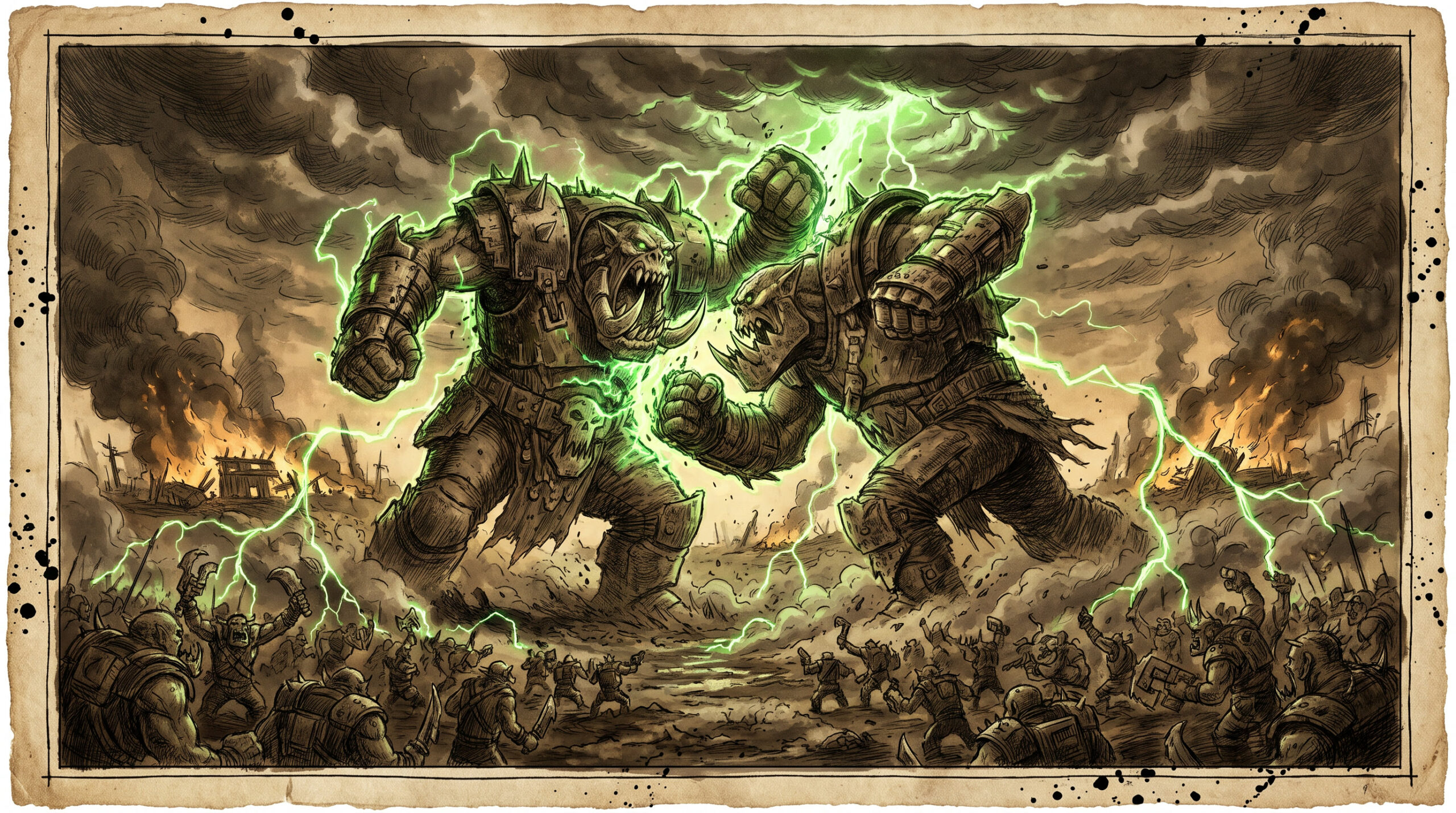
Gork and Mork: The Twin Gods of the Orks
One is brutally cunning. The other is cunningly brutal. The Orks have fought wars over which is which — and neither god has ever bothered to settle the matter.
Ask an Ork which of his gods is which, and you had best have a weapon to hand. The archives of the Ordo Xenos are thick with accounts of greenskin warbands turning upon one another mid-campaign, not over loot, nor territory, nor even the simple joy of a scrap, but over a point of theology so fine that no human savant has ever managed to write it down without laughing or weeping. One god is brutally cunning. The other is cunningly brutal. That is the whole of the difference. That is the whole of the schism.
And yet these two crude idols — squat, tusked, fists like anvils — are among the most dangerous divine presences in the galaxy. They do not scheme like the Architect of Fate. They do not hunger like the Prince of Excess. They simply are, vast and green and indestructible, and where their shadow falls across the immaterium, worlds burn. This chronicle sets down what the archives hold concerning Gork and Mork, gods of the Orks, and what remains — even now — unknown.
Gork and Mork: What the Xenologists Record
The Ork psyche, the tacticae assessments state plainly, is strong and robust beyond the measure of most species. Every sentient race casts a reflection in the mirror-universe of the warp; humanity’s fears and lusts congealed into the Ruinous Powers, and the Aeldari’s excesses birthed something worse still. The Orks, being creatures of appetite and violence and an almost geological confidence, cast a reflection that is correspondingly potent — and correspondingly simple.
What emerged is not a pantheon of subtleties but two enormous, belligerent, unkillable presences. Gork and Mork are said to dwell in a region the greenskins call the Great Green, a warp-realm no Navigator has ever charted and no Inquisitor has returned from describing. They are not worshipped in the human sense. There are no hymnals, no confessionals, no penance. There is only the expectation that if an Ork fights hard enough and loud enough, the gods will notice and lend their weight to the swing.
Brutally Cunning, Cunningly Brutal: The Great Schism
The distinction between the two deities is, by every record we possess, deliberately and gloriously absurd. One is brutally cunning. The other is cunningly brutal. Which is which depends entirely upon whom you ask, and Orks have gone to war over the answer.
In practice, a rough division of devotion exists. Gork is the god of the ordinary boyz — the direct manifestation of raw, joyous, uncomplicated force. He is the boot that comes down. Mork, meanwhile, is the god of the Oddboyz: the Meks with their impossible engines, the Weirdboyz crackling with borrowed Waaagh! energy, the sly and the strange. He is the kick you never saw coming.
Yet the tacticae are careful to note that in the grand accounting it does not appear to matter greatly which of the two an Ork invokes. Both are said to lend aid to individual greenskins in battle. Both are green. Both are enormous. Both, one suspects, would find the distinction between them a fine excuse for a fight.
Gargants: Idols That Walk and Kill
The most visible expression of Orkish faith is not a temple but a war engine. The titanic Gargants are raised in the image of the twin gods — living idols of iron and rivet and belching promethium, stomping across battlefields with the divine countenance grinning from their prows.
The archives record something curious about their construction. The Mekboyz who build them do not, so far as can be determined, work from plans. They work from a vision held in the imagination — a shape that comes to them, and comes most readily during a Waaagh!, when the psychic tide of the greenskin horde runs highest. Whether this constitutes genuine divine revelation, or merely the ordinary madness of a Mek with too many welding torches, our savants cannot agree. What is certain is that the results walk, and kill, and are very difficult indeed to stop.
Ghazghkull Mag Uruk Thraka, Prophet of the Waaagh!
No account of the Ork gods can omit the Beast of Armageddon. Ghazghkull Mag Uruk Thraka is named across a thousand greenskin tongues as the prophet of Gork and Mork, and the Orks believe — with the terrible sincerity that makes their belief a weapon — that the twin gods guide his wars personally, whispering to him the surest way to break each foe set before him.
The invasions of Armageddon bear the fingerprints of something more than warbossly instinct, and the Great Waaagh! that followed has carried his name across warzones without number. The greenskin faith in his prophethood is not incidental to his power; it may well be the engine of it. Where Orks believe, Orks converge, and where Orks converge, the Waaagh! grows.
Nor is Ghazghkull alone in claiming divine favour. In the Sanctus Reach, the warlord Grukk Face-rippa — who by the accounts of that campaign started his great Waaagh! more or less by accident — found fleets converging upon him weekly from across the system, drawn by the conviction that he was blessed by Gork himself. Every victory made the belief truer. Every believer made the victory likelier. Such is the arithmetic of greenskin godhood, and it is why Ork faith is a strategic threat rather than a curiosity.
Which Came First: The Gods or the Greenskins?
Here the archives fall into open dispute, and honesty compels us to record both positions rather than choose between them.
One tradition holds that the gods came first, and the Orkoid species was shaped in their image. Visions granted to the Primarch Vulkan, to Ghazghkull himself, and — most peculiarly — to the grot Makari are all cited in support of this reading: that the greenskins are living copies of something that was already stamping about in the warp before ever a spore fell on soil.
The contrary position is attributed to the notorious Mad Dok Grotsnik, who is recorded as claiming the reverse — that it was Orkoid belief and the raw pressure of Waaagh! energy that manufactured the gods, and not the other way about. Given the source, one hesitates to call it revealed truth. Given the source, one hesitates to dismiss it either.
Vulkan and the War of the Beast: A Glimpse of Creation
The single most extraordinary testimony in the file dates to the War of the Beast in M32, when the Ork warlord known simply as the Beast came nearer to breaking the Imperium than any greenskin before or since.
The accounts state that Vulkan, grappling with the Beast atop the Cathedral Gargant, forced them both into the raw Waaagh! energy that powered the machine. Within that torrent the Primarch is said to have witnessed the origin of the Orks — and to have seen Gork and Mork themselves, warring with one another at the beginning of time. From this he is held to have grasped the true nature of the greenskins: their relationship to Chaos, and their character as an emergent species that improves through nothing more sophisticated than endless, cheerful trial and error.
Whether the Primarch’s vision was literal history or a warp-born allegory, the archives do not say. The warp is a poor witness. But the notion of two gods brawling at the dawn of creation, and never once stopping, has an awful plausibility to it.
The Singing in the Madboyz’ Skulls
The gods are not always distant. Among the Weirdboyz and the maddened, there is talk of a summons — that Gork and Mork are singing the madboyz to the Waaagh!, drawing them west or east or wherever the greatest fight is brewing, whether or not the Ork in question wished to go. One such account preserved in our transcripts describes a greenskin who found himself dancing helplessly toward the horizon before the compulsion released him.
Set that beside the arithmetic of the Sanctus Reach, and the Imperial reader may draw a cold conclusion. The Ork gods do not need cathedrals. They need only enough greenskins in one place, believing hard enough, and the lightning does the rest.
Questions from the Archive
What is the difference between Gork and Mork?
One is brutally cunning and the other is cunningly brutal — and the Orks themselves cannot agree which is which, having fought wars over the question. In practice, Gork is generally revered by the ordinary boyz as raw brutal power, while Mork is the god of the Oddboyz, particularly cunning types such as Meks and Weirdboyz. The archives note that in the grand scheme it appears to make very little difference which of the two an Ork invokes.
Are Gork and Mork real gods, or did the Orks invent them?
The archives are genuinely divided. The Ork psyche is so robust that its reflection in the warp forms a potent presence, which is undisputed. But whether the gods preceded the Orks or the Orks preceded the gods remains contested: visions granted to Vulkan, Ghazghkull and the grot Makari suggest the Orkoid species emerged in the gods' image, whereas the Mad Dok Grotsnik is recorded as claiming that Orkoid belief and Waaagh! energy created the gods. No definitive answer survives.
Why is Ghazghkull called the prophet of Gork and Mork?
Ghazghkull Mag Uruk Thraka is hailed across the greenskin race as the chosen mouthpiece of the twin gods, who are said to guide his wars of conquest and reveal to him the surest means of defeating his enemies. This was held to be especially apparent during the invasions of Armageddon and the Great Waaagh! that followed. Whether the guidance is literal divine instruction or the Orks' own faith made manifest, the practical result — a galaxy-spanning Waaagh! — is the same.