The Cerberus Insurrection: When the War Hounds Met the Dait’Tar
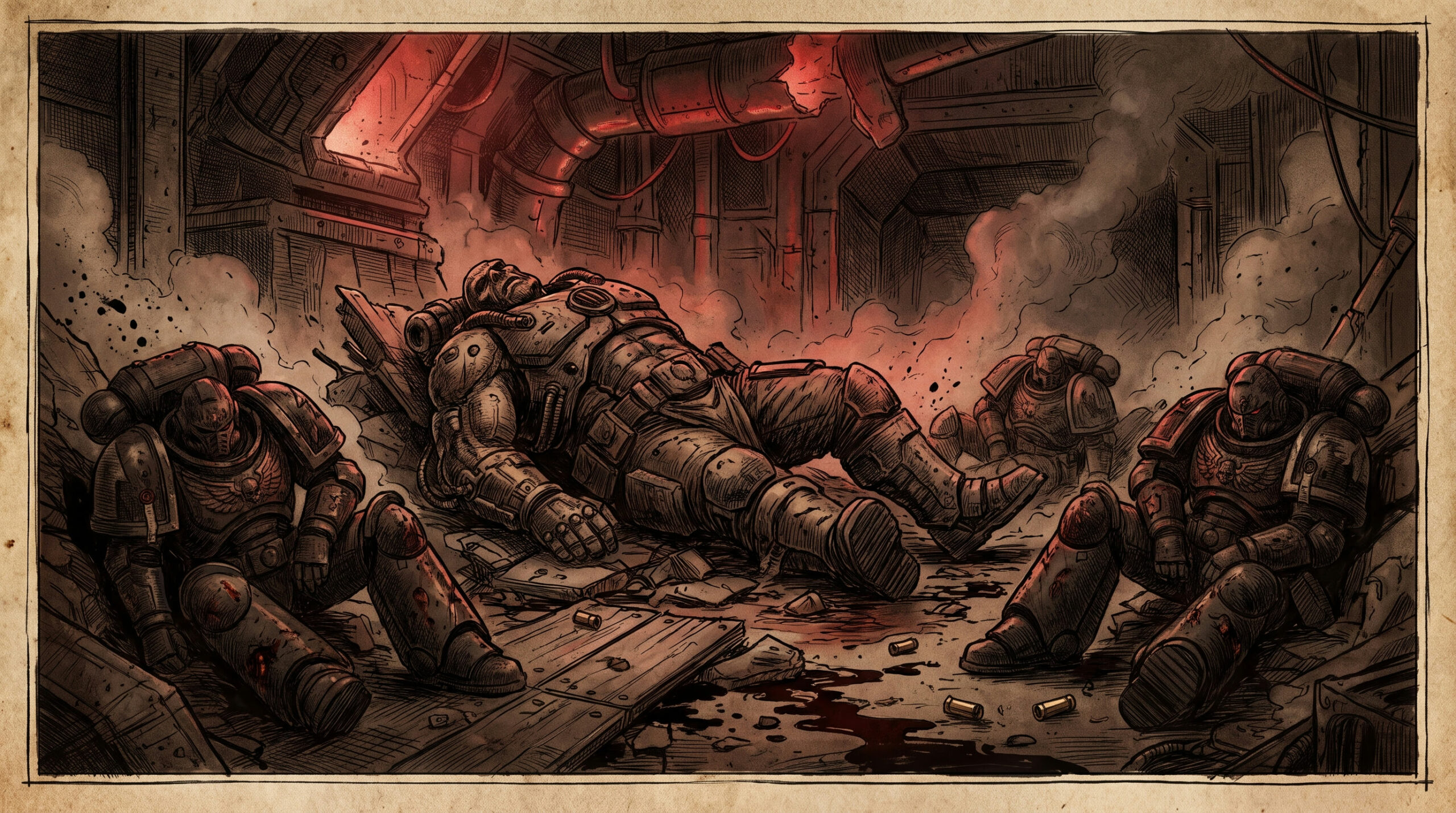
Four to five Astartes lay dead about each of the hulking carcasses. The Imperium buried the arithmetic, and then it buried the men who had done the counting.
There is a file in the deeper stacks that carries no campaign honour, no battle-standard citation, no illuminated plate. It is catalogued only by the name of a rock: Cerberus. A penal asteroid, a warren of tunnels and cell-galleries, a place built to hold what the young Imperium did not wish to look at. The archives record that it rose in revolt. They record that the matter was settled. They do not, in the ordinary way of Imperial records, boast about it.
That silence is the first clue. The second is the composition of the force sent to end it: not a compliance detachment, not a punitive fleet, but the XII Legion itself — then styled the War Hounds, later and more infamously the World Eaters — despatched by the Emperor’s own word while His other Legions were already outbound among the stars. Whole worlds have been reduced for less ceremony. A prison riot should not have merited it.
Unless, of course, the prisoners were not merely prisoners.
Cerberus: A Rock Built to Forget Things
The colony of Cerberus was an asteroid gaol, one of that grim archipelago of holding-worlds and rock-prisons scattered through the Sol reaches in the last years of Terran Unification and the first of the Great Crusade. Such places were the Imperium’s cellar. The archives are candid that a young dominion conquering its own homeworld generates a great deal that must be put somewhere: defeated techno-barbarian soldiery, oath-breakers, agitators, the merely inconvenient. Cerberus swallowed them.
What the records preserve of the insurrection’s beginning is not a plan but a temperature. Cerberus fell into a state of near-continuous rioting and mob violence — anarchic revolt rather than organised rebellion, the whole warren boiling at once. No manifesto survives. No demands were transmitted, or none that any surviving document reproduces. The rock simply stopped obeying.
The XXIInd Dracos Regiment and the First Repulse
The first response was orthodox and Terran. The XXIInd Dracos Regiment of the Imperial Army — mortal men, veterans of the homeworld’s own subjugation — was committed to impose order.
They were thrown back in disarray.
It is worth dwelling on that, because the Imperial Army of this era was not a militia. These were the soldiers who had walked over the corpse of old Terra, who had stormed hive-fortresses and techno-barbarian redoubts. Something in the tunnels of Cerberus broke their assault and sent the survivors reeling back to their transports, and in the reeling they brought word of what they had met. Among the insurrectionists was a cadre that should not have existed: outlawed Thunder Warriors, the Emperor’s first gene-forged legion, long believed dead to the last man.
They called themselves the Dait’Tar. The archives preserve the name and almost nothing else — not its language, not its meaning, not who among them chose it. The chronicler must be honest: whether the Dait’Tar were survivors of the Culling who had fled to the rock, or condemned men interned there by design, no surviving record states plainly. Both readings have their partisans in the scriptorium. Neither can be proven from the file.
Why the Emperor Sent the War Hounds
Imperial doctrine held, and would go on holding for ten thousand years, that the last of the Thunder Warriors died gloriously at Mount Arrarat in the closing battle of the Unification Wars, in the year 669 of the thirtieth millennium. It is a clean story. It is also, as the deeper files admit without ever quite saying so, a story.
Living Thunder Warriors were therefore not simply a military problem. They were a documentary one. A truth in armour, with a grudge, holding a fortified rock in the Emperor’s own back garden while His Legions sailed outward preaching the perfection of His new sons.
Most of the Space Marine Legions were already assigned to the first Expeditionary Fleets, outbound and beyond easy recall. And so the Emperor turned to the XII, and the instructions He gave were explicit: reclaim Cerberus colony, and carry His wrath to those who had defied Him. There is no clemency clause in that phrasing. The archives whisper that none was intended, and that the choice of the War Hounds — already the most brutal instrument in the young Legiones Astartes — was itself the sentence.
Whether the XII fought here under any primarch’s hand is not something this file will assert. The Legion bore its Terran name, its lord was yet to be found upon Nuceria, and the sagas that grew up afterwards are not to be trusted on the point.
The Slaughter of the Prisoners
Against the general population of Cerberus, the War Hounds performed precisely as designed. The record is a single flat sentence and needs no embellishment: they slaughtered all prisoners. Cell-blocks, galleries, feeding-halls, the improvised barricades of men armed with cutting tools and looted lasguns — all of it went under. Rooms were reduced to blood-soaked charnel houses. Weapons were found abandoned where their owners had, at the last, simply run.
This was the part of the operation that went to plan, and it took a fraction of the time.
Five Hours in the Tunnels: The Dait’Tar Stand
Then the XII found the Dait’Tar, and the confidence of the Emperor’s new angels was shaken in the dark.
The Thunder Warriors were greatly outnumbered — by Astartes and by Guardsmen both. It did not matter as much as it should have. They held their ground in the bleak tunnels, in corridors too narrow for manoeuvre, where reach and mass and sheer sustained savagery counted for everything and tactical elegance counted for nothing. Mark I Thunder plate, chainblades, fists. The fighting was close-quarters from first contact to last.
It lasted five hours.
Five hours is an eternity in a boarding action. Legion assault doctrine measured such engagements in minutes. And when at last the signal came that Cerberus-Primary had been returned to Imperial Compliance, the arithmetic of the tunnels was there to be read by anyone with the stomach for it.
Four to Five Dead Around Each Carcass
The second wave of Imperial Army troops was ordered forward to the bleak business of clean-up: hunting through the warren for survivors. There proved to be precious few — the War Hounds are not a Legion that leaves loose ends breathing.
What those troopers found instead entered the record as multiple independent reports, and it is the most damning passage in the entire file. Again and again they came upon the hulking carcass of a Thunder Warrior, and around it, four to five dead Space Marines.
Not one. Four. Five.
The Legiones Astartes were the Emperor’s improvement upon His first work — longer-lived, stabler, sane. Cerberus recorded, in the plainest currency there is, that in the matter of killing at arm’s length the discarded pattern remained the superior one. The archives do not editorialise. They simply preserve the ratio, and let ten thousand years of readers do the rest.
The Sealing of the Record
Aside from these bare facts, much else remains a mystery. The entire insurrection was kept highly secret by the Imperium, and it is not difficult to reconstruct why. Two truths came out of that rock and neither could be permitted to travel: that Thunder Warriors had outlived the official myth of their glorious extinction, and that they had died only at a price of four or five Astartes apiece.
So Cerberus was buried. No honour was struck. No campaign name was sung in the XII Legion’s halls, so far as any surviving muster-roll shows. The Dait’Tar were unmade, their name reduced to five letters in a sealed dossier, and the young Imperium turned its face outward to the stars with its narrative intact.
The scriptorium notes, without drawing conclusions, that the War Hounds of Cerberus would in time become the World Eaters, and that whatever was learned in those tunnels about the pleasure of close slaughter was not thereafter forgotten. No record survives to say the two things are connected. The archivist merely observes that they lie adjacent in the file.
Questions from the Archive
What was the Cerberus Insurrection?
A revolt on the asteroid prison colony of Cerberus during the early Imperium, in which the inmates rose in anarchic rioting and were found to be bolstered by a renegade cadre of outlawed Thunder Warriors calling themselves the Dait'Tar. After the Terran XXIInd Dracos Regiment was thrown back, the Emperor despatched the XII Legion — then the War Hounds, later the World Eaters — to retake the rock. All the prisoners were slaughtered and the colony returned to Imperial Compliance. The whole affair was then classified.</p>
Were Thunder Warriors really stronger than Space Marines?
On the evidence of Cerberus, in close combat, yes. The Imperial Army troops sent in for clean-up operations reported repeatedly finding the carcass of a single Thunder Warrior with four to five dead Space Marines around it, and the Dait'Tar held the tunnels for five hours despite being heavily outnumbered by Astartes and Guardsmen alike. Broader lore holds the Thunder Warriors were stronger, more savage and more resilient than the Astartes, but far shorter-lived and prone to mental collapse and metabolic failure — which is precisely why they were superseded.
Why did the Imperium keep the Cerberus Insurrection secret?
Two reasons suggest themselves from the record. First, official Imperial history insisted the last Thunder Warriors died heroically at Mount Arrarat in 669.M30, and living survivors in revolt made a lie of that. Second, the casualty ratio in the tunnels demonstrated that the Emperor's discarded first-generation warriors could out-fight His new Legiones Astartes at close quarters. Neither truth served the Great Crusade, so the file was sealed and much of the detail remains a mystery.