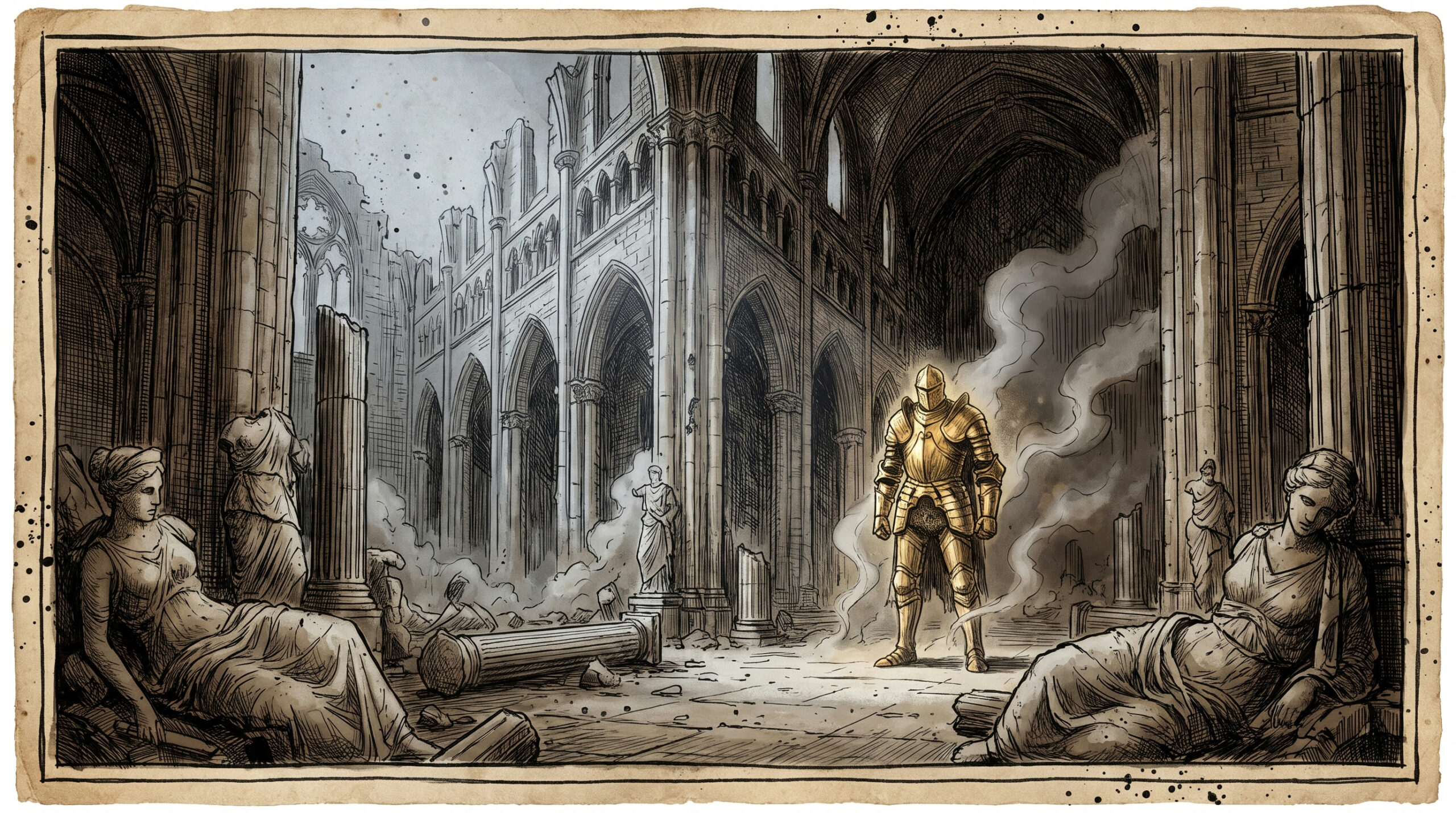
The Imperial Truth: The Great Lie That Built an Empire
The Emperor cast down every god and every altar — then commanded that no man call Him one. The archives whisper that the greatest fiction of all wore the mask of fact.
In the last two centuries of the thirtieth millennium, humanity was told a bold and beautiful thing: that there were no gods, that the cosmos was rational, and that fear was merely ignorance yet to be conquered. This was the Imperial Truth — the creed the Emperor carried out of Terra and pressed upon a galaxy of broken worlds. It was, by the accounts that survive, the noblest doctrine the species ever raised. It was also, the archives whisper, a lie the Emperor knew to be false even as He proclaimed it.
To read the surviving sources is to hear two voices at war: the confident materialist and the desperate concealer. Understand the tension between them, and you understand why the Imperium of the forty-first millennium worships the very man who forbade His own worship.
The Doctrine of Reason: What the Imperial Truth Actually Was
At its heart the Imperial Truth held that the universe was rational — that knowledge defeated fear and delivered mankind from the terrors of Old Night. It was an atheistic, materialist, and rationalist ideology, pioneered by the Emperor on Terra even before the Great Crusade began, and defined by reason, respect for the methodology of science, and secular progress.
The Herator Prime Kyril Sindermann framed it in words the archives preserve with unusual clarity. Religion, he declared, had damned our species for thousands of years, driving mankind to madness, to war, to murder. Faith in demons, spirits, and afterlives were simple tools for simple minds. Humanity had at last witnessed the cosmos and understood the fabric of reality: there were no gods, and no need for gods.
Note the precision of the denial. The Truth did not pretend that other dimensions, alien species, or psychic powers were fictions — such things plainly existed. It insisted only that they were not supernatural. Those who named them sorcery, or laid them at the feet of gods, merely betrayed an incomplete understanding of reality.
The Emperor’s Purpose: Uniting a Shattered Species
The Imperial Truth was never mere philosophy. It was the ideological engine of the Great Crusade, that vast reconquest that ran from roughly 798.M30 across a little over two centuries, dragging the scattered colony worlds of mankind back beneath a single banner after five thousand years of the Age of Strife.
To carry it, the Emperor forged the Space Marine Legions and the Imperial Army; behind them came the Mechanicum, and behind them the Remembrancers — millions of official artists and chroniclers dispatched to record humanity’s rebirth. Every compliant world was to receive the light of the Truth and cast off its idols. The Emperor believed, the histories say, that the terrors of the past had grown in the shadow of superstition, and that a reborn humanity could not survive if it tolerated the delusions that had nearly destroyed it.
The Great Lie at the Heart of the Truth
Here the archives darken. For the Emperor is recorded elsewhere as a Perpetual and the mightiest human psyker ever born — a being who knew, better than any, that the Warp was real and that its predatory powers hungered. If the Chaos Gods feed upon belief, then to deny them belief is to starve them. A galaxy that does not pray raises no daemons.
This is the accusation the traitors would later hurl. In the sagas of a later age, the Iron Warrior Kalkator spits it plainly: that his kind had abandoned the service of a liar who concealed the truth of reality from those who loved Him, who hid behind untruths and oppression. Whether one calls this the confession of a damned soul or the bitter clarity of the betrayed, the charge cuts to the bone: the Imperial Truth, the doctrine of pure fact, may itself have been the greatest concealment in human history.
The Serpent in the Scriptorium: When Truth Became Myth
Even within the Great Crusade, the Truth was already rotting into its opposite. The archives preserve a telling exchange aboard the fleets, where the architect Olivier quarrelled with a Remembrancer over the eighteen books being written of the Primarchs. He wanted biography; she demanded hagiography.
‘The Imperium needs the facts,’ he insisted. ‘I won’t be part of myth making.’ She answered that the Primarchs transcend the truth, that they were not people, and that these books were the beginning of a new scripture. When he demanded whether this was the real meaning of the Imperial Truth — whether she had thrown in her lot with those who whispered the Emperor was a god — her reply was simple and fervent: ‘The Emperor is a god.’
So the double-headed eagle, once the emblem of reason, was worn openly as a pendant of faith. The chroniclers charged with recording fact had already begun manufacturing scripture. The instrument of the Truth had turned in the hand.
The Lectitio Divinitatus: The Faith the Emperor Forbade
Against the rigorous comfort of the Imperial Truth rose its shadow: the Lectitio Divinitatus, the Divine Word of the Emperor. Its adherents preached that His hand lay upon all men, that in the depths of the Warp His mighty soul did battle with the dark things that would break through and consume mankind — and that, above all, the Emperor protects.
The Emperor himself is said to have loathed this creed. He had cast down the priests of a hundred worlds; the last thing He desired was to become the object of a new religion. Yet the faith spread through the Legions and the mortal masses alike, and the archives note the grim irony that some who feared damnation were, in their devotion, closer to the terrible truth of the Warp than the rationalists who denied it.
The Death of the Truth and the Corpse-God’s Church
The Horus Heresy shattered the Imperial Truth utterly. When the Emperor was interred, broken, within the Golden Throne, the doctrine of reason could not long survive the sight of a martyred saviour sustained by daily sacrifice. From the ashes rose the Imperial Cult — the Ecclesiarchy — which enshrined the Emperor as the very god He had forbidden men to name.
The result would have horrified Him: technological stagnation, a regression into superstition and religious intolerance, and an Imperium bound together not by facts but by faith, by martyrdom, and by dread. A few Space Marine Chapters, the records note, still observe a form of the older Imperial Truth even now — cold remnants of reason in a galaxy that chose to kneel. But the wider Imperium of the forty-first millennium is the Truth’s exact inversion: a theocracy raised upon the grave of atheism, worshipping the man who told them there were no gods.
Questions from the Archive
Questions from the Archive
What is the Imperial Truth in Warhammer 40k?
The Imperial Truth was the atheistic, rationalist ideology proclaimed by the Emperor of Mankind during the Unification Wars and the Great Crusade. It held that the universe was rational, that knowledge defeated fear, and that there were no gods and no need for gods — replacing the superstition and religion that had defined mankind through the Age of Strife.
Why did the Emperor promote atheism if he knew the Chaos Gods were real?
The archives and later traitor testimonies suggest the Emperor understood that the Warp and its powers feed upon belief and worship — so denying them faith would starve them. Whether this makes the Truth a noble strategy or, as the Iron Warrior Kalkator charged, the concealment of a 'liar' who hid reality from those who loved Him, remains one of the darkest debates in Imperial history.
What replaced the Imperial Truth after the Horus Heresy?
Following the Emperor's internment in the Golden Throne, the Imperial Cult — administered by the Ecclesiarchy — rose to enshrine the Emperor as a god, the very worship He had forbidden. This was the exact inversion of the Imperial Truth, though a few Space Marine Chapters are recorded as still observing a form of the older, secular creed.