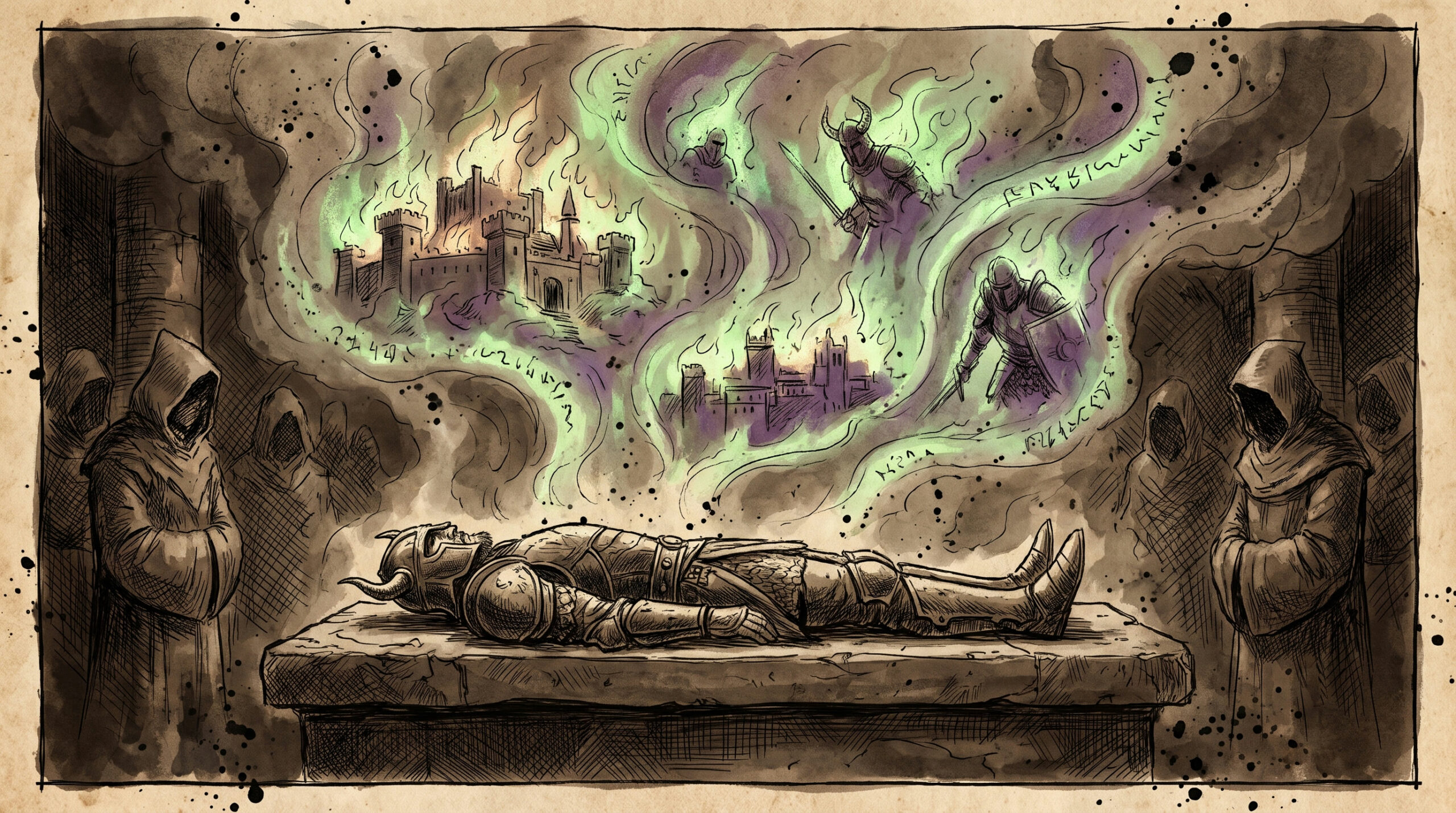
The Coma-Vision of Horus: A False Prophecy on Davin’s Moon
They promised the Warmaster something he would want to see. What they showed him on the fever-tables of Davin was a lie dressed as revelation — and he swallowed it whole.
The archives whisper of a single wound that split the galaxy in two. Not the anathame’s poison that laid the Warmaster low upon the moon of Davin, though that was terrible enough — but the dream it opened. For while Horus Lupercal lay dying in the Temple of the Serpent Lodge, his flesh raging with corruption, his soul was carried down into a swirling vortex beneath Terra and shown a future. Or so he was made to believe.
The sagas tell us that the greatest of the Emperor’s sons, beloved above all his brothers, was undone not by a blade but by a vision — a cunning fiction stitched together by powers that knew precisely how to break a proud and loving heart. What follows is drawn from the chronicles of Graham McNeill’s account of those days, and where the record grows uncertain, we say so plainly.
The Wound at the Temple of the Serpent Lodge
The poisoned blade was called an anathame, and it did what no honest weapon could: it opened the Warmaster’s spirit to the manipulations of the Warp. As Horus wasted upon the sickbed, the shamans of the Davinite lodge worked their rites, and a decision was made to cast his soul into the immaterium to save his failing body. It was here, the archives record, that a voice offered him something he would want to see. The trap was baited with the one thing a devoted son could never refuse: the truth of what he served.
Home Again: The Black Sands of Cthonia
Horus opened his eyes to a sky thick with polluted clouds, the air chemical and stagnant. It smelled of home. He lay upon an uneven plateau of dusty black powder before a long-exhausted mining tunnel, and felt the hollow ache of homesickness as he realised this was Cthonia — the hive world that had forged him, where the foundries smogged the heavens and deep-core mining hammered without end. He looked for his old comrade Sejanus, but the vortex beneath Terra had not swept him up. The Warmaster walked his boyhood world alone, and the loneliness of simpler times sat heavy upon him. It was a masterful opening gambit: to begin the deception in a place he could never doubt.
The Firestorm and the Burning Heavens
Yet the vision would not let him rest in nostalgia. The void conspired against comfort, and a new world faded up — a terrible place of bone-white sands and blood-red mountains beneath skies lit by global fires. The air tasted of ash and regret, of sorrow and fecundity. He heard the clash of swords, but saw no battle; the plaintive cries of lovers, but no flesh; whispers surrounding him, plotting and scheming, while he felt the cyclic entropy of his own body — old cells dying, new born to replace them. When he blinked away the heat, he understood the orange above him was not the reflection of a blaze but the blaze itself. The heavens burned from horizon to horizon. The archives do not name this world with certainty, but the imagery drips with the fingerprints of the Ruinous Powers.
An Imperium That Worshipped Its Maker
The secondary chronicles hold that the heart of the vision was a future Imperium transformed into a repressive theocracy — a galaxy on its knees, worshipping the Emperor and the primarchs as gods. All the primarchs, that is, save one. In this false tomorrow, Horus alone was cast out, forgotten or reviled, his labours in the Great Crusade turned to the glory of a divine Emperor who had never desired worship — or so the young Warmaster had always believed. To a son who had bled for a secular, rational dominion of Man, no torment could cut deeper than to be shown his father enthroned as a god upon the ruins of everything they had built together.
The Cruel Genius of the Lie
Here the archivist must set down the bitterest irony recorded in these annals. The theocratic, dehumanising Imperium the vision paraded before him was no honest prophecy — it was, in the main, a future his own treason would help create. The Ecclesiarchy, the god-worship, the stagnant and repressive Age of the Imperium: these grew from the ashes of the very war the vision goaded him into starting. The powers that showed him the wound had first ensured he would inflict it. They did not predict the future. They sold him one and charged him his soul.
Dagonet and the Foothold
The archives further whisper that the vision was not only a wound but a map. Within its swirling deceptions, the record suggests, Horus was shown — or led to conceive — the world of Dagonet as a foothold for what was to come. Whether this was genuine strategic foresight granted by his manipulators, or merely the seed of a plan planted in a fevered mind, the sagas do not agree. What is certain is that when the Warmaster returned to his flesh, he returned changed, and the machinery of betrayal began at once to turn.
The Vision and the Vengeance
Consider what the Warmaster became once the dream had done its work. In the accounts of the Siege of Terra, those close to him could find no vision of the future in him at all — only a mind so consumed by the present, so gorged on the gods’ vindictiveness, that it could see no further than its own horizon of vengeance. Would Horus rule as Emperor from the ruins of the Throne he meant to shatter? Or would it all dissolve, the traitors scattering like ants without a queen? He never said. Perhaps the truth is that the coma-vision gave him not a future to build but only a grievance to burn for — and in the end, let the galaxy burn, so long as the tyrant fell.
So the record closes on Davin’s moon, where a loving son was shown a lie and mistook it for a warning. The tragedy of the Horus Heresy, the archives murmur, is that every horror the vision promised came true — because the Warmaster believed it, and made it so.
Questions from the Archive
What did Horus see in his coma-vision on Davin?
While his soul was cast into the Warp to save his poisoned body, Horus was shown his homeworld of Cthonia, a world with burning skies, and — according to the chronicles — a future Imperium turned into a repressive theocracy that worshipped the Emperor and the primarchs as gods, with Horus alone cast out and reviled.
Was the vision of the future real or a trick?
It was a manipulation. The powers that showed Horus this future had first arranged his corruption, and the grim theocratic Imperium he was shown was largely the result of the very war the vision provoked him into starting. They did not reveal the future so much as sell him a lie to bring it about.
How did the vision lead to the Horus Heresy?
The vision preyed on Horus's deepest fear — that his father secretly sought godhood and would discard him. Convinced he had been betrayed by the Emperor's ambition, the Warmaster returned from his coma resolved to rebel, and the archives suggest the vision even helped shape early plans, such as using the world of Dagonet as a foothold.