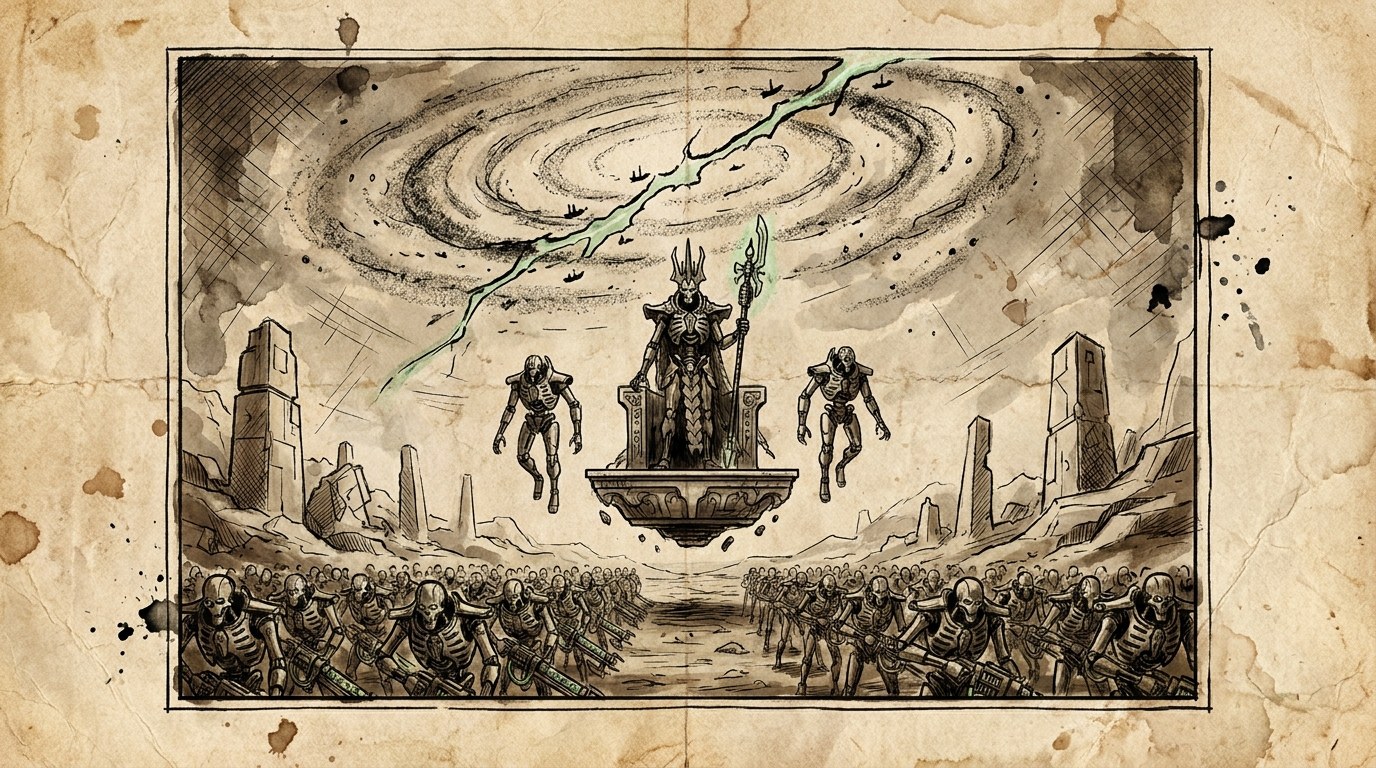
The Era Indomitus: The Present Dark
The Silent King has returned, the Rift bleeds daemons, and half the Imperium fights by faith alone. A chronicle of the 42nd Millennium — the page still being written.
It is the Forty-Second Millennium, and there is only war. Every other page in this archive is history; this one is a wound still bleeding. I write it in the present tense, and I do not know how it ends — which makes this, reader, the only chronicle in the scriptorium that you and I inhabit together. Attend closely. This is the shape of the dark we are standing in.
A Galaxy Riven
Take the measure of the present dark. The Great Rift stands open from the Eye to the galaxy’s far shore, bleeding daemons into realspace along its whole burning length. Sunward of it, the Imperium Sanctus musters and endures under the Lord Commander’s reforms — a living primarch governing from Terra for the first time in ten thousand years, his crusade concluded but his wars multiplying. Beyond it, the Imperium Nihilus — half of mankind’s realm — fights on in the dark beneath its Regent, its worlds lit by no Astronomican, holding by faith, stubbornness and the strength of whatever garrison stood upon them when the Blackness fell. The chronicles that cross the storm come years late or not at all. Some worlds out there, it must be assumed, still fight for an Imperium they have not heard from in a century. Some, it must equally be assumed, have stopped. Between the halves, the crossings — Nachmund and its desperate kin — are wars in themselves. That is the map, reader, insofar as the age permits maps at all.
The New Reckoning
Even the age’s name is a claim staked in darkness. Era Indomitus — the epoch of the unconquered — takes its title from the crusade that saved what could be saved, and its calendar from catastrophe: by the Lord Commander’s decree, the new chronicles reckon their years from the Rift’s own opening. Sit with both facts together and you have the age entire. Mankind numbers its days from the hour the sky broke — and names the era for its refusal to break with it. I have shelved ten millennia of ages named by historians safely after the fact. This one named itself in the middle of the fight, and the name is not a description, reader. It is a vow.
The Silent King Returns
And the elder powers are moving. Szarekh, the Silent King — he who led the necrontyr into the furnaces of biotransference and crowned himself with that guilt; who broke his own gods, sealed his race into the tomb-worlds, and exiled himself into the void between the galaxies — has come back. The chronicles place his return in the closing centuries of the old millennium, and the cause in what he met out in that outer darkness: the tyranid hive fleets, inbound and endless. Understand his terror precisely, for it is not for his existence but for his hope: if the hunger devours all life in the galaxy, there will never again be living flesh for his people to reclaim — and the undoing of biotransference is the last duty and whole penance of the Silent King. For decades he moved in shadow, the records say — his identity hidden even from his own kind, working through Triarch Praetorians and unwitting overlords, waking tomb-world after tomb-world along a pilgrimage only he could chart. That patience has ended. He moves openly now, throned upon the Dias of Dominion with phaerons at his side and, the darkest reports insist, a shackled fragment of a star-god — the Enchained — bound to his service. Sixty million years after the War in Heaven, its king has resumed the board, and he is not playing for territory. He is playing for his species’ soul — in the most literal sense that phrase has ever carried in this archive.
The Pariah Nexus — a Silence Spreading
His great work has a name now, and the Imperium speaks it only in sealed reports: the Pariah Nexus. Begun in earnest after the Rift tore open — the Silent King, ever the strategist, accelerating his design to answer the galaxy’s new madness — it is a swathe of space in which works of ancient blackstone still the Warp itself: a region where the empyrean’s tides fall silent, where psykers gutter, where the very souls of the living burn low like starved candles. Set it beside the pylons of dead Cadia and understand what you are looking at, reader — the same elder science, applied at the scale of sectors. Against the daemon it is a fortress; that much even Imperial savants concede in their locked studies. But mankind inside it wanes like a lamp under glass, and the Imperium contests the Nexus desperately — the chronicles record the arch-magos Cawl himself and a full battle group of the crusade’s veterans committed to that silent front. And, most tellingly of all: other necrons contest it too. The Stormlord Imotekh of the Sautekh, fiercest of the risen phaerons, has raised open revolt against the Silent King’s authority and his restorationist dream both — necron against necron, dynasty against dynasty, civil war among the deathless. Even the eldest power in the galaxy, it transpires, cannot agree what to do with it. I find that either comforting or terrifying, depending on the hour.
The Hungers That Remain
The rest of the ledger reads no kinder. The tyranid shadow swallows whole sectors, and the magi biologis have stopped pretending the fleets already beaten were anything but reconnaissance — the newest despatches, still unverified as I write, speak of a fresh tendril of Leviathan driving in from the galactic west on a course the cartographers will not say aloud, though every one of them has drawn it: toward Terra. Ghazghkull’s greenskin millions still make Armageddon a byword for war without end, and the prophet of the Waaagh! grows stronger with every year the Imperium cannot spare to finish him. From the Rift’s length the Ruinous Powers press their advantage against a divided prey, and the whisper-chronicles insist the Despoiler is not finished — that Cadia was an opening move, not a checkmate. And through it all runs the strangest current of the age: the psychic awakening, souls kindling across mankind like candles in a rising wind as the Warp’s tide climbs — a blessing, a plague, a weapon and a doom, frequently in the same person. The Emperor foresaw, the deepest records say, that mankind must become a psychic race or perish. The Era Indomitus appears determined to run the experiment at full scale, with the whole species as the crucible.
What Stands Against the Night
Against all of it stands an Imperium that is, by every honest measure, poorer, harder and more haunted than the one this archive first served — and that possesses, in the same breath, assets no age before it could claim. A living primarch at the head of the state, reforming with one hand what he defends with the other. New-made legions of Primaris Astartes, still being founded, still arriving at wars their firstborn brothers have held alone for decades. A Regent in the dark half, Dante of Baal, oldest mortal servant of the Throne, proving year upon year that Nihilus can be governed and not merely mourned. The Custodes abroad from Terra at last; the Sisters at their eternal watch; the Deathwatch at theirs. And beneath it all, the asset no ledger can weigh: a citizenry whose faith has been disappointed ten thousand times and extinguished never. The Imperium of the Era Indomitus is a wounded thing fighting a war on every border at once. It is also — and the chronicles of every prior age in this scriptorium testify how much this matters — entirely accustomed to that condition.
The Chronicle Still Being Written
I will not insult you with prophecy. The savants of every power in the galaxy read the same signs and promise their masters victory, and most of them are wrong, and none of them know which. What an archivist can say is this: every age in this chronicle — every single one — was called the end of days by those who lived in it, and every one of them was survived by someone who wrote it down. The Elder Ages ended and were recorded; Old Night lifted and was recorded; the Heresy failed of its final object and was recorded, in this very room. That is not hope, exactly. It is precedent. In this Millennium, precedent is what passes for light — and the lamp, reader, is in your hands now as much as mine.
This is the present dark. This is where the chronicle is still being written — in blood, in faith, and in the archives of the Scriptorium. When the next page is fit to bind, reader, you will find it here. Until then: the Emperor protects, the record endures, and the war, as ever, is only war. There has always been only war. And we are, against every probability this archive contains, still here to say so.
Questions from the Archive
What is the Era Indomitus?
The Era Indomitus is the current epoch of the Warhammer 40,000 setting — the years following the Great Rift’s opening and the Indomitus Crusade, in the early 42nd Millennium. It is an age of galactic war on every front: the Rift bleeding daemons into realspace, the necron dynasties rising, the tyranid shadow spreading, and the Imperium fighting on, divided in two.
When did the Silent King return?
The chronicles place Szarekh’s return to the galaxy in the closing centuries of the 41st Millennium — after sixty million years of self-imposed exile in the intergalactic void, where he had encountered the approaching tyranid hive fleets. For decades he worked through proxies, concealing even his identity; only in the Era Indomitus has the last Silent King moved openly at the head of the necron dynasties.
Why has the Silent King returned?
Because the tyranids threaten everything his species still hopes for. If the hive fleets devour all organic life, the necrons will never reclaim living bodies for their consciousnesses — the restoration Szarekh regards as his final duty and his penance for biotransference. He has returned to wake the tomb-worlds, reunite the fractious dynasties, and secure the galaxy against the hunger — under his rule, and no other’s.
What is the Pariah Nexus?
The Pariah Nexus is a vast region of space, begun in earnest after the Great Rift opened, where the Silent King’s works of ancient blackstone suppress the Warp itself — a swathe of the galaxy where souls gutter like starved candles and the sea of the empyrean falls still. The Imperium contests it desperately; so, tellingly, do other necrons, for the Stormlord Imotekh has risen in open revolt against the Silent King’s design.
Is the Imperium winning in the Era Indomitus?
No honest chronicler would say so — but neither is it losing everywhere. The Indomitus Crusade stabilised the front; Imperium Nihilus endures beyond the Rift under its Regent, Dante of the Blood Angels; a living primarch governs from Terra; and mankind still holds more of the galaxy than any rival. The Imperium’s own scribes call the age a fighting retreat that refuses to end.