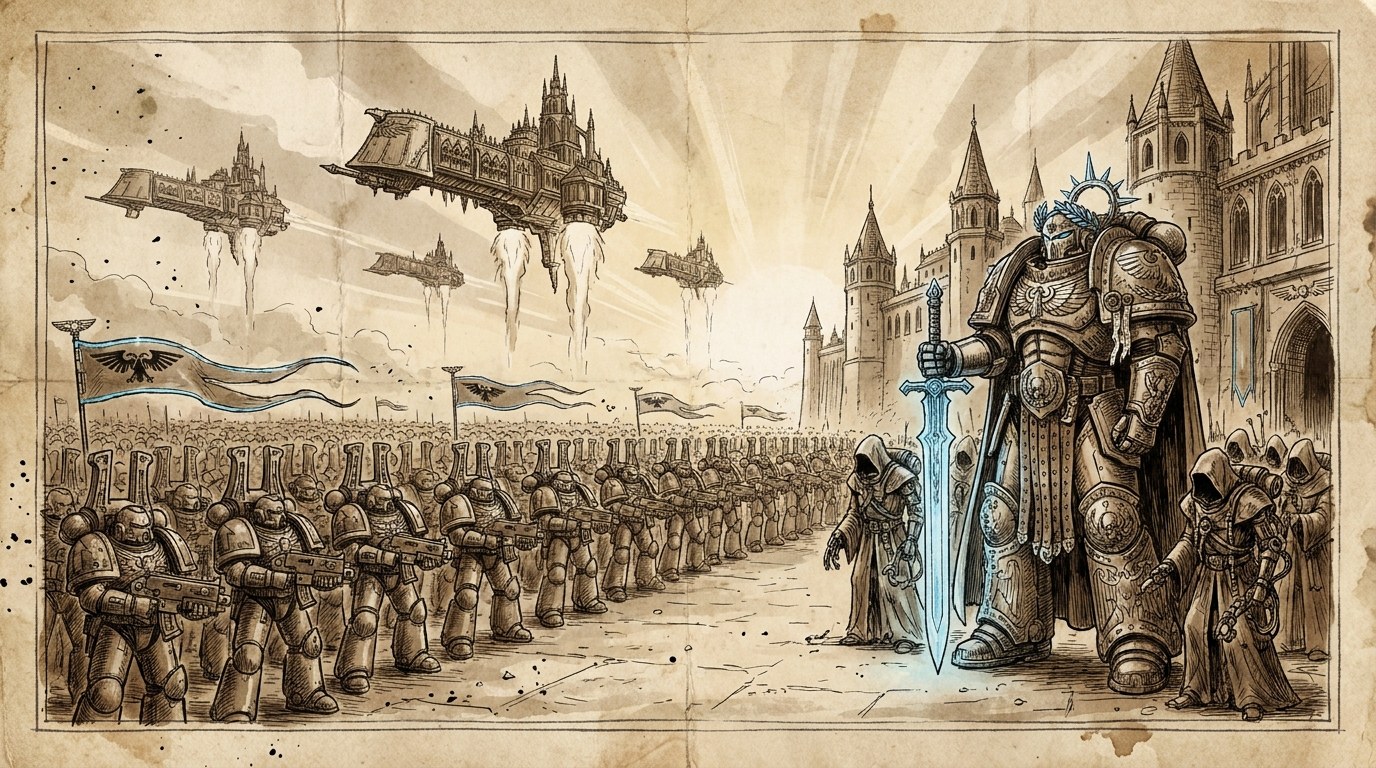
The Indomitus Crusade: The Greatest Muster Since the Heresy
A resurrected primarch, a new breed of Space Marine, and a century of unbroken war to stitch a sundered Imperium back together. A chronicle of the Indomitus Crusade.
Despair is a sin, but I will confess to its temptation: with Cadia dead and the galaxy torn in half, even this archive began to read like a chronicle of endings. Then a dead man rose from his throne of stasis, and the Imperium remembered how to march. This is the chronicle of the Indomitus Crusade — of the resurrection that made it possible, the new legions that gave it teeth, and the century of war by which a sundered species was stitched, roughly and bloodily, back into one.
The Resurrection on Macragge
Begin with the miracle, for the age demanded nothing less. For ten thousand years, Roboute Guilliman — primarch of the Ultramarines, author of the Codex, architect of the post-Heresy Imperium — had sat enthroned in the Temple of Correction on Macragge: not dead, not living, frozen in stasis at the instant of his mortal wounding by a traitor brother’s envenomed blade. Ten millennia of pilgrims had prayed before the wound. What answered, in the end, was not prayer but the strangest alliance this archive records: Belisarius Cawl, Archmagos Dominus of Mars, bearing arts the Mechanicus itself would blanch at — and the Ynnari, aeldari zealots of their newborn god of the dead, whose emissary Yvraine carried power over the threshold between death and life. On the eve of the galaxy’s tearing, amid a Black Legion invasion of Macragge itself, the stasis field was opened and the wound of ten thousand years was mended. A son of the Emperor stood among the living. I have verified the sentence against every record available to this scriptorium and it remains, each time I write it, an impossibility: he came back.
The Road to Terra
What followed resurrection was not triumph but a gauntlet. Guilliman’s first act was to set course for Terra — and the voyage, undertaken as the Rift tore open and the Blackness fell, was itself a war: the fullest records tell of ambush and capture, of imprisonment in the Warp’s own gaols, of a rescue by allies stranger even than those who had raised him, and of a final battle against a daemon primarch — his own brother of old — at the very threshold of the Throneworld. I mark those pages as disputed, for the accounts contradict one another in the manner of all stories that pass through the Warp. What no account disputes is the arrival: through darkness and dying light, a loyal primarch came to Terra for the first time in ten thousand years, and walked alone into the Sanctum Imperialis to speak with his father.
Before the Throne
What passed between the Emperor and His returned son, no record holds; Guilliman has spoken of it only in fragments, and the fragments do not comfort. What emerged from that room was purpose. Guilliman took up the title he had borne in elder days — Lord Commander of the Imperium — and to it was joined another: Imperial Regent, the Emperor’s own voice in the governance of His realm. The High Lords who had presided over the Time of Ending were, the records note with dry satisfaction, reformed — some retired, some replaced, all reminded of their purpose. And the Lord Commander looked upon the Imperium he had spent his first life designing: the creed he had never sanctioned enthroned as state religion, the Codex he had written ossified into scripture, half the realm lost behind a scar in the sky. His verdict, the honest chronicles admit, was harsher than his propagandists preferred. He did not, however, permit the verdict to delay the work. Within the year, Terra rang with the greatest muster since the Heresy.
The Ultima Founding — Cawl’s Ten-Thousand-Year Secret
He did not march with the armies of the past. Before his wounding, ten thousand years gone, Guilliman had given Belisarius Cawl a commission and a treasure — the commission, to forge a new and better Space Marine; the treasure, gene-stock derived of the primarchs themselves, sealed in the archmagos’s keeping. For a hundred centuries Cawl had laboured on that work in secret, perfecting it far beyond the letter of his orders. The Rift forced the great work into the light. In the Ultima Founding, the Primaris Space Marines were raised in numbers not seen since the Great Crusade: larger, faster and more resilient than their firstborn brothers, armoured and armed in patterns ten millennia in refinement — reinforcements for Chapters bled white by the Time of Ending, and hundreds of entirely new Chapters besides, many seeded deliberately along the Rift’s burning edge. The firstborn Chapters received their new brothers with everything from joy to cold suspicion — the records are human, whatever the subjects’ gene-craft — but they received them. The age was too dark for pride, and every Chapter Master could count.
The Fleets Set Out
The crusade sailed not as one armada but as several great battlefleets, and the order of their going tells the strategy. Fleet Tertius was first into action — cleansing the approaches of Sol itself, where a Khornate horde the records name the Crusade of Slaughter had dared the home system, before driving on into the Segmentum Pacificus. Fleet Secundus struck next into the Segmentum Obscurus, spearheaded by the Battle Sisters of the Ebon Chalice and Our Martyred Lady, on a campaign whose name is its own chronicle: the Road of Martyrs. And third from Terra came Fleet Primus — the greatest, under the Lord Commander’s own hand, bearing the largest muster of Primaris Greyshields and, in the colossal ark Zar-Quaesitor, Cawl himself with legions more asleep in its holds. With them marched the Adeptus Custodes — abroad from Terra at last — the Sisters of Silence, the Guard, the Navy, the Mechanicus, the engines of the Collegia Titanica and the knightly houses. The Grey Knights cleansed Ganymede in Sol’s own orbit and raised it into a hub-fortress for the crusade’s logistics. And with the Astronomican still weak, the fleets dared only short Warp-jumps — feeling their way outward through a broken galaxy, fanning into spearheads that split and split again, until the crusade was less an armada than a tide.
A Hundred Worlds Dragged Back
The chronicles of the campaigns would fill this scriptorium — and one day, Emperor willing, they shall. Here let the pattern stand for the whole: a world burning alone since the Blackness, its defenders praying to a Throne they could no longer feel; then new stars descending — giants in unfamiliar armour, banners of a primarch out of legend — and the line, everywhere, holding. Wherever the battle groups found heretic hosts they broke them; wherever they found survivors they armed them; wherever they found nothing they raised garrisons over the graves and pressed on. A hundred worlds were dragged back from the brink — the count is the chroniclers’, and for once I will not quibble it — and behind the fleets the light of the Astronomican followed, spreading like dawn along their wakes. Saints walked ahead of those fleets, the faithful insist, and the dead marched behind them. I record both claims without judgement. In that age, reader, the line between them had grown thin.
Raukos — the Reckoning of the Crusade
It ended, formally, in victory: at the warp-wound the charts name the Pit of Raukos, where the crusade’s massed strength annihilated a daemon-fed host and sealed a breach that had bled ruin for a decade. There the Lord Commander judged the front stabilised, and closed the greatest campaign since the Heresy — roughly a century after its launching, though the records disagree in the Rift-crooked manner I have taught you to expect. Weigh the reckoning honestly, as he did. Stabilised, not won: the Rift still burned; Nihilus still bled; the enemies of mankind were checked, not broken. Guilliman himself is said to have called the Imperium’s condition by names his propagandists would never print. But set against the ledger of the age before it — Cadia fallen, the light extinguished, every chronicle a list of losses — the Indomitus Crusade taught a drowning species to swim again. Armies can be counted. That could not be, and it was the crusade’s true gift.
To Ultramar — and Into the Dark
The Lord Commander’s war did not end with his crusade. Even as Raukos burned, Ultramar was drowning: Mortarion — daemon primarch of the Death Guard, another brother returned in ruin — had struck out from his conquered Scourge Stars to make Guilliman’s realm a garden of plagues. The Plague Wars that followed dragged across Ultramar’s five hundred worlds until the brothers met on quarantined Iax, and the record of that meeting is a standstill that satisfied neither — the poisoner withdrawing to the war’s next theatre, the statesman to his. And then Guilliman did the thing the age will longest remember: he took the crusade’s remnant strength across the Rift itself, into the Dark Imperium — where the Devastation of Baal had all but consumed the Blood Angels beneath a hive fleet’s full hunger — relieved what could be relieved, and set a regent over the half of mankind’s realm that Terra cannot see: Dante of Baal, oldest of the Chapter Masters, lord now of a lightless empire. The crusade was over. The war, as ever in this archive, was merely reassigned.
Thus the Indomitus Crusade: a dead man’s muster, a hidden founding brought into the light, a century of war bought with ten millennia of preparation — and for the first time since Cadia fell, a chronicle of mankind that stopped being a list of losses. File it beside the Great Crusade, reader, and note what the shelving admits: the Imperium’s finest hours have all been counter-attacks.
Questions from the Archive
What was the Indomitus Crusade?
The Indomitus Crusade was the vast campaign of reconquest launched from Terra by the resurrected primarch Roboute Guilliman after the Great Rift opened — the greatest muster of Imperial arms since the Horus Heresy. Its fleets fought for roughly a century to relieve embattled worlds on both sides of the Rift and stabilise the sundered Imperium.
How was Roboute Guilliman resurrected?
Guilliman had lain ten thousand years in stasis on Macragge, frozen at the edge of death from his traitor brother’s poisoned blade. He was returned to life on the eve of the Rift’s opening by an unprecedented alliance: the arcane genius of Archmagos Belisarius Cawl, and the death-god’s power channelled by the aeldari Ynnari and their emissary Yvraine.
Who are the Primaris Space Marines?
The Primaris Space Marines are a new and improved breed of Astartes, developed in secret over ten thousand years by Belisarius Cawl on Guilliman’s ancient order, using gene-stock derived from the primarchs themselves. Raised in the Ultima Founding, they reinforced existing Chapters and founded hundreds of new ones during the crusade.
How long did the Indomitus Crusade last?
The crusade ground on for roughly a century of continuous warfare — records across the Rift-torn galaxy disagree on exact spans, for time itself ran strangely in those years — before Guilliman formally concluded it after the victory at the Pit of Raukos and turned to the defence of Ultramar in the Plague Wars.
What happened after the Indomitus Crusade?
Guilliman returned to Ultramar, where Mortarion and the Death Guard had invaded from the Scourge Stars, and fought the Plague Wars to a bitter standstill on Iax. He then carried the crusade’s work into the dark half of the galaxy, relieving Baal and naming Commander Dante of the Blood Angels Regent of the entire Imperium Nihilus.