The Fall of Cadia: The Planet Broke Before the Guard Did
Ten millennia of defiance ended beneath the wreck of a Blackstone Fortress. A chronicle of the Thirteenth Black Crusade, the pylons, and the last stand of Cadia.
For ten thousand years, one world stood between the Eye of Terror and everything else. The chronicles of ten millennia are stitched through with the same three words, spoken in fortress-chapels and void-station chantries and the last transmissions of dying regiments: Cadia stands. I must now write the chronicle that ends them — and I will write it at full length, because a world that held the gate of Hell for a hundred centuries has earned better than a summary.
The Gate and the Vigil
Understand first why Cadia mattered. The Eye of Terror — that great wound torn in reality by the aeldari’s fall, where the traitor Legions fled after the Heresy — has only one stable passage into the wider galaxy, and Cadia sat squarely within it: the pin of the Cadian Gate, first bulwark of a fortress-chain raised after the First Black Crusade taught the Imperium what the Eye intended. The world itself was made a weapon. Its cities were kasrs — fortresses first, dwellings second, their every street a firing lane; its children learned to strip a lasgun before they learned their letters; its regiments, the Cadian Shock Troops, were accounted the finest soldiery in the Imperial Guard and were exported to a thousand wars as the standard other worlds were measured against. The whisper — I record it as whisper — says Cadian eyes were born violet from generations beneath the Eye’s baleful light. Whatever the truth of that, this much is documented beyond doubt: no world in the Imperium was more ready for the storm, and the storm knew it.
The Pylons — the True Prize
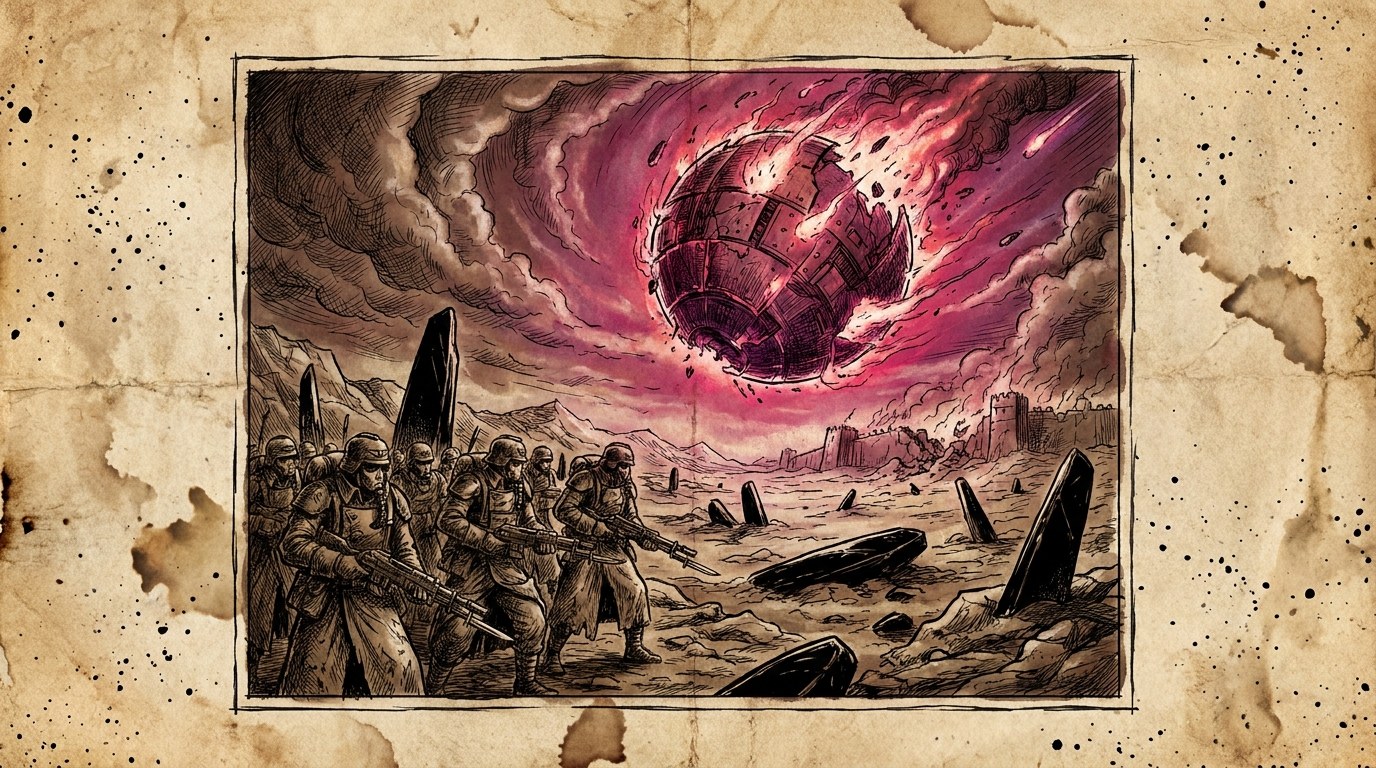
But mark this well, for the Despoiler understood what the Imperium, for ten millennia, did not: Cadia’s walls were never its true defence. Scattered across the world stood the pylons — black, seamless monoliths older than mankind, of a make the savants now attribute, in fearful whispers, to the necrons and the elder science of the War in Heaven. The pylons becalmed the Warp itself. Their silent null field was the cage that held the Eye in check and kept the Gate narrow — had held it, patient as only dead engineering can be, since before the Emperor walked. Now set beside them the other relic of that same black science: the Blackstone Fortresses, star-forts of the ancients, two of which Abaddon had carried off from the Gothic War eight and a half centuries before while the Imperium’s ledgers recorded a victory. Twelve Black Crusades, reader, and the scribes counted twelve failures. They were not failures. They were reconnaissance, theft and rehearsal — a ten-thousand-year siege-work aimed not at a fortress but at a lock, by the one enemy patient enough to spend millennia acquiring the key.
The Storm Breaks
In nine ninety-nine, em forty-one, the Thirteenth Black Crusade came through the Gate with the fury of ten millennia’s hate — the greatest host to leave the Eye since Horus fell upon Terra: the Black Legion at its core, and about it every traitor banner, cult-horde and daemon-pact the Despoiler’s long diplomacy had gathered. The war for the Cadian system beggars compression — void-battles that filled the approaches with wrecks, the fortress-moons contested metre by metre — but its shape on Cadia itself was simple and terrible: the kasrs died one by one, and made the enemy pay for every stone. The defence coalesced around Kasr Kraf, the lynchpin fortress, and around a man: Lord Castellan Ursarkar E. Creed — cigar-chewing, unbeautiful, unbreakable — whose genius for the unexpected had been Cadia’s pride for a generation. Creed fought the campaign of his life. The records are unanimous, and I want the fact set down before the ruin comes: the Despoiler brought the greatest army of the age, and the ground defence of Cadia did not break it. What broke was stranger, and it fell from the sky.
Saints and Machines — the Strange Relief of Cadia
For as the world darkened, help arrived in the unlikeliest procession this archive records. Out of the storm came Saint Celestine, the living saint of the Ecclesiarchy, descending on wings of light with her Sisters at her back — hope made flesh at the hour hope was rationed. With her travelled an inquisitor of iron temper, Katarinya Greyfax, whose own history — the whisper goes — had lately been a xenos collector’s possession. And on his own inscrutable errand came Belisarius Cawl, Archmagos Dominus of the Adeptus Mechanicus, ten thousand years old and carrying — though no soul on Cadia knew it — a cargo that would matter to the whole species’ future. Cawl went down into the catacombs beneath the pylon fields. What the Mechanicus had studied fruitlessly for centuries, he set about completing in days: waking the pylons — all of them, as one array. And the strangest records insist he did not labour alone; that a deathless xenos potentate whose interest in Cadia’s black stones predated mankind lent his hand in the dark. I file that report where I file all such things, reader: too wild to affirm, too well-attested to burn.
The Elysion Fields — the Hour the Gate Nearly Closed
The war’s fulcrum came at the pylon fields of Elysion. As the Despoiler’s final ground assault stormed the array, Cawl brought it to life — and for one impossible hour, the oldest machinery in the galaxy worked for mankind. The pylons’ focused null-beam struck out at the Eye of Terror itself, and the Eye recoiled: the warp-storm overhead guttered, the daemon legions thinned like fog at dawn, and the Gate — ten thousand years a wound — began, measurably, to close. Every account of that hour holds its breath. And every account then records the cost of the null tide: Celestine, creature of the Warp’s brighter shore, weakened as the daemons did — and Abaddon, seizing the one gift the miracle gave him, struck her down and turned on Creed. The duel of the Despoiler and the Lord Castellan lasted as long as such a duel could — the records honour Creed by recording that he stood it at all — and as Abaddon raised the killing stroke, the wounded saint drove her blade through the Warmaster’s back. It did not kill him; the archives suspect nothing can. But it made him look up — at pylons closing his life’s whole road — and the master of the Long War teleported away from the first battle he had personally fled in ten millennia. On the ground, reader, at the hour that mattered, Cadia won.
The Will of Eternity — a Fortress Slain by a Falling Star
What no wall could do, the Despoiler answered from orbit. His fleet’s terror-weapon was the Will of Eternity, one of the stolen Blackstones of the Gothic War, whose warp-beam could crack a planet’s shield — and had been foiled once already: Creed, reading the threat early, had thrown a boarding force of Imperial Fists into the fortress’s black halls, where they crippled its systems from within against all odds, and when its great beam finally fired upon Cadia’s void shield, the shield — barely — held. Then the Phalanx, star-fortress of the Fists, drove alone through the Black Fleet and broke the Will of Eternity apart. Above any other world, that is where this chronicle ends in victory. Above Cadia, Abaddon looked upon his ruined super-weapon and made the calculation only he would make: a Blackstone Fortress is a weapon in either condition. He drove the burning wreck down into the planet itself. The impact broke Cadia’s back. The pylons — so nearly triumphant — shattered and fell silent; the null cage failed; the Eye of Terror, unchained after ten thousand years, reached out and began to swallow the world that had defied it. Groundquakes swallowed the kasrs’ graves; the sky tore; the daemons returned with the tide. Cadia had perhaps hours, and everyone upon it knew.
The Evacuation — Cadia Dies Standing
What was done with those hours is why this chronicle is a memorial and not merely an obituary. Creed refused evacuation for himself and organised it for everyone else: the wounded saint led the withdrawal to the ships while the Lord Castellan and the Cadian Eighth held the collapsing line against the returned daemon legions — the planet cracking beneath their boots, the ships climbing through a burning sky. Better than three million souls were lifted off a world of casualties beyond counting; the Phalanx shepherded the ragged fleet out as Cadia came apart behind it. Even then the Despoiler was not done: the Black Fleet fell upon the evacuation at the Warp’s edge — the records say Abaddon’s seers had scented the precious thing in Cawl’s hold — and more of Cadia’s survivors died in the escape than history usually admits. But the fleet won free. The Archmagos’s cargo — and every Cadian aboard those ships — sailed out of the ending of their world and into the war for everything else. The planet broke, the survivors said, before the Guard did. That is not an epitaph, reader. On the lips of every Cadian who escaped — and they are legion, and they are angry — it is a promise.
The Unanswered Pages
Every great fall leaves questions, and Cadia’s are among the heaviest in my keeping. Creed was lost in the final hours — no body, no vox, no witness; his fate is a blank page, and I have learned to fear blank pages. One whisper, too strange to credit and too persistent to omit, places him alive and unaging in the vault of that same deathless xenos collector whose hand helped wake the pylons; I record it, and pass on. The pylon-shards of dead Cadia, the darker reports insist, have themselves become relics contested by powers who understand what they were. And the largest question needs no whisper at all, for the whole galaxy read the answer in its own torn sky: what happens when the cage of ten thousand years is opened? The chronicle of the Great Rift is shelved beside this one. I bound them in the same leather deliberately.
Thus fell Cadia: not outfought but murdered, its lock broken with a hammer when the key defied the thief. Ten thousand years the vigil held, and on its last day it was still holding — remember that, when the count of the age’s defeats is read. The gate is gone; the watchers are scattered; and on a hundred embattled worlds tonight, soldiers in violet-eyed regiments still answer the roll-call of a planet that no longer exists. Cadia stands, they say. In every way that matters to this archive, they are correct.
Questions from the Archive
What caused the Fall of Cadia?
Cadia fell during Abaddon the Despoiler’s Thirteenth Black Crusade in 999.M41. When the Despoiler’s ground assault failed to take the fortress world — and its reactivated pylons came within a breath of sealing the Eye of Terror itself — he hurled the wreck of the Blackstone Fortress Will of Eternity into the planet. The impact shattered Cadia, silenced the pylons, and the world was consumed by the expanding Eye.
What were the Cadian pylons?
The pylons were ancient monoliths of unknown, pre-human origin — Imperial savants now attribute them to the necrons — scattered across Cadia’s surface. They projected a null field that becalmed the Warp around the Cadian Gate, holding the Eye of Terror in check. While they stood, Cadia was the cork in the bottle of Hell; when they fell, the Great Rift followed.
Who fought in the Fall of Cadia?
Lord Castellan Ursarkar E. Creed commanded the defence with the Cadian Shock Troops, joined by Saint Celestine and her Sisters, Archmagos Belisarius Cawl of the Adeptus Mechanicus, the Imperial Fists aboard the Phalanx, Space Wolves, Black Templars and more — against Abaddon the Despoiler’s Black Legion, the Volcani Cults, and daemon hosts unnumbered.
What was the Will of Eternity?
The Will of Eternity was a Blackstone Fortress — an ancient star-fort of elder science seized by Abaddon during the Gothic War, eight centuries before. When the Phalanx crippled it above Cadia, the Despoiler turned even that defeat into a weapon, driving the burning wreck down into the planet itself to destroy the pylons he could not silence by war.
What happened to Ursarkar Creed?
Lord Castellan Creed refused every call to abandon Cadia, duelled the Despoiler himself amid the pylons, and held the line as the planet died so that millions could escape. He was lost in the final hours, and his fate is a blank page in the archives — though one whisper, too strange to credit and too persistent to omit, places him alive in the vault of an ancient xenos collector.