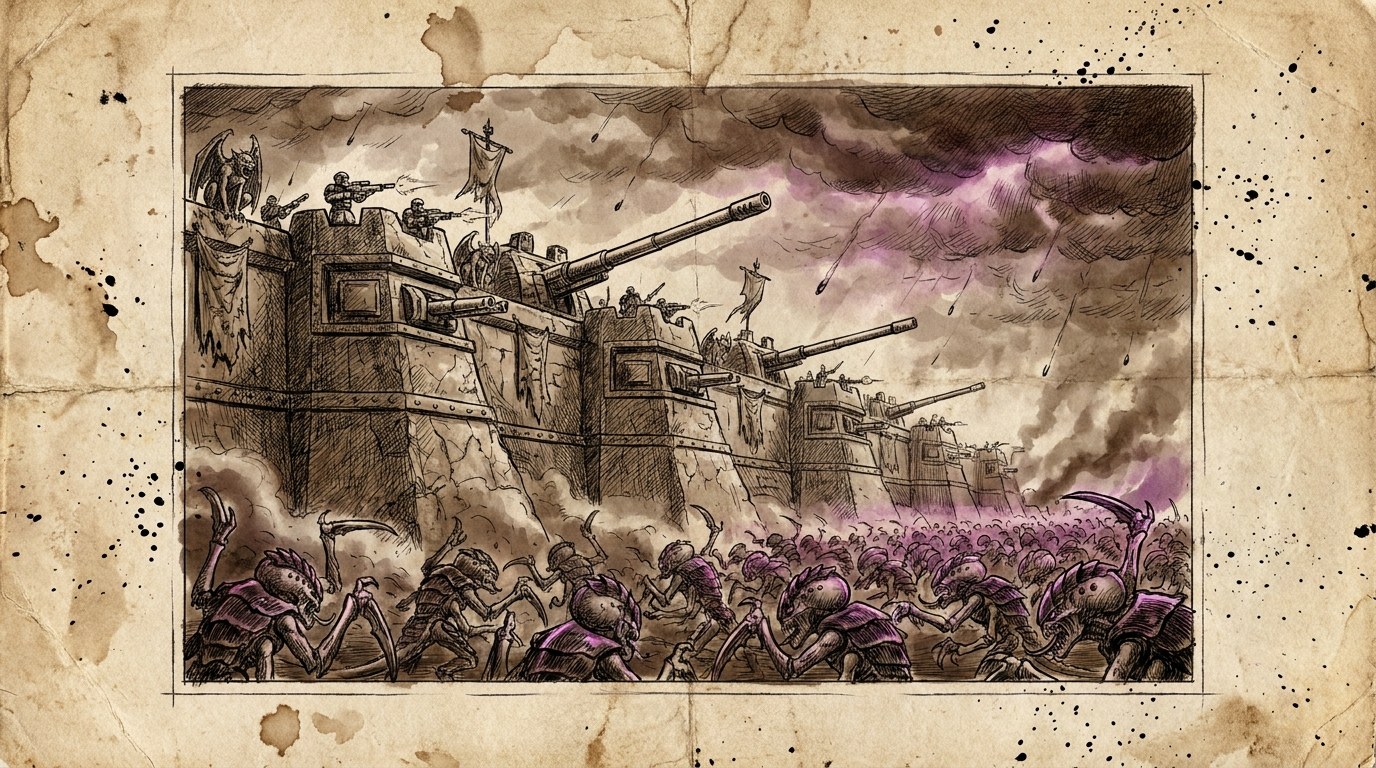
The Time of Ending: When Every Darkness Came at Once
Hive fleets from beyond the galaxy, tomb-worlds waking beneath the soil, and thirteen Black Crusades. A chronicle of the Imperium's long twilight at the close of the 41st Millennium.
Every archivist learns to fear a certain pattern in the records: not one disaster, but many, arriving together — as though the galaxy itself had turned predator and could smell the blood. The final centuries of the Forty-First Millennium are nothing but that pattern, page after page after page. The chronicles name the period the Time of Ending, and for once the chroniclers were not exaggerating. Attend, and I will show you the wounds opening one by one.
The Shape of the Ending
Understand first what made the age singular. The Imperium had never known peace; its whole history is a fever-chart of invasion and revolt. But the crises had always come in sequence — one hydra-head at a time, each survivable because the others slept. In the closing centuries of em forty-one, the sequence collapsed. A hunger from beyond the galaxy; an empire waking beneath the ground; the greatest greenskin since the Beast; and the Despoiler’s long game reaching its final move — all at once, on every horizon, against an Imperium already stretched to cracking by ten thousand years of attrition. The fortress had weathered every storm. Now the storms began to arrive together, and the sea itself was rising.
The Shadow in the East — Behemoth and Macragge
It began, as endings often do, with something new. In seven forty-five, em forty-one, a shadow fell across the Eastern Fringe that swallowed astropathic voices whole — the psychic silence the savants would learn to call the Shadow in the Warp — and behind it came Hive Fleet Behemoth: a fleet of living ships and a species that was less an army than an appetite, devouring worlds down to the bedrock and rendering their biomass into more of itself. The records name the species for the dead outpost world of Tyran, whose final data-core, recovered at terrible cost, gave the Imperium its first sight of the enemy: the tyranids. Behemoth drove into the heart of Ultramar itself, and was broken at the Battle of Macragge — the polar fortresses drowning in chitin, the Ultramarines’ veteran First Company annihilated to a man holding them, and the hive fleet’s core finally dragged to ruin in the void at a cost the Chapter mourns to this hour. The Imperium told itself the horror was over. The magi biologis, reading the data, already knew better: nothing about Behemoth’s behaviour suggested a whole. It behaved like a fingertip.
Kraken and the Doom of Iyanden
The second fingertip came in the millennium’s final decade. Hive Fleet Kraken did not repeat Behemoth’s spear-thrust; it seeped — splintering into a hundred tendrils that infiltrated the Eastern Fringe system by system, strangling astropathic relays, isolating worlds as Old Night once had, then eating them at leisure. Its breaking cost the Imperium the great battle of Ichar IV and cost the aeldari far more: the craftworld Iyanden, jewel of the surviving eldar nations, stood in Kraken’s path and was all but emptied — its halls, the laments say, left more ghost than living. I set that beside the Time of Ending’s other entries deliberately, reader. The hive fleets do not distinguish between our species and our enemies. To the hunger, the whole galaxy is one meal, and every war we fight against each other is the setting of its table.
Leviathan — the Third War and the Hollow Truth
Then, in nine ninety-seven, came the truth the first two wars had only hinted at. Hive Fleet Leviathan rose not from the galactic east but from beneath — out of the intergalactic void below the galactic plane, in twin tendrils vaster than both earlier fleets together, striking at the Imperium’s unguarded underbelly through Segmentum Tempestus, Ultima and Solar. It became horribly clear, the records state, that Behemoth and Kraken had been reconnaissance: probing expeditions for a main fleet whose true scale the cartographers still decline to estimate. From Macragge to the marches of Armageddon the Imperium’s forces wheeled to meet the new tendrils — stripping sector after sector of defenders, and leaving every other enemy of mankind an open door. Study this mechanism, reader, for it is the Time of Ending in miniature: each threat did not merely wound; it unlocked the next.
The Great Awakening — the Tomb-Worlds Stir
And while the Imperium bled at its edges, something older woke beneath its feet. The first warning is dated eight ninety-seven, em forty-one, at a fortress-convent of the Adepta Sororitas on a world called Sanctuary 101: every Sister slain, the walls unbreached, the vox recording nothing but silence and the whisper of metal on stone. The Imperium filed it as a xenos raid. It was a herald. On world after world in the years that followed — worlds humanity had settled, mined and farmed for a hundred generations — the ground gave up dynasties of living metal: the necrons, risen from sixty million years of sleep to reclaim an empire that predates mankind entire. At Damnos the ice yielded them; on a hundred worlds the pattern repeated, and the horrified savants at last connected the risings into one event — the Great Awakening. The oldest chronicle in this archive, the War in Heaven, had come out of its grave. And somewhere beyond the galaxy’s rim — though no Imperial record of the age knew it — the Silent King himself had already turned for home.
Armageddon — the Thrice-Cursed World
No chronicle of the Time of Ending can pass over Armageddon: a single hive world that has borne three invasions, as though the galaxy itself kept returning to a wound it favoured. Of the First War the archives hold only sealed doors — a daemonic incursion in the mid-millennium whose records the Inquisition erased with a thoroughness that is itself a testimony. The Second War has no seals: in nine forty-one, em forty-one, the ork warlord Ghazghkull Mag Uruk Thraka — self-proclaimed prophet of the greenskin gods — fell upon Armageddon with millions, and was broken by the iron of Commissar Sebastian Yarrick, the sacrifice of the Steel Legion, and a world’s refusal to die. Ghazghkull withdrew, learned — mark that word, for an ork who learns is the most dangerous thing in the galaxy — took Yarrick’s measure again at Golgotha in ninety-seven, and released him alive, the records insist, so the war to come would be worth fighting. And in nine ninety-eight, fifty-seven years to the day after his first invasion, the prophet of the Waaagh! returned to Armageddon with the greatest greenskin armada assembled since the Beast. The Third War swallowed fleets, Chapters and legions of Guard — and it has never ended. Armageddon burns in the present tense, reader. Some pages of this archive I must write with the ink still wet.
Twelve Black Crusades — and the Gothic War
And always, behind every other darkness, the Eye. Twelve times across ten thousand years, Abaddon the Despoiler — heir of Horus, Warmaster of Chaos, the failed Crusade’s most terrible unfinished business — had led the traitor hosts out of the Eye of Terror against the fortress-chain of the Cadian Gate. Twelve times the Imperium held, at costs that beggar tallying, and the scribes of my order took comfort in the arithmetic. They should have read the twelfth entry more carefully. The Gothic War, early in the millennium, ravaged an entire sector for two decades — and when Abaddon withdrew, the ledgers recorded it as victory, because ledgers count worlds and not intentions. The Despoiler had come for something specific: the Blackstone Fortresses, star-forts of impossible antiquity, works — the fearful savants now whisper — of the same elder science as Cadia’s own pylons. He left with two of them. For eight and a half centuries that theft sat in the records, filed and forgotten, a loaded weapon on history’s table. Twelve rehearsals, reader. Every one of them was aimed at Cadia, and the thirteenth — but the thirteenth has a chronicle of its own, and I have not the heart to compress it here.
A Fortress Against the Rising Sea
I could fill a shelf with the age’s lesser wounds — lesser only by this company’s monstrous standard: the Badab War’s fratricide between loyal Chapters; the grinding damnation of the Siege of Vraks; the young tau empire’s expansions gnawing the Eastern Fringe while greater predators kept the Imperium’s eyes elsewhere; Waaaghs and successions and plagues beyond numbering. Set it all in the balance and marvel, as I do nightly, at the other pan: the Imperium held. Battered, bleeding from every border, led — let the record be honest — by a Senatorum of no greater wisdom than Vandire’s age or the Beast’s, mankind’s fortress endured the rising sea by the only method it has ever trusted: it paid. In soldiers, in worlds, in futures. The Time of Ending is not a chronicle of defeat; it is a chronicle of solvency at ruinous interest. The Imperium endured — as a fortress endures a rising sea. It is the tide that should concern you.
The Time of Ending, the chronicles call it, and note well what the name does not say: an ending of what? Not of the Imperium — not yet, not quite. What ended in those centuries was something quieter: the ability to believe the storms would always come one at a time. The next page of this archive is called Cadia. Steady your hands before you turn to it.
Questions from the Archive
What was the Time of Ending?
The Time of Ending is the name given to the final centuries of the 41st Millennium, when catastrophes struck the Imperium from every direction at once: the Tyrannic Wars against the hive fleets, the Great Awakening of the Necron tomb-worlds, Ghazghkull’s invasions of Armageddon, and Abaddon the Despoiler’s Thirteenth Black Crusade against Cadia.
What were the Tyrannic Wars?
The Tyrannic Wars were the Imperium’s wars against the tyranid hive fleets — Behemoth, which was broken at the Battle of Macragge in 745.M41; Kraken, which ravaged the Eastern Fringe and devoured craftworld Iyanden’s people in the years around 993.M41; and Leviathan, which struck from below the galactic plane in 997.M41. Each earlier fleet proved to be only the vanguard of something larger.
What was the Great Awakening?
The Great Awakening is the name the horrified records give to the rising of the necron tomb-worlds in the 41st Millennium’s final years. The first warning came at Sanctuary 101 in 897.M41, where a fortress-convent of the Adepta Sororitas was slaughtered by living metal; by 999.M41 dynasties were waking across the whole galactic map, on worlds mankind had innocently settled over their sleeping vaults.
What happened at Armageddon?
Armageddon, a vital hive world, was invaded three times: first by a daemonic incursion whose records the Inquisition sealed, then in 941.M41 by the ork warlord Ghazghkull Mag Uruk Thraka — broken by Commissar Yarrick and the Steel Legion — and again in 998.M41, when Ghazghkull returned exactly fifty-seven years later with the greatest ork Waaagh! since the Beast. That third war has never truly ended.
How many Black Crusades were there?
Abaddon the Despoiler launched thirteen Black Crusades from the Eye of Terror over ten millennia. The first came in the 31st Millennium; the twelfth — the Gothic War — cost the Imperium dearly and put ancient Blackstone Fortresses in the Despoiler’s hands; and the Thirteenth, in 999.M41, finally achieved what the previous twelve could not: the destruction of Cadia.