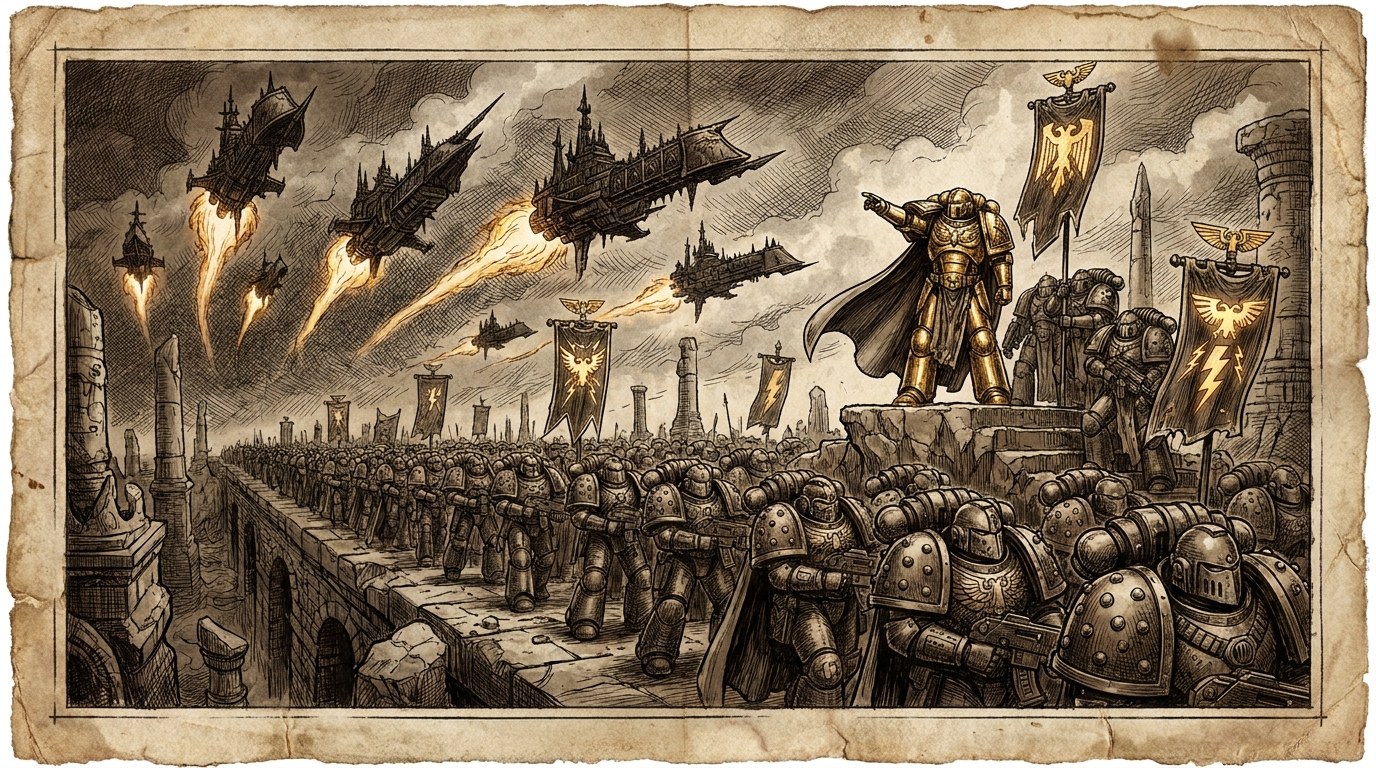
The Great Crusade: Mankind’s Finest Hour
Seven thousand fleets, twenty demigod sons, and a galaxy reclaimed beneath the Aquila. A chronicle of the two centuries when humanity almost won.
I keep one page of this archive apart from all the others, and on the bad nights I read it: the muster-rolls of the Great Crusade. Because whatever the Imperium became, for two hundred years mankind reached out for the whole galaxy with open eyes — and very nearly took it. This is the chronicle of those two centuries: the fleets, the Truth they carried, the demigods who led them, and the hour at Ullanor when it all began, invisibly, to end.
Seven Thousand Fleets — the Launch from Terra
When Unity was won and the last storms of Old Night abated, the Emperor did not pause to enjoy His throne. From the Field of Winged Victory within the Imperial Palace, the expeditionary fleets were launched upon the greatest endeavour in the history of the species: the conquest of the galaxy. The chronicles preserve the scale without blinking — the skies over Terra thick with starships, hundreds of thousands of them, organised into more than seven thousand fleets, reserve groups and follow-on echelons. For nearly two centuries the Emperor Himself led from the vanguard, a golden figure at the spear-tip of mankind’s return to the stars. And note the ledger-keeping, for it tells you everything about the age’s confidence: each expedition numbered, each conquest logged by fleet and sequence — the sixty-third fleet’s nineteenth compliance entered into the rolls as Sixty-Three Nineteen, the eight hundred and ninth fleet’s fifth as Eight-Hundred-and-Nine Five. Mankind was numbering its way across the galaxy, and fully expected the numbers to run out of galaxy before the galaxy ran out of patience.
The Treaty of Olympus — Mars Sworn to the Throne
None of it sails without the red planet. Before the fleets could launch, the Emperor went to Mars — where the Mechanicum’s priesthood had endured Old Night as a sovereign power — and presented Himself in the one guise that priesthood could not refuse: the Omnissiah, their prophesied incarnation of the Machine God. The covenant that followed, the Treaty of Olympus, bound Terra and Mars into the twin-headed Imperium whose aquila we still bear: Martian sovereignty guaranteed, its structures and society inviolate, in exchange for the fleets, the armour and the arms of the Crusade — and the exclusive services of Navigator Houses to steer them. The deepest records are frank about the courtship: the Emperor offered peace with one hand and kept a dagger behind His back with the other, and the offer was, in truth, an ultimatum. They record too the one oath He demanded above all — that the forbidden Vaults of Moravec, wherein Mars kept its most dangerous relics of the machine-wars, never be opened. Remember that oath, reader, when you come to the chronicle of the Heresy. It was not kept.
The Imperial Truth — an Empire Against the Gods
The fleets did not carry a faith. They carried its opposite — the Imperial Truth: the credo that belief in gods is falsehood, that reason must drive out superstition and enlightenment replace barbarism. Religion was outlawed in the Emperor’s realm, and worlds that would not set down their idols were made to. He had rehearsed the argument in person, the records tell, in the closing days of Unity — walking disguised under the name Revelation into the last church on Terra, to debate its lone priest through the night before the bulldozers came; the old man told Him to His hidden face that Terra had merely exchanged one tyrant for another. The Emperor demolished the church and kept the conversation, which tells you much about Him. And the deepest records preserve His private reasoning, which chills more than any sermon: superstition and faith are easy doors for the Warp’s denizens to enter the human heart. He was not building an empire of atheists for philosophy’s sake. He was sealing doors — against an enemy He declined to name, to the sons and subjects who would meet that enemy unwarned. The tragedy of everything that followed lives in that silence.
The Primarchs Reunited with Their Legions
The Crusade’s spear-tips were the Legiones Astartes: gene-wrought giants built at industrial scale in the yoked laboratories of Luna, where the Selenar gene-cults — whose mastery of the helix, the records concede, outstripped even the Emperor’s own — paid for their survival of the First Solar War by building His armies. Sons of the Selenar, some old accounts call the Legions still. But each Legion was made from a deeper pattern: the gene-print of a primarch — one of twenty demigod sons wrought in the Emperor’s own image, stolen from their cradles by the Ruinous Powers and scattered as infants across the stars. As the fleets pushed outward, the Emperor crossed the galaxy in search of His star-lost children, and with each reuniting gifted the son command of the Legion created from his flesh: Horus of Cthonia, first-found — so the chronicles insist, though this archive has reason to keep a raised eyebrow on that page — then Russ of Fenris, Ferrus of Medusa, Sanguinius of Baal, Guilliman of Macragge, Magnus of Prospero, Mortarion of Barbarus, and the rest, each reunion a legend in itself. Eighteen were found. Of the other two, this archive keeps a page that is deliberately, eternally blank — and the blankness is the record.
Compliance — the Word and the Sword
Let the record say honestly what the Crusade did when it arrived. Planet after planet, the chronicle runs, fell, was fortified, made compliant, then made productive — the chroniclers of its high years boasting of a thousand worlds a year. Where the lost cousins of mankind welcomed reunion, compliance was a festival; where they did not, it was a war, and the record admits how unconscionably often the fleets were forced to break the very cultures they had sailed to embrace. And after the warships came the quieter conquest: the iterators, silver-tongued teams who studied each world’s beliefs and traditions and gently, expertly supplanted them — embellishing local custom into secular loyalty, while the Munitorum weighed the planet’s worth and mythmakers spread the Imperial Truth from system to system. After Ullanor the whole apparatus gained its chroniclers too: the Order of Remembrancers, poets and imagists accredited to the fleets under Malcador’s own countersignature, dispatched to record the reunification of mankind so that future generations would inherit the truth of it. I owe my own office, in some measure, to that decree — and I honour it tonight in the only way an archivist can: by recording that the truth the remembrancers found was both glorious and bloody, and that both words belong in the ledger.
Ullanor — the Height of the High Tide
It reached its zenith on Ullanor: the breaking of the greatest ork empire the age had encountered — the largest empire, the war-records state plainly, that the Crusade had ever faced — ruled by the overlord Urlakk Urg. The Emperor Himself led the campaign, millions of Army soldiers and hundreds of thousands of legionaries cutting a road into the heart of the greenskin realm, and it ended in blood and iron when Horus stormed the overlord’s high keep and pitched Urg from its balcony to break on the flagstones below; leaderless, the ork empire tore itself apart. To stage the triumph that followed, the Mechanicum planed a continent flat — mountain ranges dismantled, valleys filled — so that millions of soldiers, the engines of the Titan Legions and nine primarchs could march in review before the Master of Mankind. It was the greatest gathering of Imperial might in history, and the chronicles record it as a farewell. For at Ullanor the Emperor did the thing that broke the age in two: He named Horus Warmaster, sole regent of the Crusade’s armies — and went home.
The Emperor’s Secret Labour — and the Gathering Shadow
Why leave the Crusade at its height? The deepest records answer plainly, and the answer was a secret worth everything: beneath the Palace, the Emperor turned to the great work — a bridge from Terra into the webway, the hidden roads of the ancient aeldari, which would have freed mankind’s ships and words from the Warp forever: no more Navigators, no more Geller fields, no more sea of predators between every world and its neighbour. Freed from the Warp, He is recorded to have said, mankind could at last be shepherded safely into its destiny as a psychic race. It was, if the records speak true, the whole purpose behind the Truth, the Crusade, everything — the endgame of fifty thousand years of patience. And while He laboured in secret, the shadow gathered in the fleets He had left behind. Lorgar of the Word Bearers had already been broken at Monarchia — his god-worshipping perfect city razed by the Ultramarines at the Emperor’s order, his whole Legion forced to kneel in its ashes while their father rebuked them for the crime of worshipping Him; the ash Lorgar smeared on his face that day never truly washed off, and where his faith went next, the galaxy would learn in fire. Out on the rim, meeting after strange meeting — cultures like the xenos-mingling societies whose full records the archives keep sealed — ended in wars that need not have been. The instrument was sharpened, the hand withdrawn. Two hundred and three years the Crusade had run. It had perhaps a decade left, and no soul at the triumph knew it.
The Reckoning of the Finest Hour
Mankind’s finest hour. I wrote that once without irony, and I let it stand — because it was. Measure it honestly: a species that had spent five thousand years dying alone in the dark reached out, in two centuries, and took back a million worlds; fed the hungry cousins of its diaspora; broke xenos empires that had preyed on human misery through all of Old Night; and did it all beneath a banner that promised — whatever else it compelled — that no man need kneel to a god again. And measure the cost as honestly: the cultures crushed for the crime of difference, the truths withheld that might have armoured eighteen sons against the dark, the pride wounded at Monarchia and left to fester. The Great Crusade was the best thing the Imperium ever did and it carried the seed of the worst, and neither fact cancels the other. That is not a paradox, reader. That is history, and this archive exists because someone must hold both pages open at once.
Thus the high tide of mankind, from the Field of Winged Victory to the planed plains of Ullanor. The Warmaster’s chronicle is shelved beside this one, and I still cannot file the two of them together without my hands shaking. Finest hours end. What matters — what this whole scriptorium is for — is that they are not forgotten while the long bill for them is being paid.
Questions from the Archive
What was the Great Crusade?
The Great Crusade was the two-century campaign of galactic reconquest launched by the Emperor from Terra at the end of the Age of Strife. Hundreds of thousands of ships in more than seven thousand fleets carried the Legions of Space Marines out to reunite the scattered worlds of humanity under one Imperium — and one Imperial Truth.
What was the Imperial Truth?
The Imperial Truth was the Crusade’s founding creed: that there are no gods, and that reason and science — not faith — would light mankind’s future. Religion and superstition were outlawed. The novels record the Emperor’s private purpose: enforced unbelief closed the doors through which the Warp’s predators enter the human heart.
How were the Space Marine Legions created?
The Legions were gene-wrought from the genetic patterns of the twenty primarchs, built at industrial scale with the conscripted mastery of Luna’s Selenar gene-cults — whose art of the flesh, the records admit, outstripped even the Emperor’s own. As each lost primarch was found among the stars, the Emperor gave him command of the Legion made in his image.
What happened at Monarchia?
Monarchia, capital of Khur, was a city the Word Bearers Legion had raised to worship the Emperor as a god. In answer, the Emperor had the Ultramarines evacuate and raze it, then forced the entire assembled Word Bearers Legion to kneel in its ashes while He rebuked them — worship of Him being a violation of the Imperial Truth. Lorgar’s humiliation there is widely held to have seeded his turn to Chaos, making Monarchia one of the Heresy’s first sparks.
How did the Great Crusade end?
At the triumph on Ullanor, after the greatest ork empire of the age was broken, the Emperor named Horus Warmaster — supreme commander of the Crusade — and returned to Terra to labour in secret on the webway project beneath the Palace. Within a decade, the Warmaster’s betrayal had turned the Crusade’s armies upon each other in the Horus Heresy.