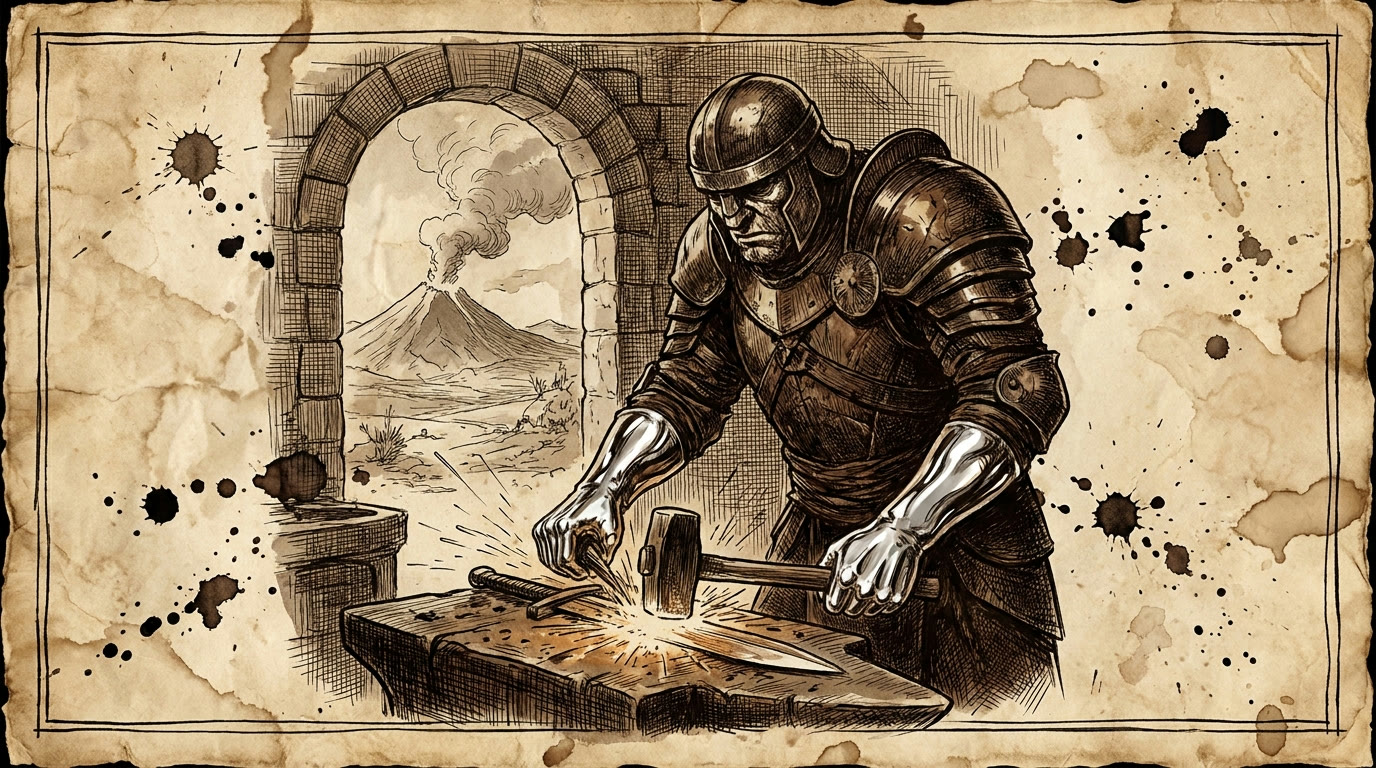
Ferrus Manus: Primarch of the Iron Hands
The Gorgon of Medusa, whose bare hands ran with living silver. 'I do not claim worlds,' he said. 'I conquer them.'
His brothers called him the Gorgon, and imagined him cold. They mistook the furnace for the anvil.
The Silver Hands of Medusa
Medusa made him: a wasteland of ice, volcanic shale and migrating land-fortresses, where weakness is a sentence carried out by the weather. When the Imperium found him, the wonder was already upon him — his hands and forearms sheathed in flowing, living silver metal, gleaming with an uncanny lustre, whose secret he kept to his grave. The sagas of Medusa tell of a silver wyrm drowned in lava by a boy’s bare hands. Ferrus never confirmed the tale, and I never dared ask. After the reunion he laboured awhile in the subterranean forges of the Imperial Palace, crafting masterwork weapons for his brothers with those impossible hands.
The Tenth Legion
His Iron Hands fought as he did — in jet-black plate scoured to bare ceramite, with overwhelming force and open contempt for half-measures. I do not claim worlds, he said. I conquer them. Guilliman counted him first among his dauntless few — the brothers who could be depended upon to win any campaign outright. On his back he bore Forgebreaker, the great hammer forged for him in brotherhood by Fulgrim, in the years when that name was still bright.
Iron is strong, he taught his sons. He never lived to teach them the second half of the lesson.
Questions from the Archive
Where was Ferrus Manus found?
On Medusa, a bleak volcanic wasteland. He came to the Imperium already bearing his miracle: hands and forearms of flowing, living silver metal whose secret he never shared.
What legion did Ferrus Manus command?
The Tenth Legion, the Iron Hands, who fought in bare black ceramite and conquered through overwhelming force.
What was Forgebreaker?
His signature war-hammer, forged for him by his closest brother Fulgrim during the Great Crusade — a gift from the friendship that would one day die at Isstvan.